Pre Sale Deck Improvements That Raise Home Value in Ontario, CA
Your house is going on the market, and the deck is the one thing you keep avoiding. The boards feel soft near the stairs, the railing moves when someone grabs it, and you have no idea whether a buyer's inspector will shrug or flag it as a hazard. The good news: most pre-sale deck repairs before selling involve targeted improvements rather than full remodels. You do not need a new deck to pass an inspection or make a strong first impression at a showing. You need the right handful of fixes, done in the right order, before the listing photos get taken.
This matters more in the Inland Empire than sellers expect. According to the North American Deck and Railing Association (NADRA), an estimated 50 percent of the roughly 50 million decks in the U.S. are more than 25 years old. In older Ontario, California neighborhoods, that tracks. A lot of wood decks around San Bernardino County went up in the 1990s and early 2000s, and years of Southern California sun and dry-wet cycles have taken a toll. Here are eight pre-sale fixes, listed in the order a buyer's inspector will care about them.
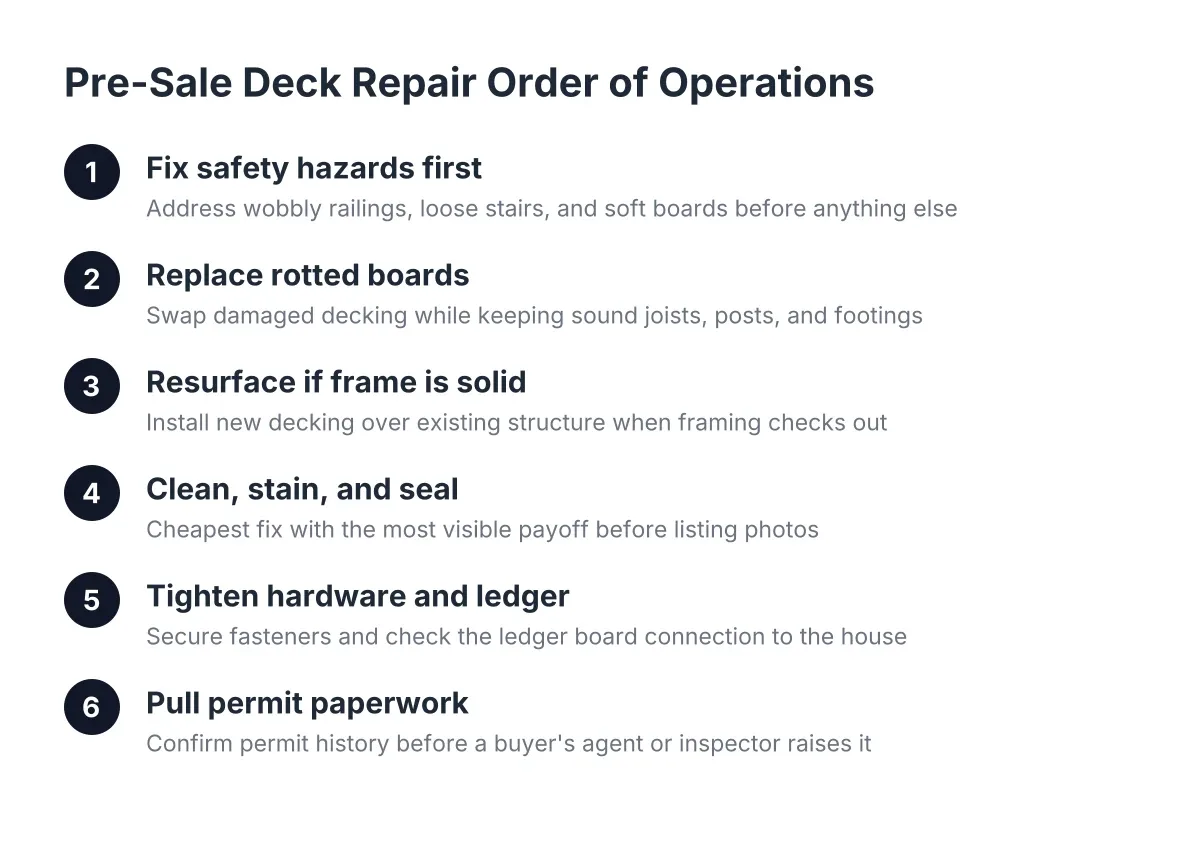
1. Safety Priorities: Railings, Stairs, and Soft Boards
Before you spend a dollar on appearance, handle anything that could hurt someone. A wobbly deck railing, a loose stair stringer, or a spongy board near the door are the three things most likely to show up in a buyer's inspection report. They are also the three things most likely to kill a deal or trigger a repair credit larger than the fix itself would have cost.
Walk your deck slowly and push hard on every railing section. Bounce your weight at the center of the stairs and along traffic paths. Anything that flexes, shifts, or feels soft should be addressed before selling your home and completing deck repairs. These are usually targeted deck repair jobs, not replacement jobs, and a local deck builder can often knock them out quickly.
2. Replace Rotted Boards Instead of Replacing the Deck
A deck with ten rotted boards and a sound frame does not need to come out. Deck board replacement swaps the damaged decking while keeping the joists, posts, and footings that are still doing their job. For a seller, this is usually the highest-return move on the list because it fixes what inspectors flag without the cost or timeline of full deck replacement.
The catch is knowing where the rot stops. Surface rot in a few boards is one thing; rot that has traveled into the joists underneath is a structural problem. Probe suspect areas with a screwdriver. If the tip sinks into framing members, not just decking, get a professional assessment before you list. This is the one spot on this list where guessing wrong gets expensive.
3. Resurface for Results When Structure Remains Solid
Deck resurfacing sits between repair and replacement. If the footings, posts, and framing check out but the walking surface is cracked, splintered, and gray, you can strip the old boards and install new decking over the existing structure. Sellers sometimes use this moment to switch to composite decking, which photographs well and signals low maintenance to buyers.
However, resurfacing only makes sense when the frame genuinely has life left. Putting new boards on a failing substructure is the one version of pre-sale deck improvements that can backfire, because an inspector who crawls underneath will see exactly what was covered up. A deck builder who inspects the framing before quoting resurfacing is giving you the straight answer; one who quotes without looking underneath is not.
4. Clean, Stain, and Seal Before the Listing Photos
For a structurally sound wood deck that just looks tired, a wash and a fresh coat of stain and sealer is the cheapest improvement with the most visible payoff. Gray, weathered wood reads as neglect in listing photos, even when the deck is fine. The same deck, cleaned and stained, reads as a usable outdoor living space, which is exactly what Inland Empire buyers picture using ten months a year.
Timing matters here. Do the safety repairs and board replacement first, then stain, so the new boards blend in and nothing gets redone. In Ontario, CA, the dry climate means stain can go on most of the year, but freshly replaced boards may need a short weathering period first. Plan this step two to three weeks before photos if you can.
5. Tighten the Hardware and Secure the Ledger Connection
Loose hardware is invisible in photos and glaring in an inspection. Over years of heat cycles, lag bolts back out, joist hangers loosen, and nails lift. An afternoon with a drill and a wrench, tightening every visible fastener, closes off a long list of minor inspection notes before they get written.
Pay special attention to where an attached deck meets the house. The ledger board connection is the most common failure point on residential decks, and inspectors know it. If the ledger is fastened with nails instead of structural bolts, or if you see rust streaks or gaps at the house, have a deck builder evaluate it. This is a structural item, not a cosmetic one.
6. Pull the Permit Paperwork Before the Buyer's Agent Asks
Unpermitted deck work surfaces at the worst possible time, usually during escrow. If your deck or a past addition to it was built without a permit, a buyer's lender or inspector may raise it, and you will be negotiating from a weak position. Checking your permit history with the city of Ontario before listing costs you nothing but a phone call.
If work does need to be legalized or a repair needs a permit, the price of the paperwork is modest next to a stalled sale. According to HomeAdvisor, a deck building permit typically costs between $230 and $500 depending on location. A local company that handles deck permits and planning in San Bernardino County can tell you whether your specific repair even requires one; many small repairs do not.
7. Know the Real Numbers Before You Decide Repair vs. Replace
Suppose a homeowner in Rancho Cucamonga has a 20-year-old, 300-square-foot wood deck with a sagging railing, a dozen rotted boards, and solid framing. As an illustrative estimate, targeted repairs and a refinish might land in the low four figures, while full replacement would be a five-figure project. Listed in 60 days, the repair path almost always wins; the buyer gets a safe, clean deck, and the seller keeps the budget for other listing prep.
That said, replacement is not always money down the drain. According to the National Association of Realtors' 2023 Remodeling Impact Report, homeowners recover 89 percent of the cost of a new wood deck through added home value. For context on new construction, Angi puts the average cost of a professionally built deck at $30 to $60 per square foot. An online deck calculator, or a trex decking calculator if you are pricing composite, gives you rough material numbers, but those tools do not see your framing, your soil, or your permit situation. Use them to orient yourself, then get a real quote.
8. Get One Honest Inspection Before You Spend Anything
If one contractor told you the deck is fine and another called it a hazard, you are not alone; that split verdict is the most common story sellers bring to a deck builder. The fix is a specific, written assessment: which boards are rotted, whether rot reached the framing, whether the railing meets current height and strength expectations, and whether the ledger is properly attached. Vague answers in either direction, "it's fine" or "tear it all out," deserve skepticism.
NADRA estimates that of the more than 60 million decks in the U.S., about 30 million are past their useful life and need repair or replacement. Some decks genuinely are done. But an honest inspection separates that case from the far more common one, where a focused list of repairs gets the deck inspection-ready for a fraction of replacement cost. Ask the person inspecting to walk you through what they found, underneath the deck as well as on top of it.
How Pre-Sale Deck Improvements Pay Off at Closing
A deck shows up twice in a home sale: once in the listing photos and once in the inspection report. Pre-sale deck improvements earn their money by winning both moments. Clean, stained decking with a solid railing pulls buyers outside during showings, which matters in Ontario, California, where the backyard is a living space for most of the year. A clean inspection report then protects your price during negotiations, because there is nothing on the deck for a buyer to claw back as a credit.
The sequence to remember is simple:
- Safety first: railings, stairs, and soft spots.
- Structure second: rotted boards, framing, and the ledger connection.
- Paperwork third: confirm permits before escrow does.
- Appearance last: clean, stain, and seal before photos.
Work the list in that order, and most sellers in the Inland Empire get their deck sale-ready in weeks, not months, and for repair money, not replacement money. The deck that scared you a month before listing becomes the feature that sells the backyard.
If you need custom deck design, Inland Empire Decks can help.
Prefer to talk it through? Call (909) 298-8578 — a quick call is usually the fastest way to get a straight answer for your situation.