
Deck Builder Hiring — Complete Guide
Hiring the wrong contractor can turn a dream deck into a lawsuit, a safety hazard, or a half-finished eyesore. This guide walks you through deck builder hiring from start to finish, covering licensing, insurance, quotes, contracts, and the red flags that separate a professional crew from a handyman side gig. It comes from an Inland Empire deck specialist based in Ontario, California, so every piece of advice reflects what actually happens on job sites across San Bernardino County and Riverside County. By the end, you will know exactly which questions to ask, which documents to demand, and which warning signs mean you should walk away before signing anything.
What You'll Find in This Guide
Verifying Your Deck Builder's License and Credentials
Before you compare a single quote, verify the license. In California, any construction project valued at $1,000 or more in combined labor and materials requires a contractor licensed by the Contractors State License Board (CSLB). A deck of any meaningful size clears that threshold immediately. This means the friendly neighbor with a truck and a circular saw is legally barred from building your deck, no matter how good his fence looked.
For deck work in Ontario, California and the surrounding Inland Empire, look for a C-6 (cabinet, millwork, and finish carpentry) license, a B (general building) license, or a specialty classification that covers structural carpentry. Ask for the license number, then check it yourself on the CSLB website. The lookup takes two minutes and shows you the license status, bond information, and any disciplinary history. In practice, this single step filters out the majority of problem contractors before they ever set foot on your property.
Insurance Is Not Optional
Beyond the license, demand proof of two types of insurance. First, general liability insurance protects you if the crew damages your home, your neighbor's fence, or the gas line under your yard. Second, workers' compensation insurance protects you if a worker gets injured on your property. Without it, an injured worker can sue you as the homeowner. Ask for certificates of insurance sent directly from the insurance carrier, not photocopies from the contractor. A legitimate Inland Empire deck builder will provide these without hesitation, because they get asked constantly.
Why This Matters More Than Ever
Deck safety is not an abstract concern. According to the North American Deck and Railing Association (NADRA), an estimated 30 million of the more than 60 million decks in the U.S. are past their useful life and need replacement or repair. Many of those failing decks were built by unlicensed labor that skipped footings, undersized framing, or ignored ledger attachment codes. As a result, the license check is not bureaucratic box-ticking. It is your first and best defense against a structure that fails under the weight of a family barbecue. Getting deck builder hiring right starts here, before any conversation about boards or railings.
Reading and Comparing Deck Quotes From Multiple Builders
Once you have two or three licensed, insured candidates, the quotes start arriving. This is where most first-time deck planners get lost, because bids rarely look alike. One contractor quotes a lump sum. Another itemizes every joist hanger. A third gives you a per-square-foot number and a handshake. To compare them fairly, you need to normalize what each one actually includes.
Start with scope. A complete quote should specify decking material and brand, framing lumber grade, footing type and depth, railing style, fastener type, permit handling, demolition and haul-away, and cleanup. If any of those items is missing, ask. However, do not assume the cheapest bid simply found efficiencies. In most cases, a bid that comes in 30 percent under the others left something out, and you will pay for that omission later as a change order.
Benchmark Against Real Numbers
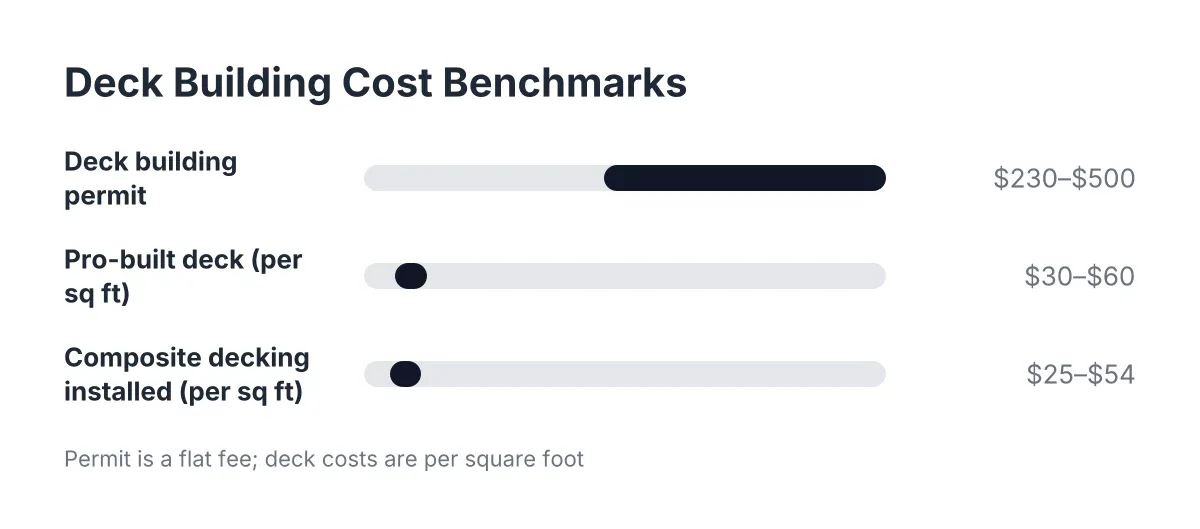
Regional pricing gives you a sanity check. According to Angi, a professionally built deck averages $30 to $60 per square foot. Composite decking runs $25 to $54 per square foot installed, also per Angi, with materials alone at $12 to $22 per square foot. Additionally, HomeAdvisor reports that a deck building permit typically costs between $230 and $500 depending on location. If a bid for a 300 square foot composite deck in Rancho Cucamonga or Fontana lands dramatically below those ranges, something is wrong with the math or the materials. For a deeper look at what drives pricing in Southern California specifically, our guide on what deck builder hiring costs breaks down every variable.
Watch How They Handle Permits
Pay close attention to permit language. In Ontario, California and neighboring cities like Chino, Upland, and Corona, decks above a certain height or attached to the house require a building permit and inspections. A professional pulls the permit under their own license. By contrast, a contractor who asks you to pull an owner-builder permit is shifting legal liability onto you, often because their license cannot support the work. That request alone should end the conversation. Comparing deck quotes is not just about the bottom line. It is about which contractor put their scope, their compliance, and their accountability in writing.
Understanding Deck Builder Contracts and Red Flags
The contract is where good deck builder hiring decisions get locked in and bad ones get expensive. California law gives homeowners specific protections here, and a legitimate contractor builds those protections into every agreement. For example, state law caps the down payment on a home improvement contract at $1,000 or 10 percent of the contract price, whichever is less. Consequently, any contractor demanding half the money up front is either ignorant of the law or counting on you being ignorant of it. Neither is acceptable.
The Red Flags That Should Stop You Cold
Beyond the deposit demand, watch for these warning signs. A cash-only payment requirement suggests the contractor is avoiding a paper trail. A verbal-only agreement, or a one-page contract with no material specifications, leaves you with no recourse when the composite boards you discussed become bargain-bin lumber. Similarly, pressure tactics like "this price expires today" exist to stop you from checking references. A contractor who cannot name recent clients in Riverside, Ontario, or Upland, or who has no local reviews you can verify, may not have the track record they claim. Finally, vague timelines with no start date, completion window, or payment schedule tied to milestones give the contractor every incentive to stretch your job around other work.
Questions That Separate Specialists From Side Gigs
With this in mind, arrive at every meeting with a short list of questions. Ask how they attach a ledger board to stucco, which is common across Inland Empire homes. Ask what footing depth they use and why.Additionally, ask who handles the inspection schedule with the city.Furthermore, ask how they handle change orders in writing. A specialist answers these instantly and specifically, because they solve these exact problems every week. A generalist or handyman hesitates, deflects, or improvises. That difference in fluency tells you more than any sales pitch. To put it simply, the goal of these questions is not to test technical knowledge you do not have. It is to watch how the contractor responds under mild scrutiny, because that behavior predicts how they will respond when something goes wrong mid-project.
Ready to Get Started?
If you are planning a deck in Ontario, California or anywhere in the Inland Empire, put us through the same vetting process this guide describes. We will show you our CSLB license, our insurance certificates, and a written scope before you commit to anything. Reach out for a consultation, and see for yourself what a specialist deck crew looks like on paper and in person.