
Wood Deck Construction — Complete Guide
Choosing wood for your new deck means balancing warmth, cost, and upkeep in a climate that puts lumber to the test. This guide covers traditional wood deck ideas, species choices, construction methods, and the long-term care that keeps natural wood looking sharp in Ontario, California and across the Inland Empire. You will learn how pressure treated, cedar, and redwood decking compare, what a wood deck actually costs to build, and how long each option lasts under Southern California sun. Along the way, we link to deeper guides on cost, construction, and our local building process. By the end, you will know whether wood is the right call for your yard and what to do next.
What You'll Find in This Guide
- How Much Does Wood Deck Construction Cost?
- Wood Deck Construction in Ontario, CA
- Deck Construction in Ontario, CA
Prefer to have a pro handle it? Wood Deck Construction is one call away.
Choosing the Best Wood for Deck Construction in Southern California
The lumber you pick shapes everything else about your project. It sets your budget, your maintenance schedule, and how the deck looks in year one and year ten. For Inland Empire homeowners, three species dominate the conversation: pressure treated pine, cedar, and redwood.
Pressure treated wood is the workhorse. It costs the least of the three, resists rot and insects thanks to its chemical treatment, and handles structural duty well. That is why nearly every deck frame we build in Ontario, California uses pressure treated lumber underneath, regardless of what goes on top. As a decking surface, it works fine on a budget. However, it needs regular staining to look good, and boards can twist or check as they dry in our hot, low-humidity summers.
Cedar sits a step up. In the cedar vs pressure treated decking debate, cedar wins on looks and workability. It has natural oils that resist decay, it stays cooler underfoot, and it takes stain beautifully. The tradeoff is softness. Cedar dents and scratches more easily, so it suits households without heavy patio furniture traffic or large dogs dragging claws across the boards.
Redwood is the premium native option, and it grows right here in California, which keeps supply reasonable compared to other regions. Weighing redwood deck pros and cons comes down to this: it offers outstanding natural rot resistance, rich color, and dimensional stability in dry heat. On the other hand, it costs more than cedar, and the quality varies by grade. Heartwood grades resist decay far better than sapwood grades, so grade selection matters as much as species.
Matching Species to Your Yard and Habits
There is no single best wood for deck construction, only the best wood for your situation. For example, a shaded north-facing deck in Rancho Cucamonga can get away with cedar. Meanwhile, a full-sun west-facing deck in Fontana will punish soft lumber and reward redwood or a well-maintained pressure treated surface. Our crew builds with all three species weekly, and we walk through these tradeoffs in detail on our wood deck construction service page. Beyond species, board thickness and fastener choice affect how the deck ages. Thicker boards resist cupping, and hidden fasteners or coated screws prevent the rust streaks that cheap nails leave behind.
Wood Deck Ideas for Function and Outdoor Living
Once you settle on a species, the fun part starts. Good wood deck ideas begin with how you actually want to use the space, not with a shape drawn on graph paper. Think about morning coffee spots, dining zones, and where the afternoon sun hits your yard in July. In practice, the most popular wood deck ideas we build for Inland Empire homeowners include ground-level platforms that extend the patio, elevated decks off second-story living rooms, and multi-level designs that step down a sloped yard toward a pool or fire pit.
Attached decks connect directly to the house and share its foundation logic, while freestanding decks float on their own footings anywhere in the yard. Additionally, built-in benches, planter boxes, and pergola-style shade structures turn a plain rectangle into a room. Shade matters more here than in most markets. Ontario, California summers regularly push past 100 degrees, so a patio cover or pergola is often the smartest line item in the whole budget.
Creative Deck Ideas Using Wood Construction
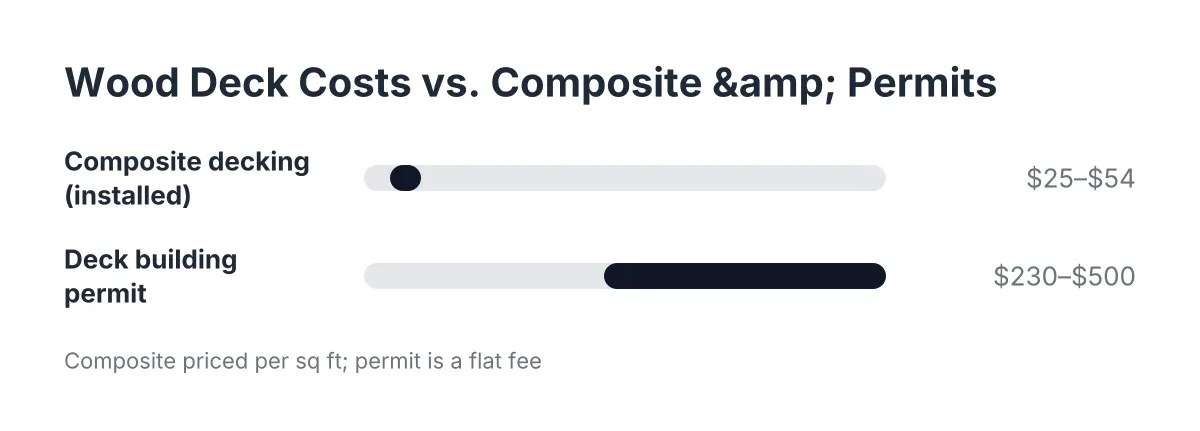
Cost depends on size, species, and height more than anything else. A simple ground-level pressure treated deck sits at the low end. A tall redwood deck with custom railings and stairs sits at the top. For a full breakdown of pressure treated wood deck cost versus cedar and redwood, read our guide on how much wood deck construction costs. For context, composite runs $25 to $54 per square foot professionally installed, according to Angi, and wood typically comes in below that range for comparable sizes.
The good news is that wood decks hold their value well. According to the National Association of Realtors' 2023 Remodeling Impact Report, homeowners recover 89% of the cost of a new wood deck through added home value. That makes a wood deck one of the strongest outdoor investments you can make.
Permits and Code in San Bernardino County
Do not skip the paperwork. Most decks in Ontario, CA require a building permit, especially anything attached to the house or raised more than 30 inches. According to HomeAdvisor, a deck building permit typically costs between $230 and $500 depending on location. We handle permits and plans as part of every project, because an unpermitted deck creates real problems when you sell or file an insurance claim.
Wood Deck Lifespan and Maintenance in a Hot, Dry Climate
Here is the honest tradeoff with wood: it demands more from you than composite does. In exchange, you get a material that looks and feels like nothing else, and one you can refinish, repair, and modify for decades. Understanding wood deck lifespan up front helps you budget for the whole ownership experience, not just the build.
In the Inland Empire, a well-built pressure treated deck typically lasts 15 to 20 years with consistent care. Cedar lands in a similar range, while quality redwood heartwood can push past 25 years. However, those numbers assume maintenance actually happens. Our dry heat is gentler on wood than the freeze-thaw cycles back east, but relentless UV exposure breaks down finishes fast. As a result, the biggest threat to a wood deck in San Bernardino County or Riverside County is not rot. It is sun damage that goes untreated year after year.
The Maintenance Rhythm That Protects Your Investment
Plan on a simple annual cycle. Wash the deck each spring, inspect boards and fasteners, and apply a UV-blocking stain and sealer every two to three years. Beyond that, replace individual boards as they crack or cup rather than waiting for widespread failure. Small, cheap fixes early prevent expensive structural repairs later. For instance, a $40 board swap today can prevent a joist repair that costs twenty times that in five years.
The national numbers show what happens when maintenance slides. The North American Deck and Railing Association estimates that of the more than 60 million decks in the U.S., roughly 30 million are past their useful life and need repair or replacement. That said, the underlying structure matters as much as the surface. Proper footings, correct joist spacing, and code-compliant ledger attachment determine whether your deck stays safe at year 20. This is exactly why we handle every layer ourselves, from concrete footings to railing caps, as part of our full deck construction service in Ontario, CA. A beautiful deck surface over a bad frame is a countdown clock. Conversely, a solid frame under tired boards is a resurfacing project, not a teardown, which is a far cheaper conversation.
If your existing deck is showing its age, an inspection tells you which side of that line you are on. We check framing, footings, ledger connections, and railings, then give you an honest read on repair versus replacement.
Ready to Get Started?
If you are weighing wood deck ideas for your Ontario, California home, talk to a builder who works with pressure treated, cedar, and redwood every week. We serve homeowners across the Inland Empire, including Rancho Cucamonga, Fontana, Corona, Riverside, Chino, and Upland, and we will give you straight answers on species, cost, and code before you commit to anything. Reach out for a free on-site consultation and let's design a wood deck built for Southern California living.