How to Vet Deck Contractors Near Ontario, CA: 8 Checks Before You Sign
Searching for deck contractors near Ontario, California means wading through results that confuse this city with Ontario, Canada, plus directory pages that just forward a phone number. If your yard slopes, drops off, or needs an elevated deck off a second story, the stakes are higher. A handyman who builds ground-level platforms can get in over his head fast on a hillside lot in San Bernardino County. This list walks through eight vetting checks that separate a legitimate, insured Inland Empire deck crew from a side gig, so you can compare quotes with confidence instead of guesswork. When your property features a sloped lot, finding a qualified deck contractor becomes even more critical.
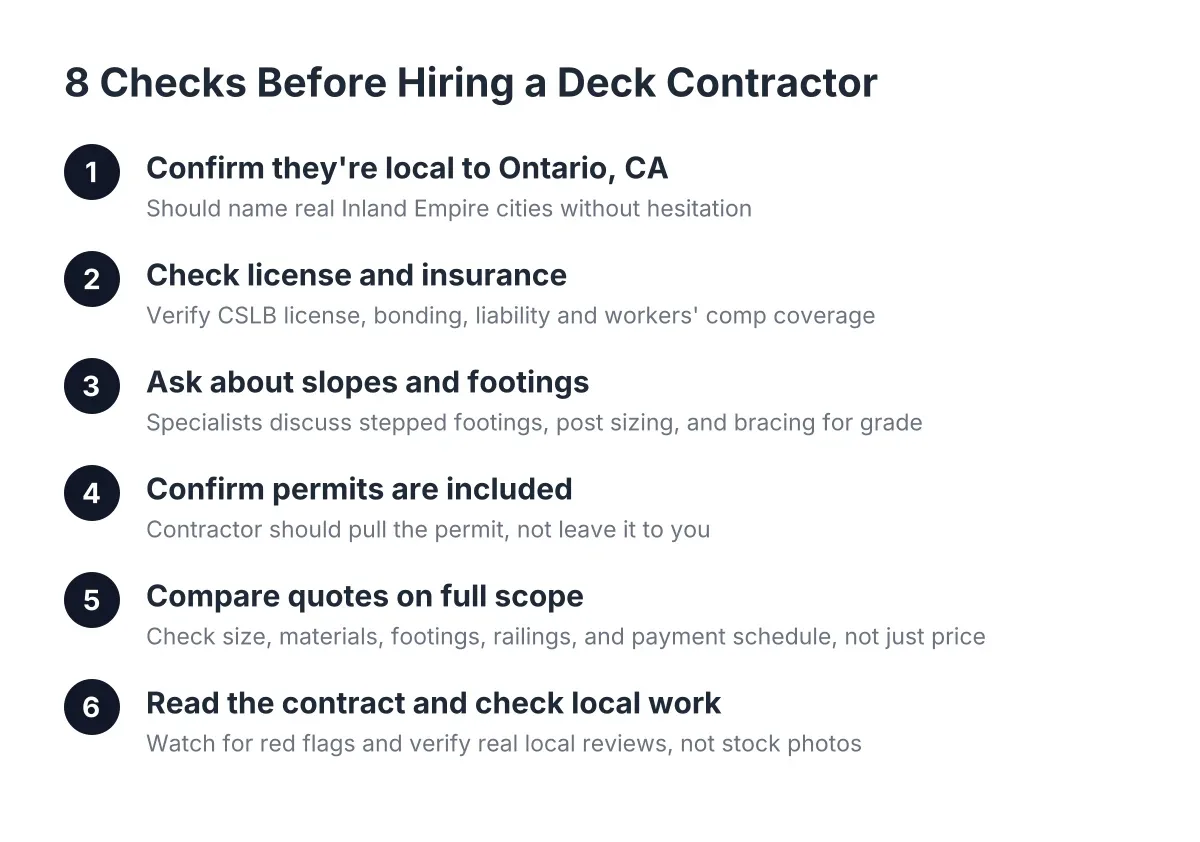
1. Confirm the Contractor Is Actually in Ontario, California
A deck builder serving Ontario, CA should name real Inland Empire places without hesitation. When you call, listen for familiar ground: Rancho Cucamonga, Fontana, Chino, Upland, Corona, Riverside. A legitimate local decking contractor knows the permit counter they deal with and the soil they dig footings into.
This matters more here than in most cities because Google regularly surfaces Canadian deck companies for "Ontario" searches. Before you book a site visit, verify the business has a Southern California address and builds in San Bernardino County or Riverside County. If the website never says California, move on.
2. Check the California License and Insurance First
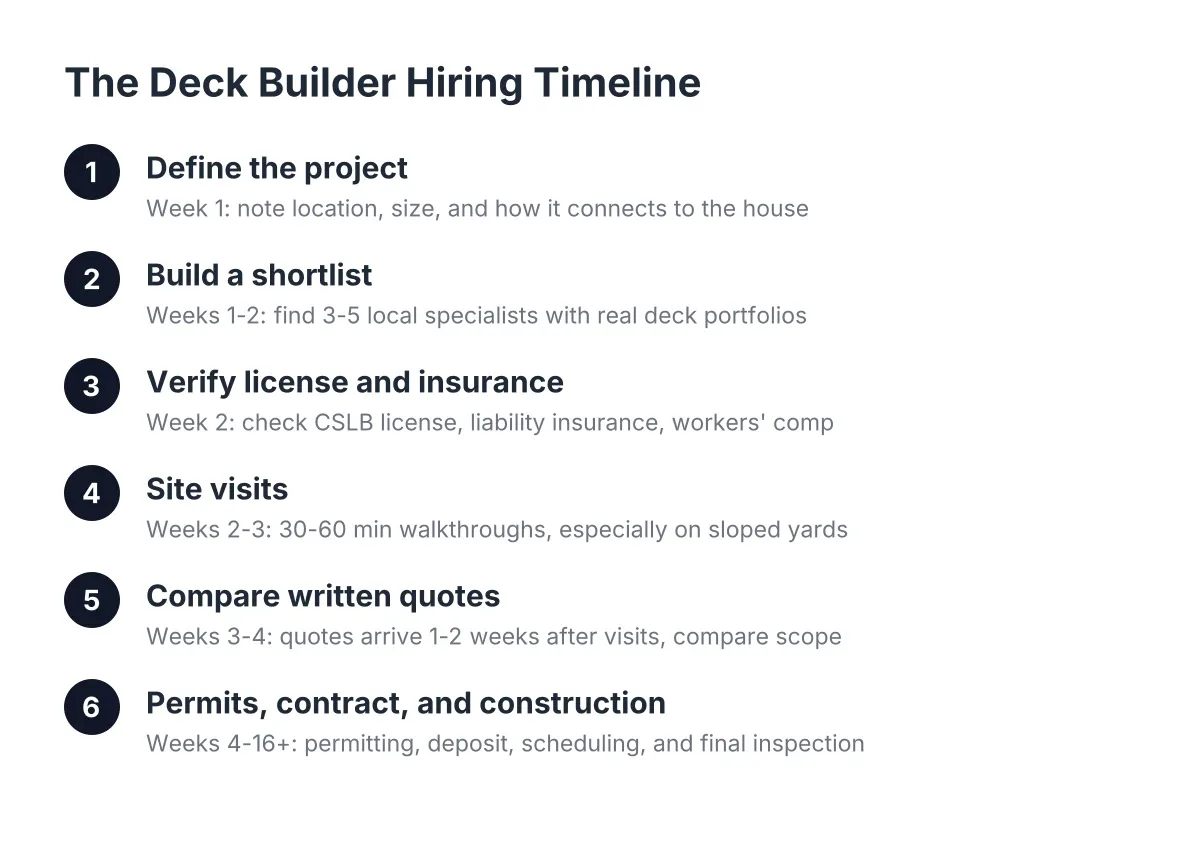
In California, any home improvement job over a small dollar threshold requires a contractor licensed through the Contractors State License Board. You can look up a license number for free on the CSLB website and see whether it is active, bonded, and matched to the business name on the quote. This is the fastest single filter for deck builder license requirements in California, and it takes about two minutes.
Insurance is the second half of that check. Ask for proof of general liability coverage and, if the company has employees, workers' compensation. Deck work involves ladders, framing, and concrete; if someone gets hurt on an uninsured job, the homeowner can end up exposed. Any contractor who stalls or gets defensive about paperwork has answered your real question.
3. Ask How They Handle Slopes, Footings, and Elevated Framing
This is the check that matters most if your yard is not flat. A sloped lot deck contractor must understand that deck footing and post installation on a grade is a different job than setting posts on level ground. The footings may need to be deeper, the posts taller, and the framing designed to resist lateral movement. Some elevated or multi-level designs also need engineering review before the city will issue a permit.
Ask a direct question: "My backyard drops several feet from the house to the fence line. How would you design the footings and framing for that?" A specialist in elevated deck construction and multi-level deck construction will talk through stepped footings, post sizing, bracing, and how a multi-level layout can turn the slope into usable tiers. A generalist will quote you a flat-lot deck and figure out the hillside later, which is how change orders and structural problems start.
For example, suppose a homeowner in Rancho Cucamonga has a walkout slope dropping about six feet behind a new-construction home. In that scenario, a cookie-cutter ground-level quote is close to meaningless; the real design question is whether one elevated deck on tall posts or two connected levels with stairs makes better use of the grade. A builder who works with sloped lot deck construction and cannot sketch both options on the first visit probably has not built many of either.
4. Make Sure Permits Are in the Scope, Not on Your Shoulders
A professional deck installation in Ontario, CA almost always needs a building permit, especially for attached decks, elevated decks, and anything with significant height above grade. According to HomeAdvisor, a deck building permit typically costs between $230 and $500 depending on location. That is a small line item on a project this size, and skipping it creates problems when you sell the home or file an insurance claim.
Ask each bidder who pulls the permit and who meets the inspector. The right answer is the contractor, with the permit cost shown in the quote. A crew that suggests building without a permit "to save you money" is signaling how they handle everything else, from footing depth to railing attachment. Deck permits and planning should be part of the service, not homework they hand back to you.
5. Compare Quotes on Scope, Not Just the Bottom Line
Comparing deck quotes only by total price is how homeowners get burned. Two bids that are thousands of dollars apart often describe two different decks. According to Angi, a professionally built deck averages $30 to $60 per square foot, and composite decking runs $25 to $54 per square foot installed. An elevated or multi-level build on a sloped lot sits toward the higher end because of extra footings, taller posts, and more framing lumber, which is worth knowing before you compare your bid to a neighbor's flat-lot project.
When you line up quotes from deck contractors near Ontario, check that each one spells out the same things:
- Deck size, height, and number of levels
- Decking material and brand, whether wood deck construction or composite deck installation
- Footing type, depth, and post specifications
- Deck railing installation, including material and height
- Stairs, landings, and any built-in features
- Permit fees, demolition or old deck removal, and haul-away
- Payment schedule and an estimated construction timeline
If a bid is vague on footings and framing, that is where the surprise costs hide. Ask the builder to fill in the blanks in writing before you compare numbers.
6. Read the Contract for These Red Flags
A deck contract should protect both sides, and most red flags show up before anyone swings a hammer. California limits how much a contractor can collect as a down payment on home improvement work, so a demand for half the money upfront is a warning sign on its own. Watch for these deck contract red flags:
- A large upfront deposit or cash-only payment terms
- No written scope, just a one-line description and a price
- No start window or estimated completion range
- The permit left out of the contract entirely
- No process for change orders if conditions in the ground differ from the plan
- Pressure to sign today to lock in a price
Payments should track progress: a modest deposit, draws tied to milestones like footings passing inspection and framing complete, and a final payment after the finished walkthrough. This structure keeps the deck builder hiring decision from turning into a leverage problem halfway through construction.
7. Look at Local Work and Local Reviews, Not Stock Photos
Deck builder reviews in the Inland Empire tell you more than a polished portfolio page. Ask each bidder for addresses or photos of decks they built in Ontario, Fontana, Chino, or Upland, and specifically for projects on sloped or elevated lots if that is your situation. A builder who works with a sloped lot deck contractor's experience on multi-level work regularly will have photos of stepped footings, tall post framing, and finished tiered decks, not just ground-level rectangles.
Read reviews with slope-specific eyes. A dozen happy reviews for simple patio-height decks do not tell you how a crew handles a six-foot grade change. Look for mentions of permits, inspections, elevated framing, and how the company handled surprises, because something always comes up once the digging starts.
8. Know What You Can DIY and When a Hillside Demands a Pro
A homeowner can safely handle the small stuff: deck staining and sealing, swapping a few worn boards, and tightening railing hardware. Replacement, resurfacing, structural repair, and any new elevated construction belong with a licensed deck builder. The risk is not abstract. A study using CPSC injury data found 224,000 people were injured due to a deck or porch over a five-year period, with 33,000 of those injuries from structural failure or collapse, according to Legacy Services LLC.
Age compounds the risk on existing decks. The North American Deck and Railing Association estimates that about half of the roughly 50 million decks in the U.S. are more than 25 years old. If you bought a resale home in the Inland Empire with an older deck, have it inspected before you invest in resurfacing; sometimes deck repair makes sense, and sometimes deck replacement is the honest answer. On sloped lots especially, footing and framing conditions can only be confirmed once a professional looks at the site, so treat any quote given sight unseen as provisional.
What a Good Deck Project Near Ontario, CA Includes Start to Finish
A complete deck construction project from a qualified contractor covers design, permits, footings, framing, decking, railing, and final inspection, not just the boards you walk on. Knowing the full scope helps you spot a thin bid. For a custom deck in Ontario, California, expect the work to include:
- Site evaluation and custom deck design that fits your lot's grade, not a template
- Permit drawings, submission, and inspection scheduling with the city
- Deck footing and post installation sized for the soil and deck height
- Deck framing, whether for an attached deck or a freestanding deck
- Decking installation in wood or composite, with manufacturer-spec fastening
- Deck railing installation that meets height and strength code requirements
- Cleanup, haul-away, and a final walkthrough
Items usually priced as extras include built-in benches, lighting, privacy screens, and patio covers. Timelines vary with permit review, design complexity, and how much structural work the slope demands, so ask each bidder for their estimate in writing rather than relying on a generic figure.
The Bottom Line for Sloped-Lot Homeowners
Finding the right sloped lot deck contractor near Ontario, California comes down to verification, not vibes: an active CSLB license, real insurance, a permit in the scope, a detailed written quote, and proof the crew has built on terrain like yours. A sloped or elevated yard is not a problem to apologize for. With the right design, the grade becomes the reason your outdoor living space is more interesting than a flat-lot rectangle.
If you are in Ontario, Rancho Cucamonga, Fontana, Chino, Upland, Corona, or Riverside and your backyard has defeated a quote or two already, talk to a local Inland Empire deck specialist. A site visit and a free quote will tell you what your slope actually allows, and a builder who works this terrain every week can show you options the flat-lot bids missed.
If you need custom deck design, Inland Empire Decks can help.
Prefer to talk it through? Call (909) 298-8578 — a quick call is usually the fastest way to get a straight answer for your situation.