Timbertech vs. Trex: Which Is Right for You?
If you are choosing between Timbertech and Trex for your new deck, the honest answer in the timbertech vs trex debate comes down to priorities. Timbertech tends to win for homeowners who want a more realistic wood look and cooler board surfaces, which matters on hot Inland Empire afternoons. Trex tends to win for homeowners who want a proven brand at a wider range of price points, including budget-friendly entry lines. Both are quality composite decking brands, and both will outlast a wood deck in the Ontario, CA climate. This page walks through where each one shines so you can pick with confidence.
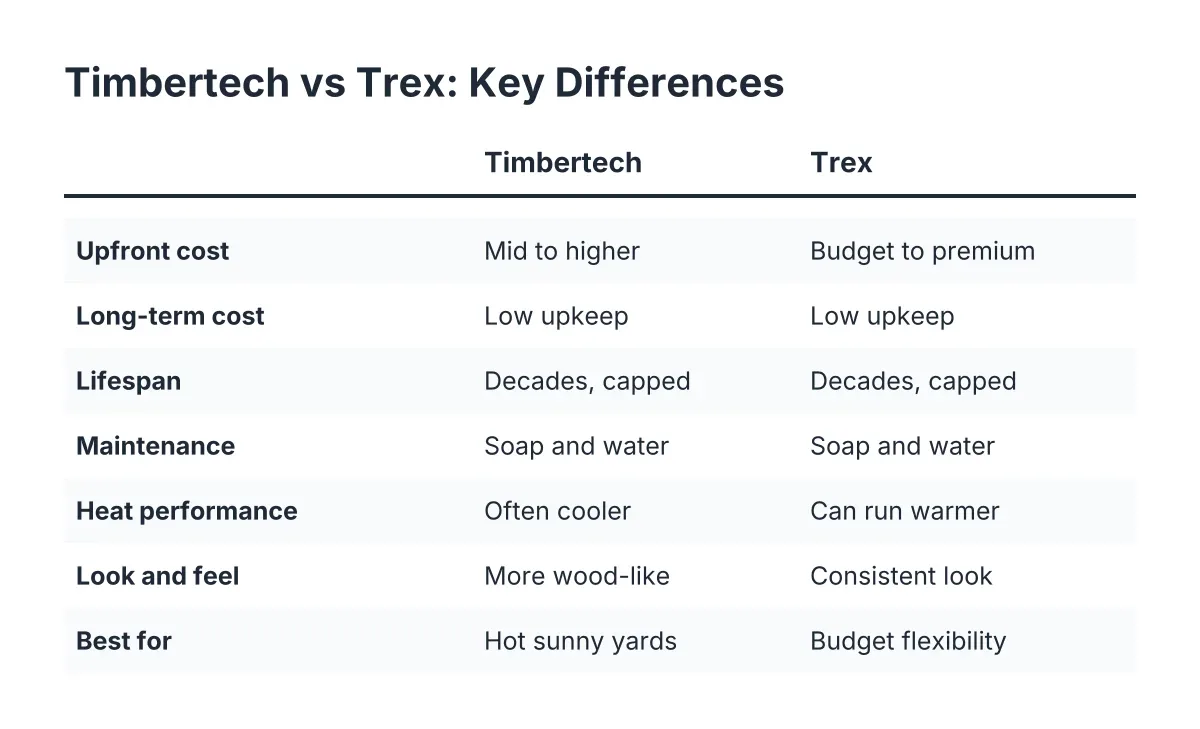
| Criteria | Timbertech | Trex |
|---|---|---|
| Upfront cost | Mid to higher range depending on line | Wider spread, from budget lines to premium |
| Long-term cost | Low, minimal upkeep | Low, minimal upkeep |
| Lifespan | Long, typically decades with capped boards | Long, typically decades with capped boards |
| Maintenance | Soap-and-water cleaning, no staining or sealing | Soap-and-water cleaning, no staining or sealing |
| Heat performance | Often stays cooler underfoot, depending on line and color | Can run warmer in dark colors under full sun |
| Look and feel | Deeper grain patterns, more wood-like in premium lines | Consistent, familiar look across popular lines |
| Best for | Realistic wood appearance, hot sunny yards | Budget flexibility, wide availability, proven track record |
Timbertech: Strengths and Trade-offs
Timbertech is a composite and PVC decking brand that makes boards from recycled materials wrapped in a protective cap. That cap is what keeps the board from fading, staining, and absorbing moisture the way bare wood does. In plain terms, it is decking that looks like wood but does not need staining, sealing, or board-by-board replacement every few years.
Where Timbertech shines is appearance and heat performance. Its premium lines carry deeper, more varied grain patterns, so from a few feet away the deck reads as real hardwood. Several of its lines are also built to stay cooler underfoot than typical composites. If your deck faces south or west in Ontario, Rancho Cucamonga, or Fontana, where summer sun hits hard for months, that cooler surface is a real comfort difference, not a brochure line.
The trade-off is cost and availability. Timbertech's most impressive boards sit at the higher end of the composite price range, and its budget lines are less widely stocked than the competition's. If your project budget is tight, you may find the Timbertech boards you actually want are a step above what you planned to spend. It is worth reading our guide on the cost of composite decking materials before you settle on a line.
Trex: Strengths and Trade-offs
Trex is the most widely recognized composite decking brand in the country, and that recognition is earned. Like Timbertech, its boards use a recycled core with a protective cap, so you get the same core promise: no staining, no sealing, no rot, and no splinters. Trex has been at this longer than almost anyone, and its track record on real decks is long and public.
Where Trex shines is range and availability. It offers lines at several price points, from entry-level boards that get you into composite decking for less, up to premium boards with richer color blending. Because Trex is stocked so widely, colors and profiles are easier to source, which can matter for your project timeline and for matching boards years later if a repair comes up. For a deck replacement where budget is the deciding factor, Trex's entry lines often make composite possible when it otherwise would not be.
The trade-offs show up at the bottom and top of the lineup. Trex's entry-level boards have a simpler, more repetitive grain pattern, and some homeowners find them plainer up close. Dark Trex colors can also run warm underfoot in full sun, which matters more in the Inland Empire than it does in milder climates. Neither issue is a dealbreaker; both are things to weigh against the price you are paying.
Timbertech vs Trex: The Deciding Factors
Cost drivers
Trex gives you more room at the low end; Timbertech asks more upfront for its standout boards. With either brand, the board itself is only part of your deck cost. Framing, footings, railing, stairs, and site conditions drive the total as much as the decking does. On a like-for-like premium build, the two brands land close together. The gap shows up when you compare Trex's entry lines against Timbertech's lineup, where Trex usually comes in lower.
Lifespan
This one is close to a tie, and that is good news for you. Both brands make capped composite boards that typically last decades in most homes, and both back their products with long manufacturer warranties on their premium lines. In our dry Southern California climate, composite decking materials avoid the two things that kill wood decks here: relentless UV exposure and the cracking that comes from repeated heat cycles. Either brand will outlast a stained wood deck by a wide margin.
Installation
Neither brand is harder to install than the other, but installation quality matters more than brand choice. Both use hidden fastener systems and both have specific spacing and framing requirements that differ from wood. A composite deck installed over an undersized or aging frame will fail no matter whose name is on the boards. That is why a proper composite deck installation starts with the framing, footings, and permits, not the board catalog.
Maintenance
Dead even. Both brands need only occasional cleaning with soap and water. No staining, no sealing, no sanding, and no annual weekend lost to deck maintenance. Compare that to a wood deck in Ontario, CA, which needs staining and sealing on a regular cycle to survive the sun, and the long-term math favors either composite brand.
Heat and sun performance
Timbertech takes a modest edge here, and in the Inland Empire that edge counts. Some Timbertech lines are engineered to stay cooler underfoot, while dark composite boards from any brand can get uncomfortable in direct summer sun. If your deck bakes in afternoon sun in Corona, Riverside, or Chino, lean toward lighter colors regardless of brand, and give Timbertech's cooler lines a serious look. If your deck sits in shade or under a patio cover, this factor drops down the list.
Which Should You Choose?
Choose Timbertech if:
- You want the most realistic wood look you can get from composite decking
- Your deck gets heavy afternoon sun and barefoot comfort matters
- Your budget has room for a mid-range to premium board
- You are building a showpiece outdoor living space you plan to keep for decades
Choose Trex if:
- Budget flexibility is your top priority and you want composite without the premium price
- You want the longest, most public track record in the category
- Easy availability of colors and replacement boards matters to you
- You are replacing a wood deck and want a straightforward, proven upgrade
If you are still torn, here is the short version: pick the specific board line you can see and touch, not the brand name. Both companies make excellent boards and both make plainer budget boards. As local deck builders here in Ontario, California, we install both, and we are happy to bring samples to your home so you can compare them side by side in your own light. Ask for a free quote and we will price your deck both ways.
Common Questions
Is Timbertech or Trex better for hot climates like the Inland Empire?
Both handle San Bernardino County and Riverside County heat well, since capped composites resist UV fading and do not crack the way wood does. Timbertech has an edge on surface temperature with some of its lines, which helps on decks in full afternoon sun. Color choice matters as much as brand; lighter boards stay cooler with either.
Does the timbertech vs trex choice change my deck cost much?
When weighing timbertech vs trex options, the board choice moves your total deck cost less than most homeowners expect. Framing, footings, deck size, railing, and stairs make up a large share of any composite deck project. The bigger cost swing comes from which line you pick within a brand, since entry and premium boards from the same company can sit far apart in price.
Can I install either brand over my existing deck frame?
Sometimes, but only if the frame is sound and meets the spacing requirements composite boards need. Deck resurfacing works well when the footings, posts, and joists are in good shape. If the frame is aging or undersized, a full deck replacement is the safer investment, since new boards over a failing frame just delay the problem.
Do Timbertech and Trex decks need permits in Ontario, CA?
Most new deck construction and many deck replacements in Ontario, California require permits, especially elevated decks and attached decks. The rules depend on deck height, size, and whether it attaches to the house. We handle deck permits and planning as part of every project, so you do not have to sort out city requirements on your own.
If you need custom deck design, Inland Empire Decks can help.
Prefer to talk it through? Call (909) 298-8578 — a quick call is usually the fastest way to get a straight answer for your situation.