Wood Deck Construction Terms Explained: A Plain-English Glossary
If you are getting quotes for a deck in Ontario, CA and keep running into words like "ledger board" or "footing," this page is for you. This wood deck construction glossary explains the terms a deck builder will use in plain English, so you can read a quote line by line and know what you are paying for. Use it to compare bids, ask sharper questions, and spot gaps in a proposal before work starts. Nothing here requires a construction background, just a few minutes of reading.
- Footing: the concrete base that holds the deck up
- Post: the vertical support resting on each footing
- Beam: the heavy horizontal piece posts carry
- Joist: the boards your decking sits on
- Ledger Board: where an attached deck meets the house
- Deck Framing: the whole structural skeleton
- Decking (Deck Boards): the surface you walk on
- Flashing: metal that keeps water out of the house connection
- Freestanding Deck: a deck that supports itself, no house attachment
- Attached Deck: a deck tied to the house at the ledger
- Railing (Guardrail): the barrier around the deck edge
- Baluster: the vertical pickets inside a railing
- Pressure-Treated Lumber: wood treated to resist rot and insects
- Composite Decking: man-made boards that skip the staining
- Staining and Sealing: the finish that protects wood from sun and water
- Deck Resurfacing: new surface boards on an existing frame
- Building Permit: the city's sign-off on your project
- Load (Live Load and Dead Load): the weight a deck is built to carry
Wood Deck Construction Glossary: What Holds a Deck Up
These are the bones of the project. When a deck builder in Ontario, California talks about the structure, these are the parts under your feet that you never see once the deck is finished.
Footing
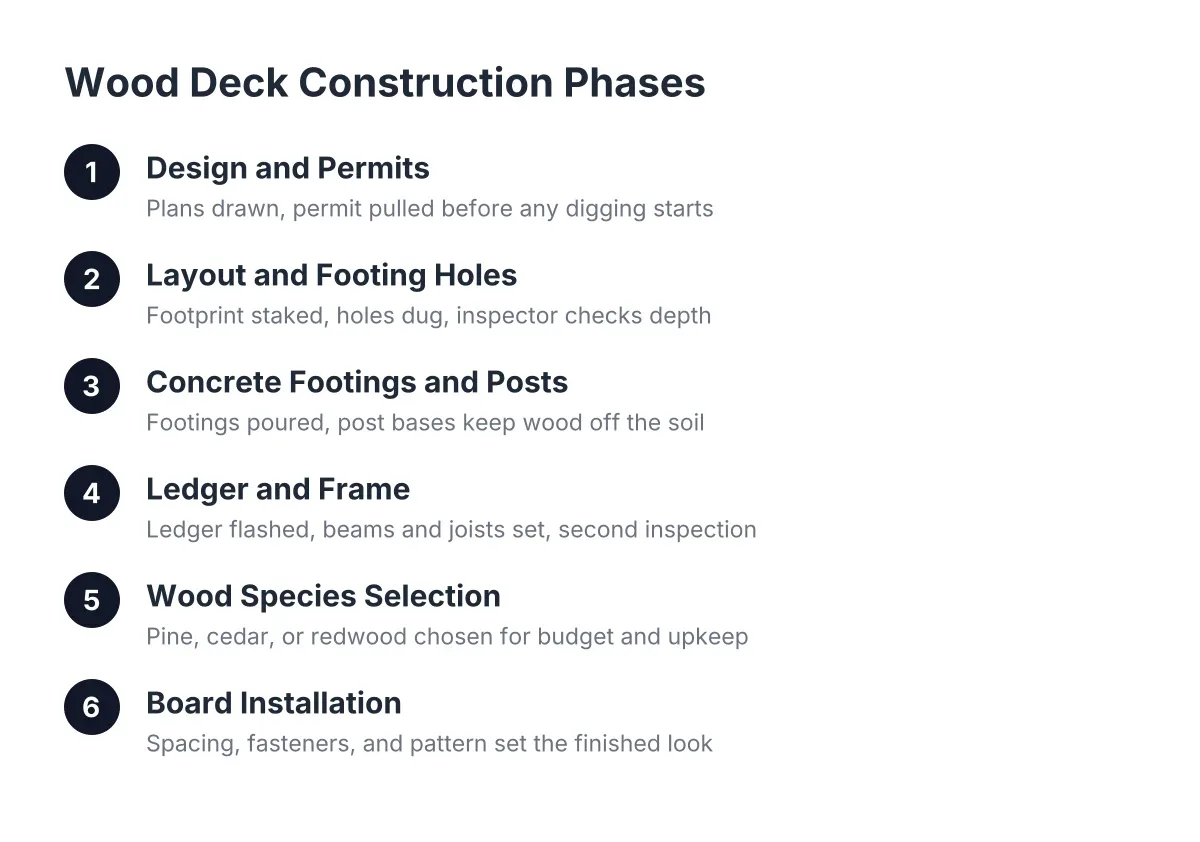
A footing is the concrete base poured into the ground that supports each deck post. Footings carry the entire weight of the deck down into the soil, so their size and depth matter more than almost anything else on the project. A quote that includes deck footing and post installation as its own line item tells you the builder plans to dig and pour properly, not just set posts on the dirt. Skimping here is how decks sink and lean over time.
Post
A post is the vertical piece of lumber that stands on a footing and holds up the deck's beams. Posts do the lifting between the ground and the frame, so their spacing and size depend on how tall and heavy your deck is. On an elevated deck, posts get longer and the engineering gets more careful, which is one reason elevated deck construction costs more than a low platform.
Beam
A beam is a heavy horizontal piece, often two or three boards fastened together, that sits on the posts and carries the joists. Think of beams as the deck's main highway: everything above routes its weight through them. If a builder mentions doubling or tripling a beam, that usually means your deck's size or span requires extra strength, not that someone is padding the bill.
Joist
A joist is one of the repeated horizontal boards that span between beams and directly support the deck boards. Joists are spaced at regular intervals, and that spacing has to match the decking you choose; composite decking often needs joists closer together than wood. When a repair estimate mentions "joist damage," expect the job to involve opening up the deck surface, which adds labor.
Ledger Board
A ledger board is the piece of lumber bolted to the house that supports one side of an attached deck. It is the single most common failure point on decks, because a poorly fastened or unflashed ledger lets water rot the house wall and can let the whole deck pull away. If a builder talks about ledger bolts and flashing in their quote, that is a good sign they take attached deck construction seriously.
Deck Framing
Deck framing means the complete structural skeleton of a deck: posts, beams, joists, and the hardware that ties them together. Framing is where most of the real engineering lives, and it is the part a city inspector looks at hardest. If you are comparing bids for wood deck construction, ask each builder what lumber and hardware they frame with; two quotes can look similar on paper and differ entirely under the boards. Our page on wood deck construction in Ontario, CA walks through how we approach framing locally.
Surface and Finish: What You See and Touch
Decking (Deck Boards)
Decking means the boards that form the walking surface of the deck. This is the part you see, so homeowners naturally focus here, but decking is usually easier and cheaper to replace than the frame beneath it. When a builder quotes deck board replacement, they are swapping surface boards only, which is a much smaller job than rebuilding the structure.
Flashing
Flashing is thin metal or waterproof material installed where the deck meets the house to keep water out of the wall. Good flashing over the ledger board protects both the deck and your home's framing from rot. It is cheap insurance, and its absence is one of the most common problems found during deck repair inspections.
Railing (Guardrail)
A railing, or guardrail, is the barrier installed around the edges of a deck to keep people from falling off. Most codes require railings once a deck sits a certain height above the ground; your builder or local building department can confirm where that line falls for your project. Deck railing installation is often priced per linear foot, so a bigger deck perimeter means a bigger railing line on the quote.
Baluster
A baluster is one of the vertical pickets that fill the space inside a deck railing. Balusters must be spaced closely enough that a small child cannot slip through, which is why builders talk about spacing rules when they quote railing work. Swapping plain wood balusters for metal ones is a common upgrade that changes the look without touching the structure.
Pressure-Treated Lumber
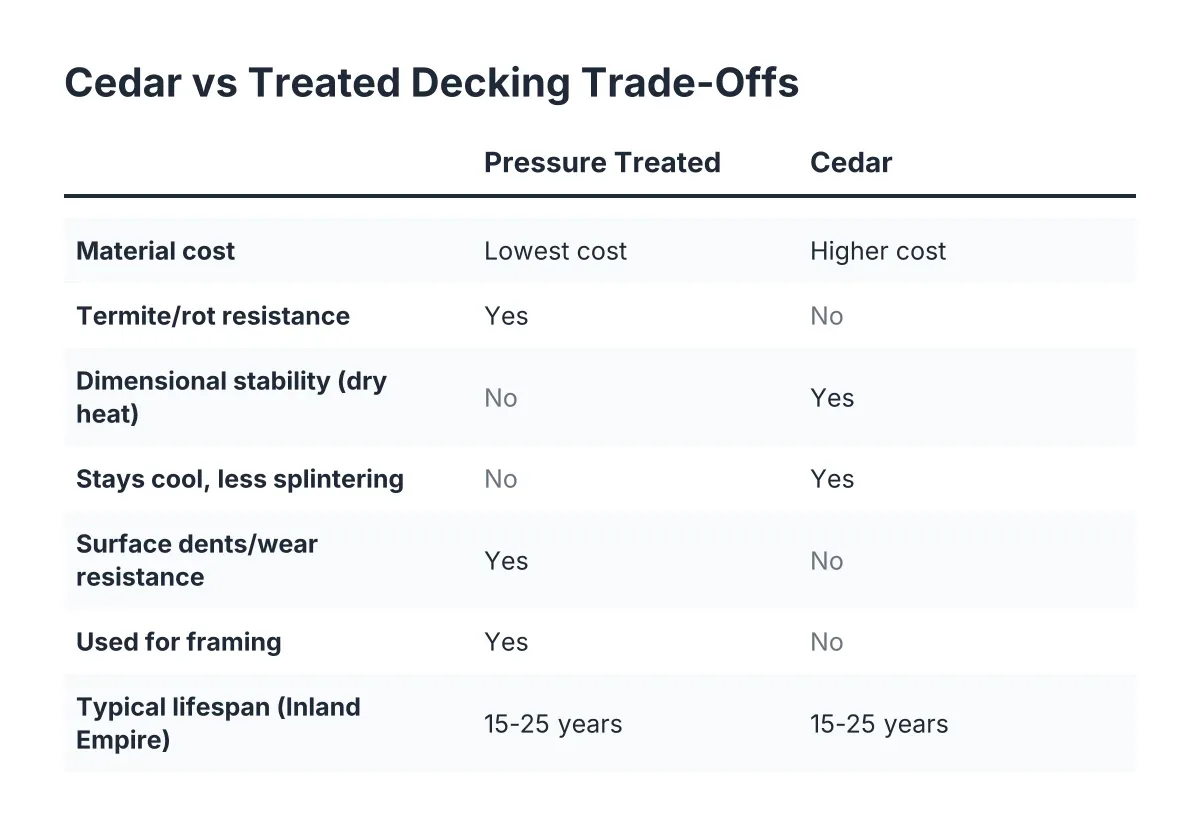
Pressure-treated lumber is wood that has been infused with preservatives under pressure to resist rot, decay, and insects. It is the standard choice for deck framing because the structure has to survive moisture and ground contact for decades. In the Inland Empire's dry heat, treated lumber also holds up well against the sun, though surface boards still need staining and sealing.
Composite Decking
Composite decking means man-made boards, usually a blend of wood fibers and plastic, used in place of solid wood for the deck surface. Composite costs more up front than wood but skips the regular staining and sealing that Southern California sun demands from wood boards. Many builders, including composite deck installation specialists, still frame in treated wood underneath; the composite is only the surface layer.
Staining and Sealing
Staining and sealing means applying protective finish to wood deck boards to guard against sun, water, and wear. In a sunny climate like Ontario, CA, UV exposure fades and dries out unprotected wood, so regular staining and sealing is the main maintenance cost of owning a wood deck. If a builder offers it as a service, ask how the first coat is handled on new construction, since fresh lumber sometimes needs time to dry before finishing.
Deck Resurfacing
Deck resurfacing is replacing the deck boards and often the railing while keeping the existing frame underneath. It is the middle option between repair and full deck replacement, and it only makes sense when the framing is still sound. A trustworthy builder will inspect your posts, beams, and joists before quoting resurfacing; if the frame is rotted, resurfacing just hides the problem.
Design, Paperwork, and Cost: Wood Deck Construction Terms
Every wood deck construction glossary should cover the words on the paperwork, not just the parts of the deck, because this is where quotes differ most.
Freestanding Deck
A freestanding deck is a deck that supports itself entirely on its own posts and footings, with no attachment to the house. Freestanding deck construction needs more footings than an attached deck, but it avoids cutting into your home's siding and the risks that come with a ledger connection. Builders sometimes recommend it when the house wall cannot safely carry a ledger board.
Attached Deck
An attached deck is a deck connected to the house along one side by a ledger board. Attached deck construction uses the house for part of its support, which can mean fewer posts and footings, but it demands careful fastening and flashing at the connection. If you are unsure which type fits your home, that is a good first question for any local deck builder.
Building Permit
A building permit is the city's written approval to build your deck, issued after someone reviews the plans. Most decks beyond a small, low platform need one, and the permit process usually includes inspections of the footings and framing. A builder who handles deck permits and planning for you is taking on real paperwork; a builder who tells you to skip the permit is handing you the risk instead.
Load (Live Load and Dead Load)
Load means the weight a deck is designed to carry: dead load is the deck's own weight, and live load is everything on top of it, like people and furniture. Load numbers drive the size and spacing of footings, posts, beams, and joists. You do not need to do the math yourself, but when a builder explains why your multi-level or elevated deck needs heavier framing, load is the reason. Deck size and structural requirements are also the biggest drivers of price; our guide to the cost of wood deck construction breaks down how those factors stack up.
Using These Terms
With this wood deck construction glossary in hand, you can read a deck quote line by line and know whether footings, flashing, and permits are accounted for. You can also ask pointed questions, like how a builder fastens the ledger or what joist spacing your decking needs. That is usually all it takes to separate a careful local deck builder from a rushed one.
If you need custom deck design, Inland Empire Decks can help.
Prefer to talk it through? Call (909) 298-8578 — a quick call is usually the fastest way to get a straight answer for your situation.