Replace or Repair Your Deck? Damage Signs and Deck Board Replacement Cost
Your deck looks tired. A few boards are soft, a railing wobbles, and you are starting to wonder whether a weekend of fixes will solve it or whether the whole thing needs to come down. Before you can budget anything, you need two answers: how bad the damage actually is, and what deck board replacement cost looks like compared to a full teardown and rebuild. Those two answers decide everything else, including whether this project runs a few hundred dollars or becomes the backyard overhaul you have been putting off.
Here in Ontario, California, we see this decision point constantly. The Inland Empire sun is hard on wood decks. Years of UV exposure, dry heat, and the occasional wet winter split boards, pull fasteners loose, and dry out sealant faster than homeowners expect. The good news is that the damage usually tells you exactly what it needs, if you know how to read it.
This guide walks through the assessment criteria a deck builder uses to call repair versus replacement, what each path costs in general terms, and why a teardown, if you need one, is the single best chance you will ever get to fix the design mistakes the original builder made.
Start With the Scale of the Problem
Deck failure is not rare, and it is not something that only happens to neglected properties. According to the North American Deck and Railing Association (NADRA), there are more than 60 million residential and commercial decks in the United States, and an estimated 30 million of them are past their useful life and need replacement or repair. NADRA also estimates that about half of the roughly 50 million decks in an earlier count are more than 25 years old.
The stakes go beyond appearance. A study using CPSC injury surveillance data found 224,000 people nationally were injured due to a deck or porch over the study's five-year period, with 33,000 of those injuries resulting from structural failure or collapse, according to Legacy Services LLC. A deck that looks fine from a lawn chair can still be one barbecue away from a serious problem underneath.
Therefore, the repair-versus-replace question is not cosmetic. It is a structural safety question first and a budget question second. The framework below keeps those in the right order.
The Three-Layer Damage Assessment
Every deck has three layers, and the layer where the damage lives determines your answer. Work from the top down.
Layer 1: The Walking Surface (Boards and Fasteners)
Deck boards are the sacrificial layer. They take the sun, the rain, the foot traffic, and the dropped charcoal. In the Inland Empire, UV damage is usually the first thing homeowners notice: graying, cupping, splintering, and checking (those long surface cracks that run with the grain).
Surface-level damage is almost always repairable. If a screwdriver sinks into a board, that board is rotten and needs to go, but one rotten board does not condemn a deck. A handful of bad boards is a straightforward deck board replacement job, and it is the cheapest category of deck repair there is.
Signs the problem stays at Layer 1:
- Individual boards are cracked, splintered, or cupped, but the frame beneath them feels solid
- Nails or screws are popping up, but joists hold new fasteners firmly
- The deck feels stable when you walk it; no bounce, no sway
- Damage is scattered, not concentrated near the house or the posts
Layer 2: The Frame (Joists, Beams, and the Ledger Board)
The frame is where repair math starts to break down. Joists and beams carry the load, and when they rot, the deck is structurally compromised even if the surface looks presentable. The most important single component is the ledger board, the piece that attaches the deck to your house. Ledger failure is the leading cause of deck collapse, and the deck ledger board replacement cost often surprises homeowners because the work means detaching part of the deck, addressing flashing and water damage at the house wall, and reattaching everything to current code.
Probe the frame from underneath with a screwdriver, especially where joists meet the ledger and where beams sit on posts. Soft wood, dark staining, fungal growth, or fasteners that have rusted through are frame-level red flags.
One or two bad joists can be sistered or replaced. However, once frame rot spreads, you are paying skilled labor to rebuild the skeleton piece by piece while working around the old surface. At that point, a full deck replacement frequently costs less per useful year than a chain of structural repairs.
Layer 3: The Foundation (Posts and Footings)
Footings and posts are the deepest layer and the clearest replacement signal. Posts that are shifting, leaning, cracked at grade, or set in undersized footings cannot be patched from above. If the original deck was built on precast pier blocks sitting on dirt, or the posts were buried directly in soil and have rotted at the ground line, the deck has no reliable foundation.
In that case, repair stops making sense entirely. You cannot put a new surface and frame on a failing foundation, and in San Bernardino County, new footings mean permits, inspections, and concrete work done to current code. That is a rebuild, and honestly, it should be.
What Deck Board Replacement Costs Compared to Full Teardown
Deck board replacement costs far less than a full teardown because you are only paying for surface materials and the labor to swap them; the frame and footings stay. A full replacement includes demolition, hauling, new framing, new footings, permits, and inspections. The gap between the two numbers is usually several times over, which is why the damage assessment matters so much.
Here is how the cost categories generally stack up, from least to most expensive:
- Spot board replacement. Swapping a handful of damaged boards and fasteners. Deck board repair cost at this scale is the smallest check you will write on a deck.
- Full resurfacing. Keeping a sound frame and replacing the entire walking surface and railing. Wood deck board replacement cost per square foot stays well below new construction because demolition and foundation work are off the table. This is also where many homeowners upgrade from wood to composite decking.
- Structural repair. Replacing joists, beams, or the ledger board. Labor-heavy and unpredictable, because hidden rot tends to reveal more hidden rot once the boards come up.
- Full deck replacement. Teardown to dirt, new footings, new frame, new surface. The biggest number, but also the only option that resets the clock on every layer at once.
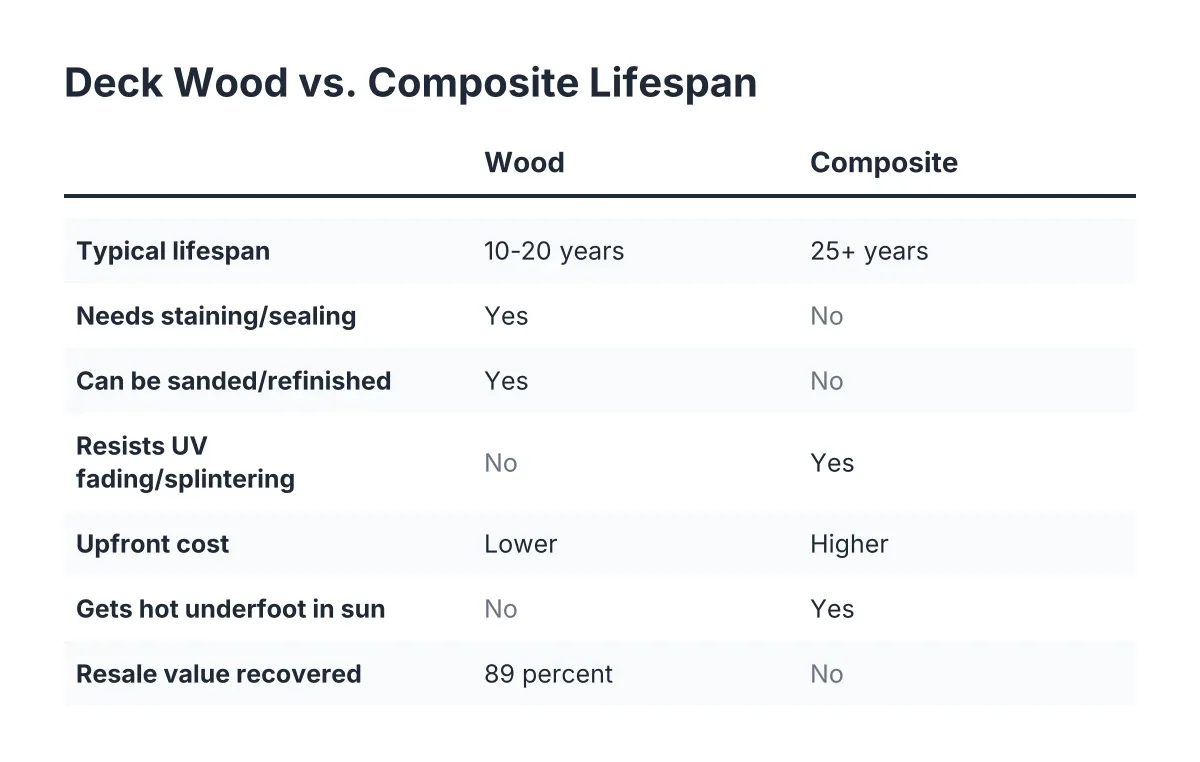
Material choice moves these numbers more than anything else. For reference on the upgrade path, composite deck materials cost between $12 and $22 per square foot for materials alone, or $25 to $54 per square foot when professionally installed, according to Angi. Wood runs lower upfront but carries ongoing staining and sealing costs that composite does not.
Be cautious with any online deck cost calculator or deck board replacement cost calculator. Those tools price the visible surface. They cannot see a rotted ledger, undersized footings, or code issues, and in the Inland Empire those hidden items are exactly what swings a quote. Use calculators to set a rough bracket, then get eyes on the structure before you trust a number.
When Repair Is Throwing Good Money After Bad
There is a tipping point, and it is earlier than most homeowners think. A useful rule: if the repair estimate approaches half the cost of a rebuild, or if you are repairing the same deck for the second time in a few years, replacement is the stronger financial move.
Say a homeowner in Rancho Cucamonga has a 20-year-old wood deck. Suppose the boards are shot, three joists are soft, and the posts sit on surface pier blocks with no real footings. In that hypothetical, a repair path means paying for new boards, new joists, and still owning a deck with a foundation that would not pass a 2026 inspection. Every dollar spent on that repair rides on a structure with maybe five years left. A rebuild costs more upfront, but every dollar buys decades instead of seasons.
Resale math supports the rebuild side too. Homeowners recover 89% of the cost of a new wood deck through added home value, according to the National Association of Realtors' 2023 Remodeling Impact Report. Few repairs return anything close to that, because buyers and appraisers see a patched old deck as an old deck.
That said, the honest limitation runs the other way as well. If your frame and footings are genuinely sound, a full teardown is overkill, and resurfacing with new boards and railing delivers most of the visual payoff at a fraction of the price. A reputable deck builder should tell you when the cheaper path is the right one. If every assessment you get ends in "tear it all out," get another opinion.
Teardown Is Your One Chance to Fix the Original Design
Here is the part most replacement guides skip, and it is the biggest reason not to treat a rebuild as a like-for-like swap. Once the old deck is gone, you are standing in a bare yard with none of the old deck's constraints. Rebuilding the exact same footprint, with the same awkward stairs in the same wrong spot, wastes the single best design opportunity you will ever have back there.
During deck replacement, nearly everything is on the table at a modest incremental cost, because the expensive parts (demolition, footings, framing labor) are already in the budget:
- Size and shape. Upgrading deck size during replacement is far cheaper than adding on later. If the old 10×12 deck never fit the patio table, build the footprint you actually use. For scale, when homeowners ask what a 14×20 deck costs, the honest answer is that it depends on material, height, and site conditions, but going bigger during a rebuild costs much less per square foot than a future expansion would.
- Material. This is the natural moment to weigh composite versus wood. Composite costs more upfront and ends the staining-and-sealing cycle; wood costs less on day one and more over its lifetime. In Ontario, CA sun, that maintenance math deserves real attention.
- Layout and flow. Move the stairs to where you actually walk. Add a second level, a built-in bench, or a wider landing at the slider. Multi-level and elevated deck construction options open up once you are framing from scratch.
- Railing. New deck railing is a code requirement on most rebuilds anyway, so choose a style you like rather than defaulting to what was there.
- Structure done right. Proper footings sized for your soil, a correctly flashed ledger, and joist spacing that supports composite decking if you ever want it.
In addition, labor pricing rewards this thinking. Labor cost to build a deck per square foot generally drops as the project grows, because mobilization, demolition, and permit overhead spread across more deck. The jump from rebuilding small to rebuilding right is smaller than most homeowners expect.
Permits, Code, and Why the Rules Help You
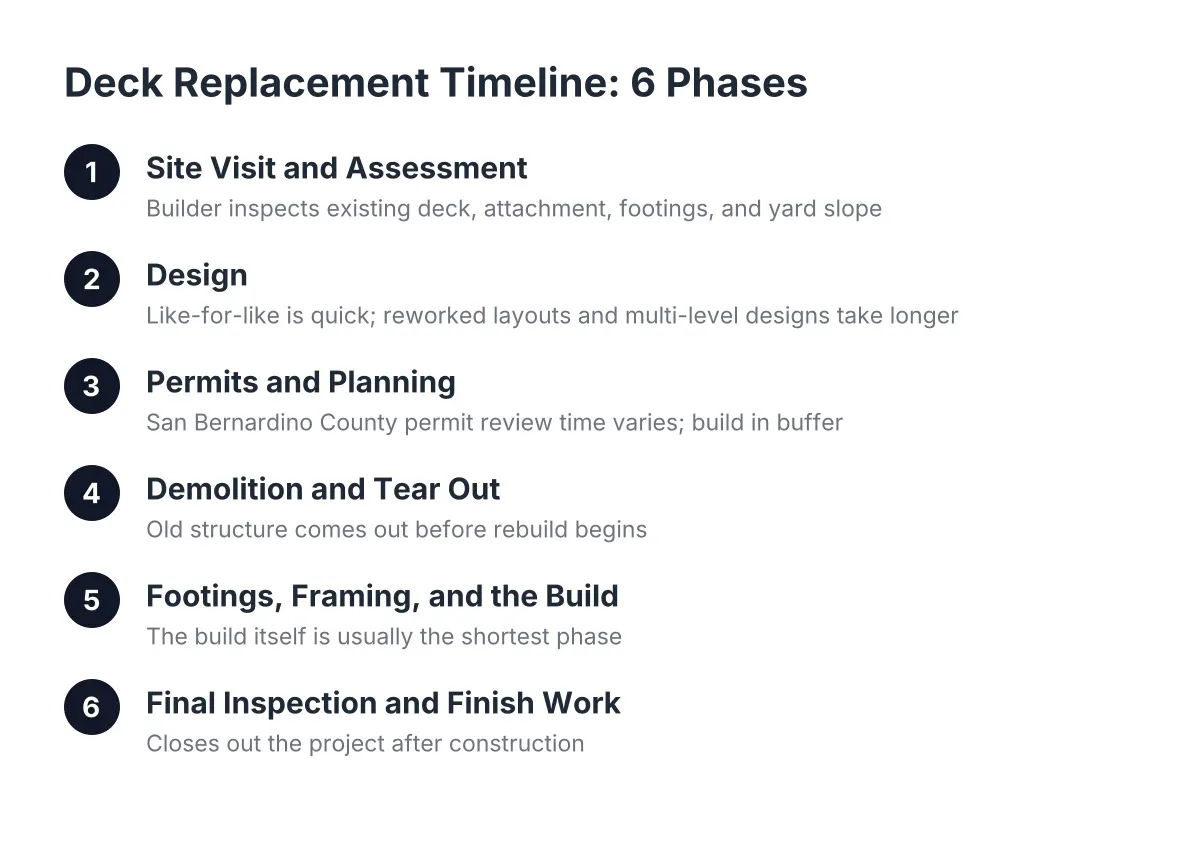
Deck replacement permit requirements catch many homeowners off guard. In Ontario, California, and across San Bernardino County, a full teardown and rebuild typically requires a permit, even if you are rebuilding the same size deck in the same spot. Repairs and simple board swaps on an existing structure often do not, though rules vary and your deck builder should confirm with the city before work starts.
This is a feature, not a hassle. The permit process means an inspector verifies the footings, the ledger attachment, and the railing heights against current code. Your old deck was built to the code of its day, or to no code at all. The inspection is your assurance that the new one will not be the deck in that collapse statistic. A local deck builder who handles deck permits and planning as part of the job removes this entire worry from your plate; it is a fair question to ask on the first phone call.
Timeline-wise, plan in phases rather than fixating on a single number. Design and permitting come first and depend partly on the city's review queue. Demolition is fast, usually a matter of days. Footings need inspection and concrete cure time before framing starts. Framing, decking, and railing make up the visible build. A straightforward rebuild moves faster than a complex multi-level project, and your builder should map the sequence for your specific deck before you sign anything.
How to Run the Assessment This Weekend
You do not need a contractor to do the first pass. Grab a screwdriver and a flashlight and work the three layers:
- Walk the surface. Note every soft, cracked, or cupped board. Count them. Under ten scattered boards on a solid frame points toward simple board replacement.
- Go underneath. Probe joists, beams, and especially the ledger connection at the house. Soft wood, rust streaks, or daylight where flashing should be means the problem is deeper than boards.
- Check the ground. Look at each post where it meets concrete or soil. Leaning posts, cracked footings, or posts buried in dirt push you toward replacement.
- Bounce test. Walk the center of the deck and the stair landings. Movement or sway signals frame or connection problems, not board problems.
- Date it. If the deck predates your ownership and is pushing 20 years or more, weight your findings toward the structural side. Hidden rot is the norm at that age, not the exception.
If everything stops at Layer 1, get quotes for board replacement or resurfacing and enjoy the smaller invoice. If you find anything at Layer 2 or 3, bring in a professional before anyone stands on that deck for a party. Structural assessment is one place where a homeowner's screwdriver test has real limits; a deck builder can open up connections and check fasteners in ways a visual inspection cannot.
The Bottom Line for Ontario, CA Homeowners
The repair-versus-replace call comes down to layers. Boards are cheap and replaceable; frames are expensive and judgment calls; foundations are non-negotiable. Average deck board replacement cost stays low when the damage is truly surface-level, so verify that it is before you celebrate the small estimate, and verify the frame before you panic over a big one.
However you land, resist the urge to rebuild the deck you had. The old deck's size, layout, and material were someone else's decisions, made for someone else's backyard life. A teardown clears all of them. Whether that means composite decking that shrugs off the Southern California sun, a footprint that finally fits the furniture, or stairs that land where you actually walk, the rebuild is your chance to get the outdoor living space designed around how you will use it for the next 25 years. Spend the planning time there. The demolition crew handles the rest.
If you need custom deck design, Inland Empire Decks can help.
Prefer to talk it through? Call (909) 298-8578 — a quick call is usually the fastest way to get a straight answer for your situation.