Deck Wood vs. Composite for Your Replacement: Lifespan and True Cost Compared
If your old deck is past saving, the biggest decision you will make during replacement is deck wood versus composite. It shapes your budget, your weekend maintenance for the next 20 years, and how the finished deck handles Inland Empire sun. This guide walks through the lifespan and total cost comparison for homeowners in Ontario, California who are planning a full tear-out and rebuild, especially those dealing with a sloped or elevated yard where the stakes of a redesign are higher.
Here is the mindset that matters before any material talk: a teardown is not a like-for-like swap. Once the old frame comes out, you have a rare chance to fix the design flaws that bothered you for years. The deck that sat two feet too low for your walkout door, the single cramped level on a sloped lot, the railing that blocked the view. Replacement is the moment to solve those problems, and the material you choose affects what those fixes cost over time, not just on day one.
Why Replacement Is the Right Time to Rethink Material and Design
Decks age out in large numbers. According to the North American Deck and Railing Association (NADRA), roughly 50 percent of the decks in the U.S. are more than 25 years old, and an estimated 30 million decks are past their useful life and need replacement or repair. If yours is one of them, you are not alone, and you are also not obligated to rebuild the same deck that failed.
A full deck replacement means the old structure comes out entirely: boards, railing, frame, posts, and often the footings. That clean slate matters for two reasons. First, the footprint can change. If your yard slopes and the original builder put in a small ground-hugging platform that never fit the grade, the new design can step down the hill in levels or rise to meet a second-story door. Second, the material can change. A frame built for a composite deck is engineered differently than one built for wood, so the decision has to happen at the design stage, not after framing.
For homeowners in Ontario, Rancho Cucamonga, Fontana, and the rest of the Inland Empire, this is also the moment to deal with sun exposure honestly. Southern California decks take year-round UV. That reality pushes the wood versus composite math in a direction that surprises people, and we will get to the numbers shortly.
What a Full Deck Replacement Includes
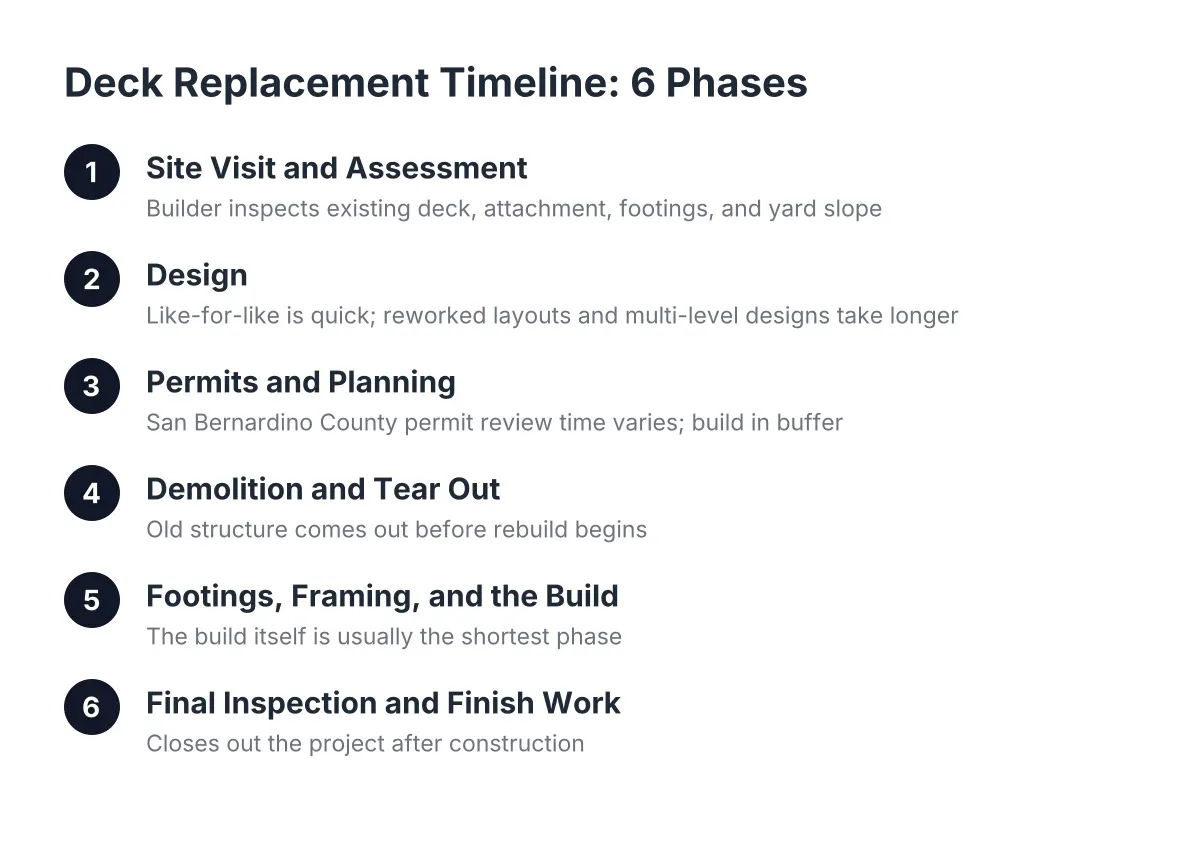
Before comparing materials, it helps to know the scope of work a good deck builder delivers on a tear-out and rebuild, because the material is only one line on the invoice. A complete replacement in Ontario, CA typically includes:
- Demolition and haul-away of the old deck, including rotted posts and failed footings
- Site assessment, including grade, drainage, and soil conditions at the footing locations
- Custom deck design sized to your lot, not a stock plan
- Permits and planning through the city, which San Bernardino County jurisdictions require for most attached and elevated decks
- New footings and post installation, engineered for the deck height and soil
- Deck framing, board installation, and deck railing installation
- Stairs, fascia, and finish details
What usually costs extra: structural engineering for tall or multi-level designs, electrical for lighting, built-in benches or planters, and upgrades like hidden fasteners or premium railing. On a sloped lot, expect the footing and framing portion of the quote to be a larger share of the total than your neighbor paid for a flat-yard deck. That is not a builder padding the bill; taller posts, deeper footings, and sometimes an engineer's stamp are what keep an elevated deck standing.
Wood vs. Composite Deck Lifespan: What Each Material Gives You
Lifespan is where the deck wood and composite comparison stops being about taste and starts being about math. In the dry, high-UV climate of the Inland Empire, the two materials age in different ways.
How Long a Wood Deck Lasts in Southern California
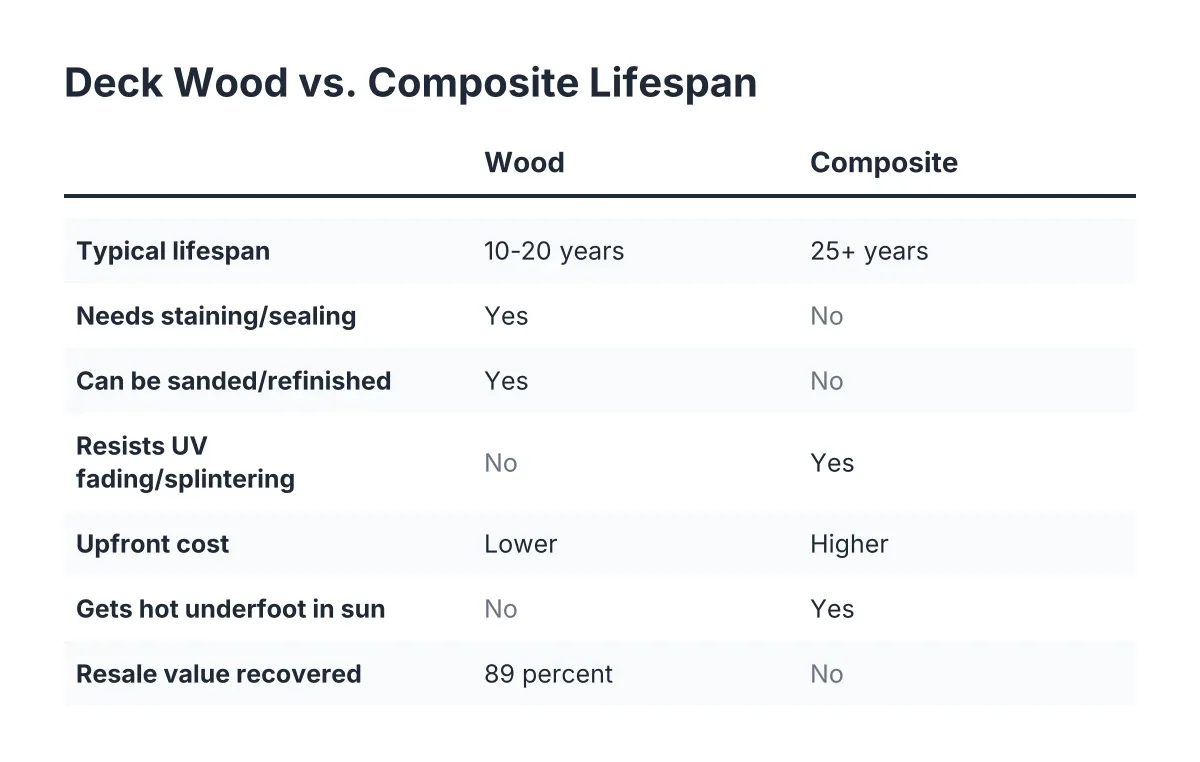
A pressure-treated or redwood deck in Ontario, California commonly serves 10 to 20 years, and the wide range depends almost entirely on maintenance. Wood here rarely rots the way it does in wet climates. Instead, the sun does the damage: boards dry out, crack, cup, and splinter. Deck staining and sealing every one to three years slows that down considerably. Skip it, and a wood deck can look tired within five years and need board replacement within ten.
Wood has real advantages. It costs less upfront, it can be sanded and refinished instead of replaced, and many homeowners simply prefer how real wood looks and feels. There is also a resale argument: according to the National Association of Realtors' 2023 Remodeling Impact Report, homeowners recover 89 percent of the cost of a new wood deck through added home value. That is a strong return for an outdoor project.
How Long Composite Decking Lasts
Quality composite decking typically carries manufacturer warranties of 25 years or more, and the boards themselves resist the exact failure modes that kill wood decks in our climate: UV fading, splintering, and drying out. Composite does not need staining or sealing. Maintenance is a wash-down a couple of times a year.
The trade-offs are honest ones. Composite costs more upfront, and dark composite boards get hot underfoot in direct summer sun, which matters on an exposed south-facing deck in Fontana or Corona. Lighter colors and shade structures help. Composite also cannot be sanded or refinished; a badly scratched or stained board gets replaced, not repaired. And remember that the frame under a composite deck is still wood, so the substructure needs proper flashing and ventilation to match the boards' lifespan.
Comparing Deck Wood and Composite on Total Cost, Not Just Day One
The honest way to compare the two materials is cost over the life of the deck, not the first invoice. Upfront, wood wins. Over 20 years, the gap narrows or flips, depending on how disciplined you are about maintenance.
For a verified reference point on the composite side: according to Angi, composite deck materials run $12 to $22 per square foot for materials alone, or $25 to $54 per square foot professionally installed. Wood comes in below that upfront, but it carries recurring costs that composite does not.
Here is where the wood budget grows over time:
- Staining and sealing every one to three years, either your weekend labor and materials or a paid service each cycle
- Deck board replacement as individual boards crack, cup, or splinter, which accelerates after year ten in full sun
- Fastener and railing maintenance, since wood movement loosens screws and rail connections over time
- A possible full resurfacing around the mid-life point if the boards wear out before the frame does
Composite flips that list. You pay more on installation day, then spend almost nothing on upkeep beyond cleaning. For a homeowner who knows they will not keep up with staining, or who is building an elevated deck where refinishing work means ladders and scaffolding, composite usually pencils out as the cheaper material over the deck's life. For a homeowner who enjoys the maintenance ritual and wants the lowest entry cost on an $8,000 to $15,000 project budget, wood remains a sound choice. Neither answer is wrong; the mistake is comparing only the first number.
One more cost note for 2026 planning: composite demand keeps climbing. Grand View Research valued the global composite railing and decking market at $4.7 billion in 2025, projected to reach $12.6 billion by 2033. Rising demand generally means more product options and color lines each year, so if you priced composite several years ago and walked away, the selection is worth a second look.
Fixing Design Flaws During the Rebuild, Especially on Sloped Lots
This section is for the homeowner whose yard refuses to cooperate. Suppose you bought a house in the Ontario or Upland foothill areas with a backyard that drops four feet from the door to the fence line. The original deck was a small flat platform perched awkwardly at the top of the slope, with the rest of the yard unusable. When that deck fails, replacing it like-for-like would repeat the original mistake.
A teardown lets you redesign for the terrain instead of around it. Common upgrades during a replacement on a sloped or elevated lot include:
- Going multi-level. A multi-level deck steps down the grade in two or three platforms connected by short stair runs, turning a slope into tiered outdoor living space instead of fighting it.
- Raising the deck to meet the house. If your door sits a step or two above the old deck, the rebuild can bring the surface flush with the threshold, which is a safety fix as much as a comfort one.
- Upsizing the footprint. Upgrading deck size during replacement is cheaper per square foot than adding on later, because the crew, equipment, and permit process are already in motion.
- Switching from attached to freestanding, or the reverse. Some sloped lots are better served by a freestanding deck on its own footings; others benefit from attaching to the house with a properly flashed ledger.
- Rethinking the railing. Wood deck framing with composite railing is a common hybrid, and cable or slim-profile railing can open up a view the old bulky railing blocked.
Material choice interacts with these design decisions. On an elevated or multi-level build, composite decking reduces the long-term maintenance burden in places that are hard to reach, and composite railing eliminates the repainting that elevated wood railing demands. If the budget forces a choice, many homeowners put composite on the walking surface and railing where sun and wear concentrate, and keep pressure-treated lumber in the frame where it belongs anyway.
In that hypothetical sloped-yard scenario, say the homeowner replaces a failing 200-square-foot wood platform with a 350-square-foot two-level composite deck. The project costs more than the original deck did, but it converts a dead slope into the main living space of the backyard. That is the kind of outcome a like-for-like swap never delivers.
Permits, Footings, and Inland Empire Site Conditions
Deck replacement permit requirements catch homeowners off guard, because many assume replacing an existing deck is exempt. In most cases it is not. A full tear-out and rebuild is treated as new construction in Ontario, California and surrounding San Bernardino County and Riverside County jurisdictions, which means plans, a permit, and inspections of the footings and framing before boards go down.
This is a feature, not a hurdle. The inspection process is what catches the shortcuts that doomed the old deck: undersized footings, an unflashed ledger board, or posts resting on dirt. On elevated and multi-level decks, the permit process may also require engineering for the post and beam sizing. A deck builder who handles deck permits and planning as part of the job saves you weeks of back-and-forth with the city.
Local conditions shape the structural work too. Inland Empire soils vary from lot to lot, and a sloped yard concentrates load on the downhill footings. Proper deck footing and post installation on a grade means digging to stable soil and sizing footings for the actual height of the structure, not copying whatever the old deck had. This is the part of the project where cutting cost creates the next failing deck.
When to Handle It Yourself and When to Call a Deck Builder
A capable homeowner can safely handle some of this project. Demolition of a low, ground-level deck is realistic DIY work if you are careful about hidden fasteners and disposal. Ongoing maintenance, like staining a wood deck or replacing a single cracked board, is also fair game.
However, the rebuild itself belongs with a licensed deck builder in most replacement scenarios, and in some it is not optional. Call a professional when any of these apply:
- The deck is elevated more than a step or two off grade, or attaches to the house at a second story
- Your yard slopes enough that post heights differ noticeably across the frame
- The old deck failed structurally, with sinking footings, a pulled ledger, or wobbling posts
- The design is multi-level or needs engineering
- The project requires a permit, which covers nearly all full replacements
Warning signs that mean call now rather than plan for next season: movement or sway when people walk on the deck, a ledger board pulling away from the house, posts that have shifted or sunk, or soft spots in the framing rather than just the boards. Those are structural failures, and an elevated deck with any of them should come out of service until a professional looks at it.
How to Choose a Deck Builder for a Replacement in Ontario, CA
Searching for deck installation near me will surface plenty of names across the Inland Empire. For a replacement on a tricky lot, three questions separate the builders who fit your project from the ones who do not.
First, ask about sloped and elevated work specifically. Have they built multi-level decks, and can they show photos of footing and framing work on a grade? A builder who only does flat, ground-level platforms will either decline your project or underprice it and improvise, and improvised footings on a slope are how decks fail.
Second, ask who pulls the permit. The right answer is the builder, as part of the job, with inspections scheduled into the timeline. A quote that stays vague about permits is a quote that assumes you will skip them.
Third, ask for the deck wood and composite comparison priced both ways for your actual design. A fair quote separates demolition, footings and framing, decking, railing, and permits as line items, so you can see exactly what switching materials changes. If the only number on the page is a lump sum, you cannot make an informed material decision.
On timeline, be wary of anyone quoting exact durations before seeing your site. A full replacement runs longer than a simple board swap because it includes demolition, permit review, footing inspections, and framing inspections, and elevated or multi-level designs add engineering time up front. A builder who walks your yard first will give you a schedule worth trusting.
Making the Call on Your Replacement
The decision comes down to an honest look at your own habits and your lot. Choose wood if upfront cost drives the budget, you will keep up with staining and sealing, and you value the look and resale math of real lumber. Choose composite if you want the deck to stay low-maintenance for decades, the design is elevated or hard to reach, or you know the staining schedule will slip. Either way, treat the teardown as your one chance to fix the layout, raise the deck to your door, step it down your slope, and build the outdoor living space the original deck never was.
If you are in Ontario, Rancho Cucamonga, Fontana, Corona, Riverside, Chino, or Upland and your deck is at the end of its life, talk to a local deck builder who works on sloped and elevated lots every week. Walk the yard together, price the design in both wood and composite, and get a free quote that shows the full scope: demolition, footings, framing, decking, railing, and permits. That conversation is where a replacement stops being a swap and starts being an upgrade.
If you need custom deck design, Inland Empire Decks can help.
Prefer to talk it through? Call (909) 298-8578 — a quick call is usually the fastest way to get a straight answer for your situation.