Is My Deck Safe? A Builder’s Deck Inspection Checklist for Real Warning Signs
If your deck has soft boards, a railing that wiggles, or rusty hardware you keep meaning to look at, this deck inspection checklist is for you. It comes from the way a deck builder actually walks a deck here in Ontario, California, not from a generic template. Work through the steps below and you will know whether you have a maintenance issue, a repair job, or a hazard that needs professional attention before anyone stands on that deck again.
Here is the honest truth most homeowners never hear: decks do not usually fail at the boards you can see. They fail at the connections you cannot. According to the North American Deck and Railing Association (NADRA), an estimated 30 million decks in the U.S. are past their useful life and need replacement or repair. A study using CPSC injury surveillance data, cited by Legacy Services LLC, found 224,000 people were injured due to a deck or porch over a five-year period, with 33,000 of those injuries caused by structural failure or collapse. Those collapses almost never start with a bad deck board. They start where the deck attaches to the house.
So this checklist works from most dangerous to least dangerous. Follow the steps in order.
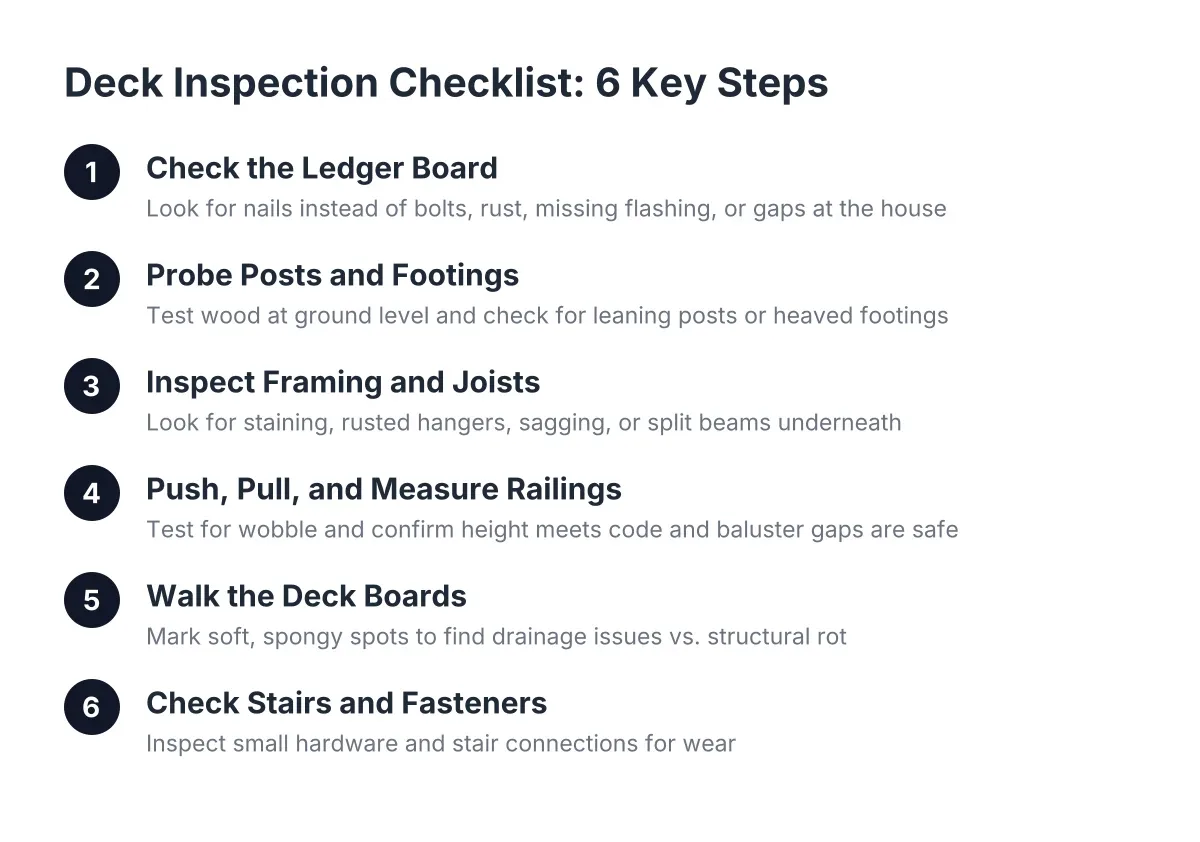
Step 1: Check the Ledger Board Before Anything Else
Start where the deck meets your house. The ledger board is the long horizontal board bolted to the home, and it carries a huge share of the deck's weight. When an attached deck collapses, ledger failure is the usual cause.
Get underneath the deck if you can, or look along the seam between deck and house. You are looking for these deck ledger board failure signs:
- Nails instead of bolts. A ledger fastened with only nails is a known failure pattern. You should see hex-head lag screws or through-bolts in a regular pattern.
- Rust streaks or corroded fasteners along the ledger.
- No visible flashing, or water stains and rot on the house siding just above the ledger.
- A gap opening up between the ledger and the house, even a small one.
- Soft, dark, or crumbling wood when you press the ledger with a screwdriver tip.
If you find any of these, stop loading the deck with people and furniture until a professional looks at it. This is the one item on the whole deck inspection checklist where I would tell a neighbor over the fence: do not host the party first and fix it after.
Step 2: Probe the Posts and Footings at Ground Level
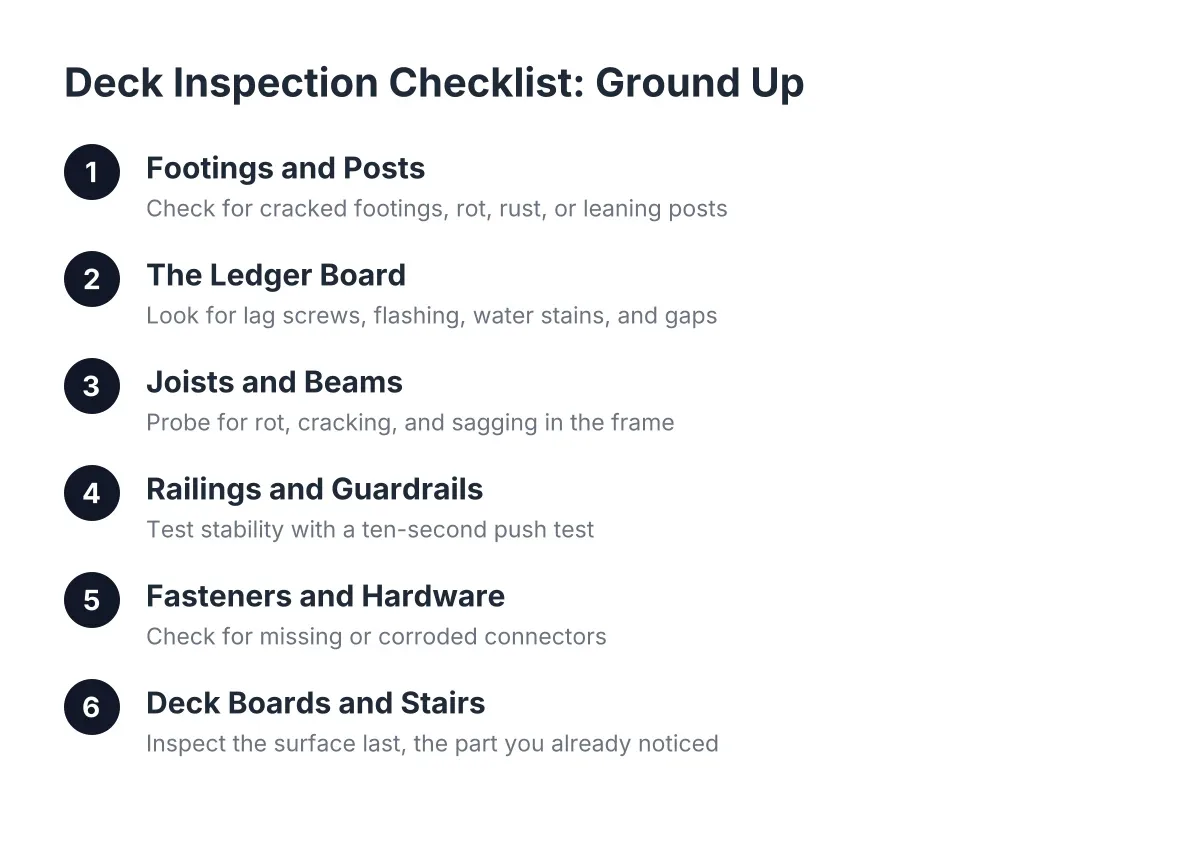
Next, move to the posts that hold the deck up. Wood rots fastest where it meets soil, concrete, or standing water, so the bottom six inches of each post matter more than the rest.
Take a flathead screwdriver and push the tip into each post near the base. Sound wood resists you. Rotten wood lets the tip sink in with light pressure, and that spongy feel is the same failure you notice in soft deck boards, just in a spot that holds up the whole structure.
While you are down there, check the footings. Posts should sit on concrete footings with a metal post base, not directly in dirt or on loose pavers. In addition, look for posts that lean, footings that have heaved or sunk, and soil washed out around the base. Here in the Inland Empire our clay-heavy soils can shift with wet winters and long dry summers, so a footing that was level 20 years ago may not be level now.
Step 3: Deck Inspection Checklist for Framing and Joists
Now look up at the underside of the deck, the framing that the boards sit on. This is where a deck framing inspection separates a cosmetic problem from a structural one. Boards can be replaced in an afternoon; rotted joists cannot.
Look and probe for:
- Dark staining or fungal growth on joists, especially near the ends.
- Joist hangers that are rusted, missing nails, or pulling away from the beam.
- Sagging or bouncy sections you can see from below when someone walks above.
- Beams with splits running through the middle, deeper than surface checking.
- Any framing member you can dent with a screwdriver.
Rust matters more than people think. Deck hardware in Southern California does not face road salt, but decades of irrigation overspray and morning moisture still eat through connectors. A joist hanger that has lost half its metal has lost more than half its strength.
Step 4: Push, Pull, and Measure Every Railing
Railings are the most common failure point that actually injures someone, because people lean on them without thinking. Grab each railing section and push outward hard, the way a guest might stumble into it. Any wobble, flex, or movement at the post base fails this step.
Then measure. As of 2026, the California Building Code requires a minimum guardrail height of 42 inches for most residential decks more than 30 inches off the ground, according to the California Building Standards Commission. Many older wood decks around Ontario, Rancho Cucamonga, and Upland were built to shorter heights decades ago. A railing can be solid and still be too short to stop a fall.
Also check the balusters, the vertical pickets. Gaps wide enough for a small child to slip through are a hazard on any elevated deck, and loose or missing balusters mean the railing needs deck repair even if the top rail feels firm.
Step 5: Walk the Deck Boards and Map the Soft Spots
Now the part you have probably already done, but do it with a system this time. Walk the entire surface slowly and mark every spot that feels soft, spongy, or springy with chalk or painter's tape. One soft board near a planter is a drainage problem and a board replacement. A cluster of soft boards over one area usually means the joist underneath is rotting too, and that changes the job from resurfacing to structural repair.
For example, suppose a homeowner in Fontana finds three spongy boards in a row along the shaded north edge of a 20-year-old wood deck. If the framing under those boards probes solid, that could be a modest deck board replacement, often a few hundred dollars in materials as a rough illustrative range. However, if the screwdriver sinks into the joist below, the fix now involves framing, and the repair-versus-replace math starts to look different.
While you walk, note cupped or badly cracked boards, popped nails, and screws standing proud of the surface. These are trip hazards and maintenance items rather than emergencies, but they belong on your deck inspection checklist.
Step 6: Check Stairs, Fasteners, and the Small Stuff
Stairs concentrate weight and take the most abuse. Check that stringers, the sawtooth boards on each side, are solid at top and bottom, that treads do not flex, and that any stair railing holds firm under a hard pull. In addition, confirm the bottom of the stairs lands on something solid rather than bare dirt.
Then do a fastener sweep across the whole deck. Widespread rusted screws, corroded nails, and stained hardware suggest the original fasteners were not rated for outdoor use, which is common on older decks. That is a fixable problem, but it needs to be fixed everywhere, not just where it shows.
Step 7: Score Your Results and Decide What Happens Next
Finally, tally what you found. Here is how a builder reads the results of this deck safety checklist:
- Ledger, post, or footing problems: stop using the deck and get a professional evaluation. These are the failures that drop decks.
- Wobbly railings or rusted structural hardware: restrict use, keep kids and crowds off, and schedule deck repair soon.
- Soft boards over solid framing: a repair or deck resurfacing candidate. The structure has life left.
- Only cosmetic issues, faded finish, minor cracks: you need staining and sealing and a regular deck maintenance checklist, not construction.
How often should a deck be inspected? Walk through this checklist once a year, and always before a season of heavy use. NADRA estimates that about half of the roughly 50 million decks in the U.S. are more than 25 years old, so if yours falls in that group, an annual check is the minimum.
One honest limitation: this self-check tells you whether a problem exists, not always how deep it runs. Rot travels inside framing where no screwdriver reaches, and repair-versus-replace decisions on a 15- or 20-year-old deck depend on how much sound structure remains. A professional deck safety inspection can open up the areas you flagged and give you a straight answer on whether the deck is worth saving. If you have gotten conflicting opinions before, one contractor saying it is fine and another calling it a hazard, bring your marked-up checklist to the conversation. A builder who has to respond to specific findings, this joist, that ledger bolt, this railing measurement, has a much harder time waving the problems away or inflating them.
Your deck should be the easiest place in your home to relax. Work the list, know what you are standing on, and fix the real problems before the next family gathering, not after.
If you need custom deck design, Inland Empire Decks can help.
Prefer to talk it through? Call (909) 298-8578 — a quick call is usually the fastest way to get a straight answer for your situation.