What Causes Wood Deck Damage in the Inland Empire and How to Prevent It
If you are searching for deck restoration near me in Ontario, California, chances are your deck is already showing signs of trouble: gray, splintering boards, a railing that shifts when you lean on it, or a soft spot near the stairs. Here is the honest truth from a builder who does both repair and replacement, so there is no incentive to steer you toward the bigger job. Most wood deck damage in the Inland Empire follows a predictable pattern, and if you catch it early, restoration is usually the smarter spend. This guide walks you through how to diagnose what is wrong, fix what you can, and know when the problem has moved past a repair.
The scale of the issue is bigger than most homeowners realize. According to North American Deck and Railing Association (NADRA), about 50 percent of the roughly 50 million residential and commercial decks in the U.S. are more than 25 years old. In a climate like ours in San Bernardino County, intense UV exposure does much of that aging. Follow these steps in order, because each one builds on the last.
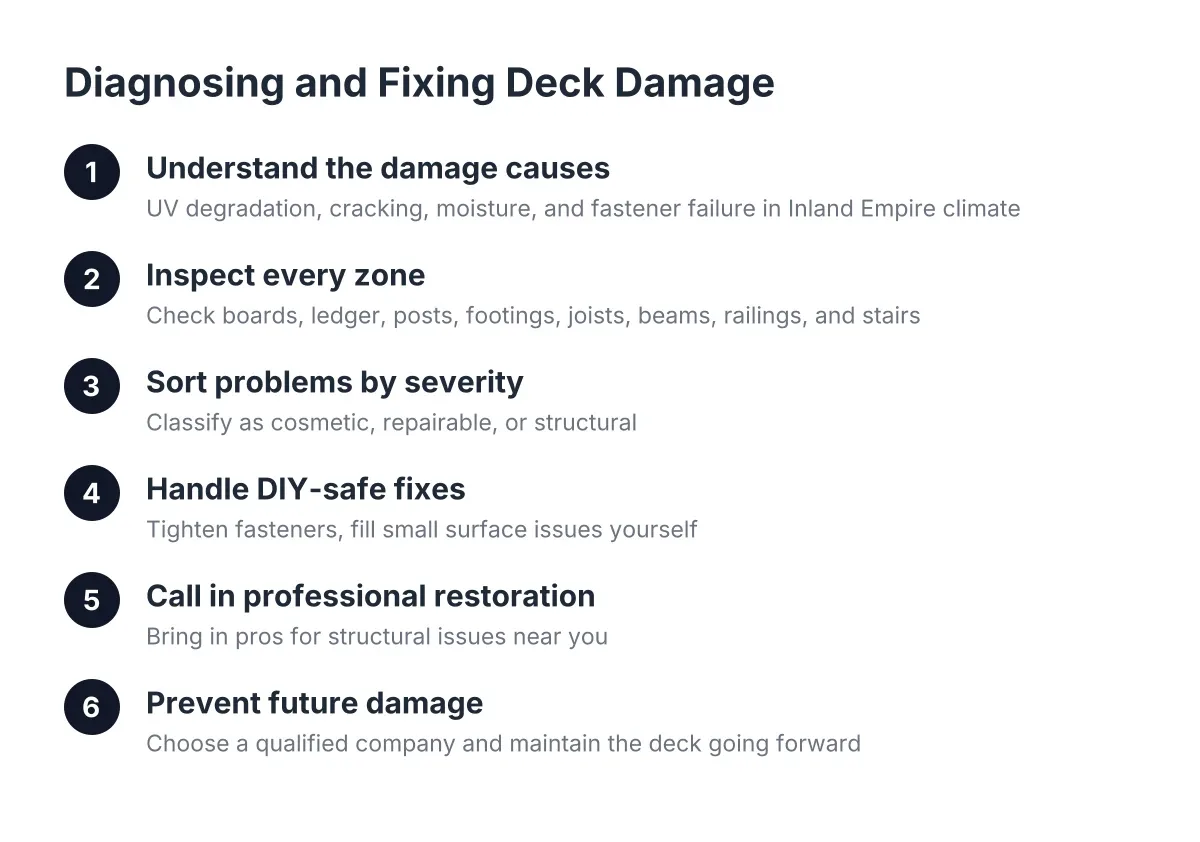
Step 1: Understand What Actually Damages Decks in Ontario, CA
Before you fix anything, know what you are fighting. Inland Empire decks do not fail the way decks fail in wet climates. Here, the sun is the main enemy, not constant rain.
The typical damage cycle in Southern California looks like this:
- UV degradation. Months of direct sun break down the lignin in wood, turning boards gray and brittle. Dry, brittle wood cracks and splinters.
- Cracking and checking. Once the surface cracks, the wood loses its protective skin. Every crack becomes a channel for water.
- Concentrated moisture damage. Winter rain, sprinkler overspray, and shaded corners drive water into those cracks. Rot starts where water sits: board ends, post bases, stair stringers, and the ledger board against the house.
- Fastener failure. Heat cycles make wood expand and contract, which loosens nails and screws over time. Loose fasteners are why railings wobble and boards squeak.
Elevated and multi-level decks, common on sloped lots around Ontario, Rancho Cucamonga, and Upland, add one more failure point: the posts and footings carrying the load. On a hillside lot, water running downslope can pool against post bases and undermine footings. If your yard slopes, pay extra attention in the steps below to anything structural.
Step 2: Walk the Deck and Inspect Every Zone
Set aside an hour and inspect methodically. Bring a flathead screwdriver, a flashlight, and your phone for photos. Work through these zones in order:
- Deck boards. Look for cupping, deep cracks, and gray splintering. Press the screwdriver into any dark or discolored spot. If it sinks in more than a quarter inch with light pressure, that is wood rot, not just weathering.
- Ledger board. This is the board bolting the deck to your house, and it is the most common point of catastrophic failure. Check for rusted bolts, gaps, and rot where the deck meets the siding.
- Posts and footings. Probe each post at ground level. Rot almost always starts at the bottom, where the post meets concrete or soil. On elevated decks, check that posts sit plumb and footings have not shifted or cracked.
- Joists and beams. Get underneath if you can. Shine the flashlight along each joist looking for dark staining, fungus, or sagging.
- Railings and stairs. Push hard on every railing section. Any movement means loose fasteners or rotted connection points. Stairs take the most abuse on multi-level decks, so probe every stringer.
Take photos of everything questionable. You will need them whether you do the work yourself or bring in a deck repair pro.
This inspection matters for safety, not just budgeting. A study using CPSC injury surveillance data found 224,000 people nationally were injured due to a deck or porch over a five-year period, with 33,000 of those injuries resulting from structural failure or collapse, according to Legacy Services LLC.
Step 3: Sort Problems Into Cosmetic, Repairable, and Structural
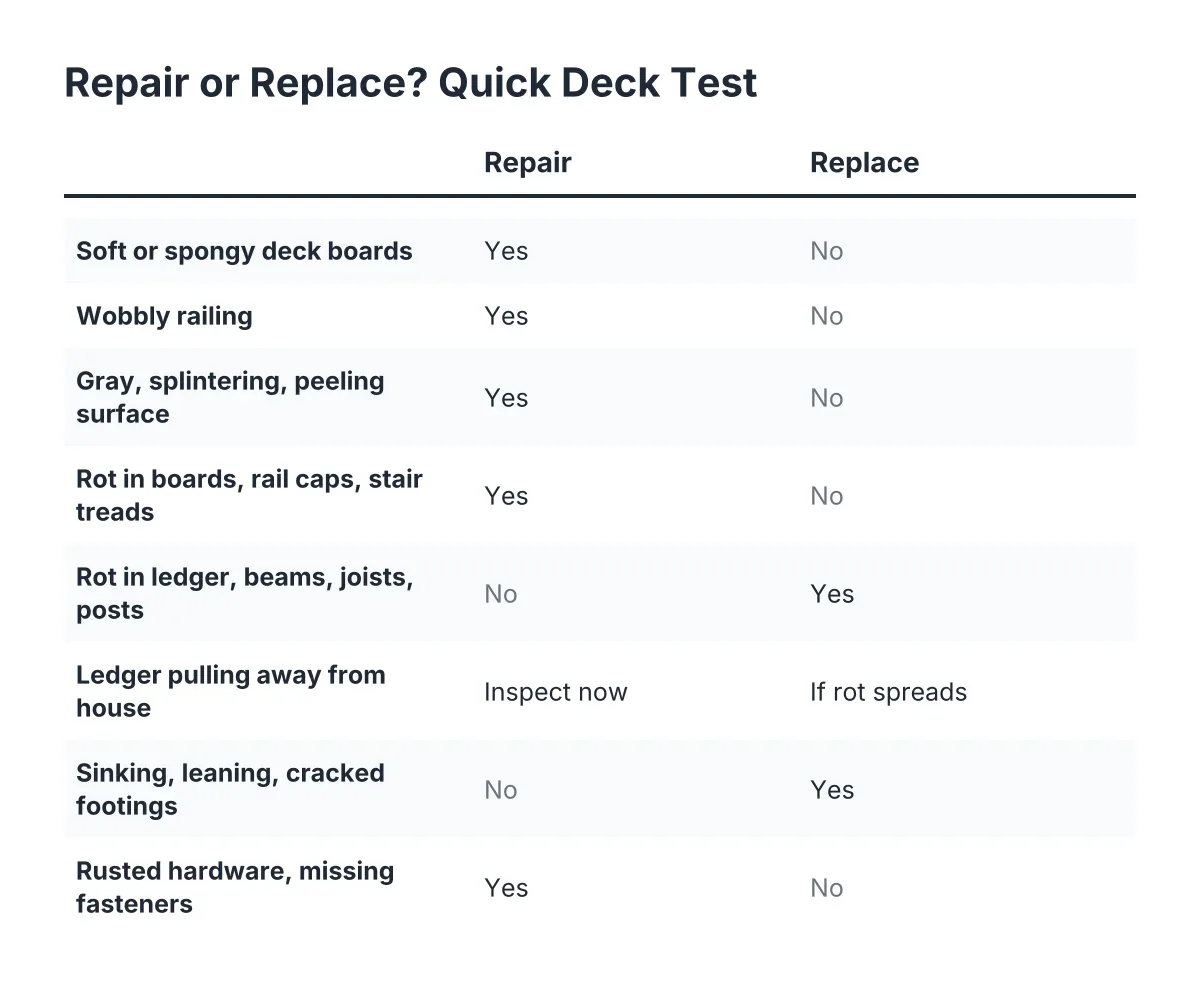
Now sort your findings into three buckets. This is where an honest repair-vs-replace call gets made, and where a builder who profits either way will tell you the same thing: the bucket determines the fix, not the sales pitch.
Cosmetic: graying, surface splinters, faded stain, minor checking. These are candidates for cleaning, sanding, and refinishing. No pro required for most of it.
Repairable: a handful of rotted or cracked boards, wobbly railing sections, loose fasteners, one soft stair tread. Deck board replacement and railing repair handle these without touching the frame.
Structural: rot in the ledger, posts, beams, or joists; shifted footings; a deck that bounces or leans. These need a professional deck structural inspection before anyone starts pulling boards. NADRA estimates that of the more than 60 million decks in the U.S., about 30 million are past their useful life and need replacement or repair. If your frame is in that group, resurfacing over it wastes money.
A useful rule of thumb: if the frame is sound, restore. If more than a few framing members are compromised, price a deck replacement before sinking money into repairs that sit on a failing structure.
Step 4: Handle the DIY-Safe Fixes First
Several fixes are within reach for a capable homeowner, and doing them yourself frees up budget for the work that genuinely needs a pro.
Tighten and replace fasteners. Drive loose screws snug, and replace popped nails with exterior-grade deck screws slightly longer than the originals. This alone fixes many wobbly railings.
Fill small surface damage. For minor gouges and checks in boards you plan to paint, an exterior wood filler such as Bondo wood filler sands smooth and holds up outdoors. However, filler is a cosmetic patch only. Never use it on rot, on structural members, or as a fix for a soft board.
Replace individual boards. If a board is rotted but the joists under it probe solid, unscrew it, cut a matching pressure-treated or matching-species board, and fasten it down. Seal the cut ends.
Clean and refinish. Wash the deck, let it dry fully, sand splintered areas, and apply a penetrating stain with UV protection. In our sun, a penetrating semi-transparent stain usually outlasts film-forming coatings; even the best deck paint tends to peel on horizontal boards that take full Inland Empire sun. Plan on recoating every two to three years as a general maintenance rhythm.
Step 5: Professional Deck Restoration Services Near Me
Professional deck restoration is the right call when the damage involves structure, height, or the house connection. Anything touching the ledger board, footings, posts, beams, or an elevated frame belongs with a licensed deck builder, because a mistake there risks collapse rather than a cosmetic flaw. Searching for deck restoration near me makes sense once your inspection turns up problems in those areas.
Call a pro now, not later, if you find any of these:
- The ledger board shows rot, rust, or gaps where it meets the house
- Any post is soft at the base or out of plumb
- The deck bounces, sways, or has visibly sagged
- Footings are cracked, heaved, or exposed by erosion on a sloped yard
- Your deck is elevated or multi-level and any framing member looks compromised
Suppose a homeowner in Rancho Cucamonga has a second-story deck off the main floor of a hillside home. The boards look tired but fine. Underneath, one support post has gone soft at the footing because downslope runoff pooled there every winter. In that scenario, a resurfacing quote from a company that never crawled underneath would miss the one problem that actually matters. That is why a structural inspection comes before any restoration estimate on an elevated deck.
There is also a permit question. Repairs that replace structural members, change the footprint, or rebuild an elevated frame often need a permit in San Bernardino County and Riverside County jurisdictions. As a general national benchmark, HomeAdvisor puts a deck building permit between $230 and $500 depending on location. A good local builder handles deck permits and planning as part of the job; if a contractor tells you no permit is ever needed for structural work, treat that as a red flag.
Step 6: Choose the Right Deck Restoration Company Near You
When you compare providers, scope matters more than price. A complete restoration quote in 2026 should spell out what is included: structural inspection, deck board replacement, fastener replacement, railing repair or deck railing installation, sanding, and staining and sealing. Items usually priced separately include framing repairs found after boards come up, footing work, and full deck resurfacing with composite decking.
Ask every candidate three questions:
- Will you inspect the framing and footings before quoting, not just the surface? On sloped and elevated decks around Ontario, Fontana, Corona, and Chino, this is non-negotiable.
- Do you do both deck repair and deck replacement? A company that only replaces decks has one answer for every problem. A builder who does both can price the repair against the replacement honestly and show you the math.
- Have you built on sloped or multi-level lots? If your yard is not flat, you want someone with deck footing and post installation experience on grade, not a crew that only knows ground-level platforms.
A fair quote lists materials, labor, and permit responsibility separately, and it explains what happens if hidden rot turns up mid-job. Vague one-line quotes lead to change-order surprises.
Step 7: Prevent the Next Round of Damage
Restoration only pays off if you protect the result. Inland Empire prevention is mostly about sun and sprinklers:
- Reapply UV-protective stain or sealer every two to three years, before the finish visibly fails
- Redirect sprinkler heads so they never hit deck posts or boards
- Keep planters, doormats, and furniture legs from trapping moisture on boards
- Sweep debris out of board gaps each season so water drains instead of sitting
- On sloped lots, keep drainage moving away from footings, and check post bases every spring
- Walk the full inspection from Step 2 once a year
Prevention is also where the money argument lands. The National Association of Realtors' 2023 Remodeling Impact Report found homeowners recover 89% of the cost of a new wood deck through added home value, and a well-maintained deck holds that value while a neglected one becomes a liability at sale time.
Get an Honest Assessment Before You Decide
Most weathered Inland Empire decks can be restored for a fraction of replacement cost, but only if the frame underneath is sound. Do the inspection, sort the problems honestly, handle the cosmetic fixes yourself, and bring in a professional for anything structural. One limitation worth stating plainly: no article can substitute for eyes on your specific deck, especially an elevated or multi-level build on a sloped lot, where load paths and footing conditions vary house to house.
If you are in Ontario, California or the surrounding Inland Empire, including Rancho Cucamonga, Fontana, Corona, Riverside, Chino, and Upland, reach out to a local deck builder for a structural inspection and a free quote. Ask for the repair number and the replacement number side by side. When the builder profits either way, you get the honest answer, and your deck gets the fix it actually needs.
If you need custom deck design, Inland Empire Decks can help.
Prefer to talk it through? Call (909) 298-8578 — a quick call is usually the fastest way to get a straight answer for your situation.