Signs Your Deck Needs Repair vs. Full Replacement in Ontario, CA
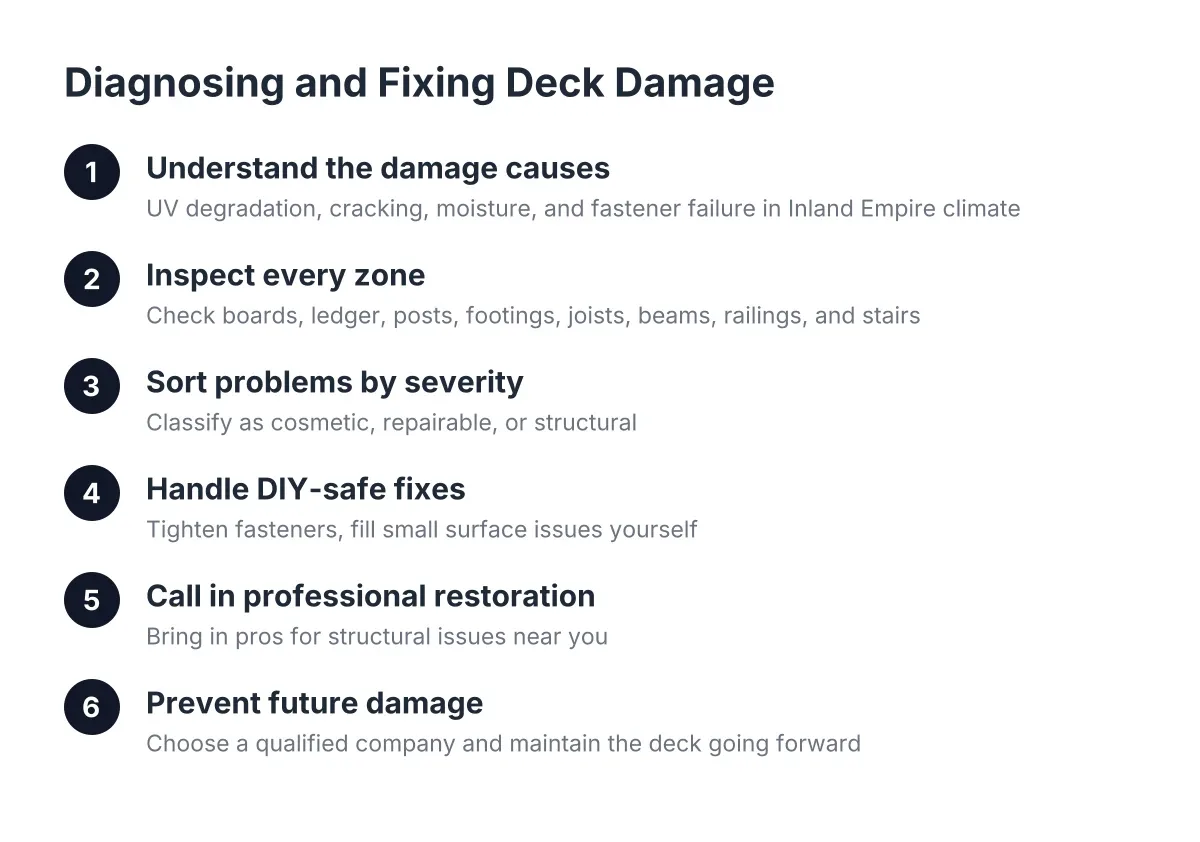
A deck builder makes money whether you repair your deck or replace it—decisions that frame the question of repair vs. replace deck—and that gives us no reason to push you toward the bigger job, so here is the honest version: most of the signs your deck needs attention point to a fix, not a teardown. A soft board is a repair. A rotted post buried in bad concrete is a different conversation. The trick is knowing which problem you are looking at, and that is what this list covers, written from the perspective of a deck repair and deck building crew working in Ontario, California and the surrounding Inland Empire.
The stakes are not small. According to the North American Deck and Railing Association (NADRA), about 50 percent of the roughly 50 million decks in the U.S. are more than 25 years old. That is a lot of aging structures in Southern California backyards. So walk through these eight signs, and by the end you should know whether you are shopping for deck repair, deck resurfacing, or a full deck replacement.
1. Soft or Spongy Boards Underfoot: Almost Always a Repair
If a deck board flexes or feels spongy when you step on it, that single board is failing, not the whole deck. Deck board replacement is one of the most common and least expensive jobs we do; a crew pulls the bad boards, checks the joists underneath, and installs new material. As long as the framing below is dry and solid, this is a repair, full stop.
The one caveat: soft boards clustered in one area, like around a planter or where a downspout dumps water, can mean the joists underneath took on moisture too. Have someone probe the framing before assuming a surface fix solves it.
2. A Wobbly Railing: Repair It This Week, Not Someday
A loose deck railing is the sign homeowners ignore longest and the one that hurts people fastest. A study using CPSC injury surveillance data found 224,000 people were injured due to a deck or porch over a five-year period, with 33,000 of those injuries tied to structural failure or collapse, according to Legacy Services LLC. Railings are where many of those failures start.
The good news is that fixing a wobbly deck railing is usually straightforward: new blocking, proper bolts instead of stripped screws, or replacing a rotted post base. This matters double if your deck is elevated. On a second-story or hillside deck in a sloped Ontario, CA backyard, the railing is not decorative, it is the thing standing between your kid and a ten-foot drop.
3. Gray, Splintering, or Peeling Surfaces: Restore, Do Not Replace
Faded gray wood, splinters, and flaking deck paint look alarming but are cosmetic. Southern California sun is brutal on horizontal wood surfaces, and an Inland Empire deck that has gone five or more years without staining and sealing will look far worse than it actually is. You can restore a deck like this with sanding, board replacement where needed, and a fresh stain and seal.
This is the sweet spot for home sellers. Suppose a homeowner in Rancho Cucamonga is listing in eight weeks and the agent flags a tired-looking deck. In that scenario, resurfacing and sealing costs a fraction of replacement, can typically be done in days rather than weeks, and changes the first impression of the entire backyard. The National Association of Realtors' 2023 Remodeling Impact Report found homeowners recover 89% of the cost of a new wood deck through added home value, and cosmetic restoration on a structurally sound deck captures much of that appeal for far less money.
4. Deciding When to Repair or Replace Your Deck: Wood Rot in Boards vs. Framing
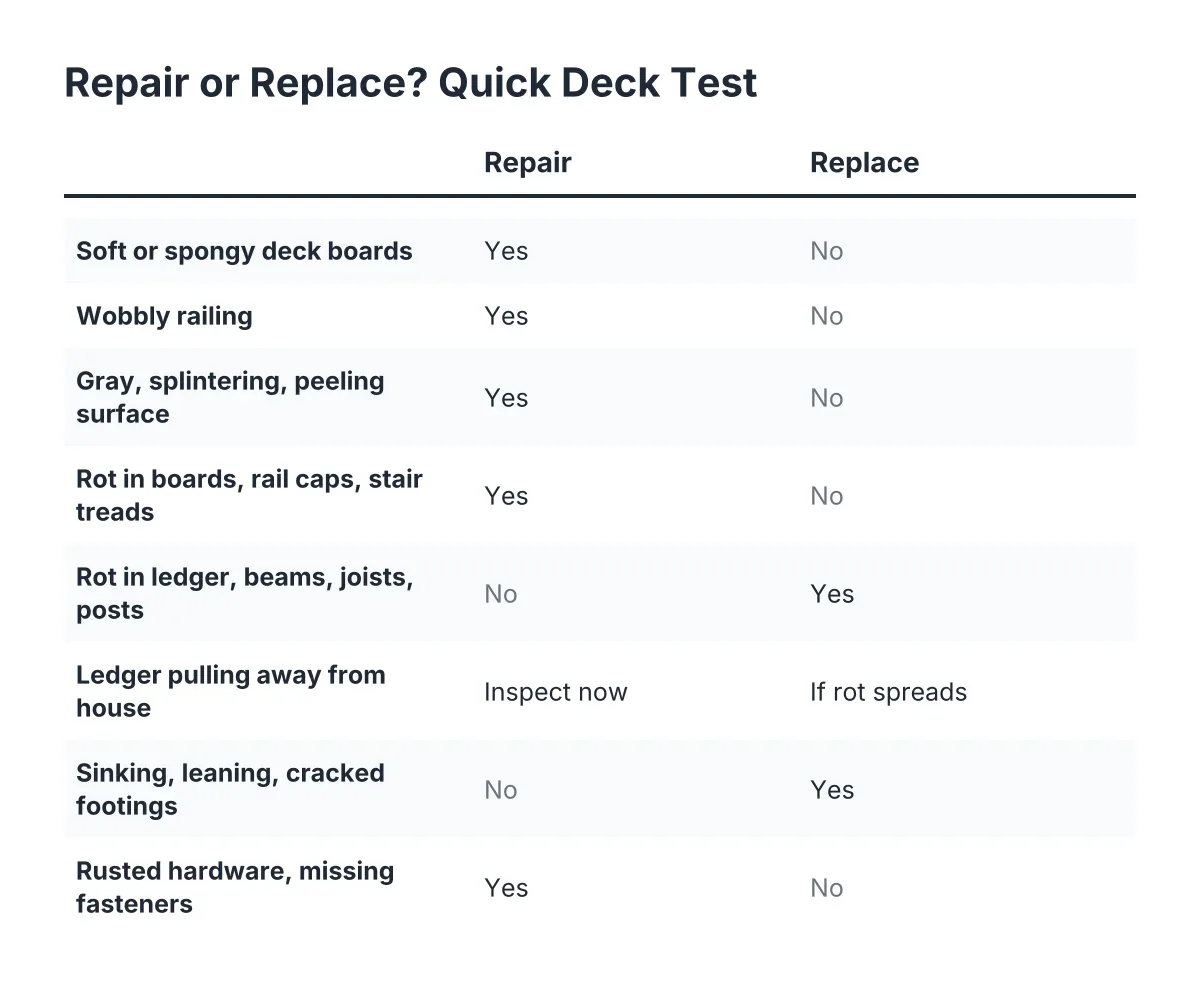
This is the single most important distinction in the repair-vs-replace question. Rot in deck boards, rail caps, or stair treads is replaceable piece by piece. Rot in the ledger board, beams, joists, or support posts is structural, and once it spreads through the framing, you are patching a skeleton that keeps failing somewhere new.
Homeowners often ask how to repair rotting wood without replacing it, and for small surface spots, epoxy wood fillers and hardeners exist. Be honest with yourself about their limits, though. Filler is fine on a decorative rail cap; it has no business in a joist or a post that carries load. If a screwdriver sinks into framing lumber with light pressure, that member needs replacement, not filler.
Here is a quick way to sort what you find:
- Repairable: rotted deck boards, stair treads, rail caps, individual balusters, one isolated joist end
- Judgment call: two or three rotted joists, a damaged beam section, rot at the base of one post
- Replacement territory: a rotted ledger board, widespread joist rot, multiple failing posts, or footings that have shifted
5. The Ledger Board Is Pulling Away From the House: Get a Professional Look Now
The ledger is the board that attaches your deck to the house, and ledger failure is the leading cause of full deck collapse. If you can see a gap opening between the deck and the house wall, or the deck feels like it tilts away from the home, stop using the deck and get a deck structural inspection. This is not a wait-and-see item.
Sometimes the fix is real but contained: new lag bolts or structural screws, proper flashing to stop the water intrusion that caused the problem, and repair of the rim area. However, if water has been running behind an unflashed ledger for years, the rot often extends into the house rim joist itself. That is when repair estimates climb and replacement with correct attachment starts making financial sense.
6. Sinking, Leaning, or Cracked Footings: Common on Sloped Inland Empire Lots
If your deck slopes when it used to sit level, or a support post is drifting off its concrete pad, the problem is below ground. Footings that were poured too shallow, set on fill dirt, or sized wrong for the load will move over time. On the sloped and hillside lots common around Ontario, Upland, and Corona, undersized footings are the most frequent original sin we find on older elevated decks.
Individual footings and posts can be replaced; a crew temporarily supports the deck, digs out the failed footing, and pours a new one at proper depth. But if most of the footings are failing, and the framing above has twisted as the deck settled, you are rebuilding the foundation of a compromised structure. On a multi-level or elevated deck, that math usually favors replacement designed correctly for the grade from the start.
What This Means If Your Yard Is Not Flat
Homeowners with sloped backyards often assume any deck problem on their lot means a huge bill. Not true. Elevated deck construction costs more up front than a ground-level platform because of the footing and post work, but repairs on an elevated deck follow the same logic as any other: isolated problems get fixed, systemic problems get rebuilt. A builder experienced with deck footing and post installation on grades can tell you which one you have.
7. Rusted Hardware and Missing Fasteners: Cheap Fix, Big Payoff
Joist hangers, post bases, and bolts are the connective tissue of a deck, and they rust out faster than the wood around them fails. Orange streaks under the deck, hangers with missing nails, or bolts you can turn by hand are all signs your deck needs hardware replacement. This is one of the cheapest structural repairs there is, and it meaningfully extends the life of an otherwise sound deck.
For a home seller, this is also the fix that keeps a buyer's inspector calm. Inspectors look under decks. Fresh, correct hardware on solid framing reads as a maintained home; rusted hangers read as deferred maintenance on everything else too.
8. The Deck Is Simply Old, and Problems Keep Stacking Up
How often do decks need to be replaced? A well-built and maintained wood deck commonly serves 15 to 25 years; composite decking surfaces tend to last longer, though their framing is still wood. NADRA estimates that of the more than 60 million decks in the U.S., about 30 million are past their useful life and need repair or replacement. Age alone does not condemn a deck, but age plus a growing repair list does.
The pattern to watch: you fixed boards two years ago, the railing last spring, and now a joist is soft. When every season brings a new failure, the structure is telling you it is done. At that point, putting more money into deck repair is spending good money on a bad frame, and a deck replacement quote is worth getting even if you hoped to avoid it.
How to Decide: A Straightforward Test for Repair vs Replace Deck
You can repair a deck when the problems are isolated and the framing is sound; you should replace it when the structure itself, the ledger, posts, footings, or most of the joists, has failed. Run your deck through these questions:
- Is the damage in the surface or the skeleton? Boards and railings are surface. Ledger, beams, joists, posts, and footings are skeleton.
- Is the problem in one spot or everywhere? One soft board is a repair. Soft spots across the whole deck suggest systemic moisture damage.
- Is the deck level and firmly attached? Leaning, sagging, or pulling away from the house means structural evaluation before anything else.
- What does the repair list total? As a rough rule of thumb, once repairs approach half the cost of a comparable new deck, replacement usually wins on value, especially if the deck is over 15 years old.
One honest limitation: you cannot fully answer questions one and three from the surface. Framing rot hides under deck boards, and footing depth is invisible without digging. If your deck is elevated, attached to a second story, or built on a slope, have a qualified local builder or inspector look underneath before you commit money in either direction. What looks like a simple board swap from above can be a framing problem below, and what looks like a disaster can turn out to be three boards and some hardware.
The point of this list is not to scare you toward a new deck or talk you out of one. It is to give you the same sorting logic a builder uses on a walkthrough, so when you do get quotes in Ontario, CA, you can tell whether the recommendation matches what your deck is actually showing you.
If you need custom deck design, Inland Empire Decks can help.
Prefer to talk it through? Call (909) 298-8578 — a quick call is usually the fastest way to get a straight answer for your situation.