Deck Staining Cost in Ontario, CA: Labor, Materials, and Timeline Explained
If you own a wood deck in Ontario, California, the Inland Empire sun is slowly cooking it. UV exposure and summer heat dry out wood fibers, open up cracks, and fade stain faster than milder climates. This guide walks you through deck staining services step by step: what the work includes, what drives the cost, how long the job takes, and how to tell when a stain job is the right move versus a deeper repair. By the end, you will know what a fair quote looks like and how to get the longest life out of the work.
One note before we start. This article is written for Ontario, California homeowners in San Bernardino County, not Ontario, Canada. Everything here is tuned to Southern California sun and heat, not snow and ice.
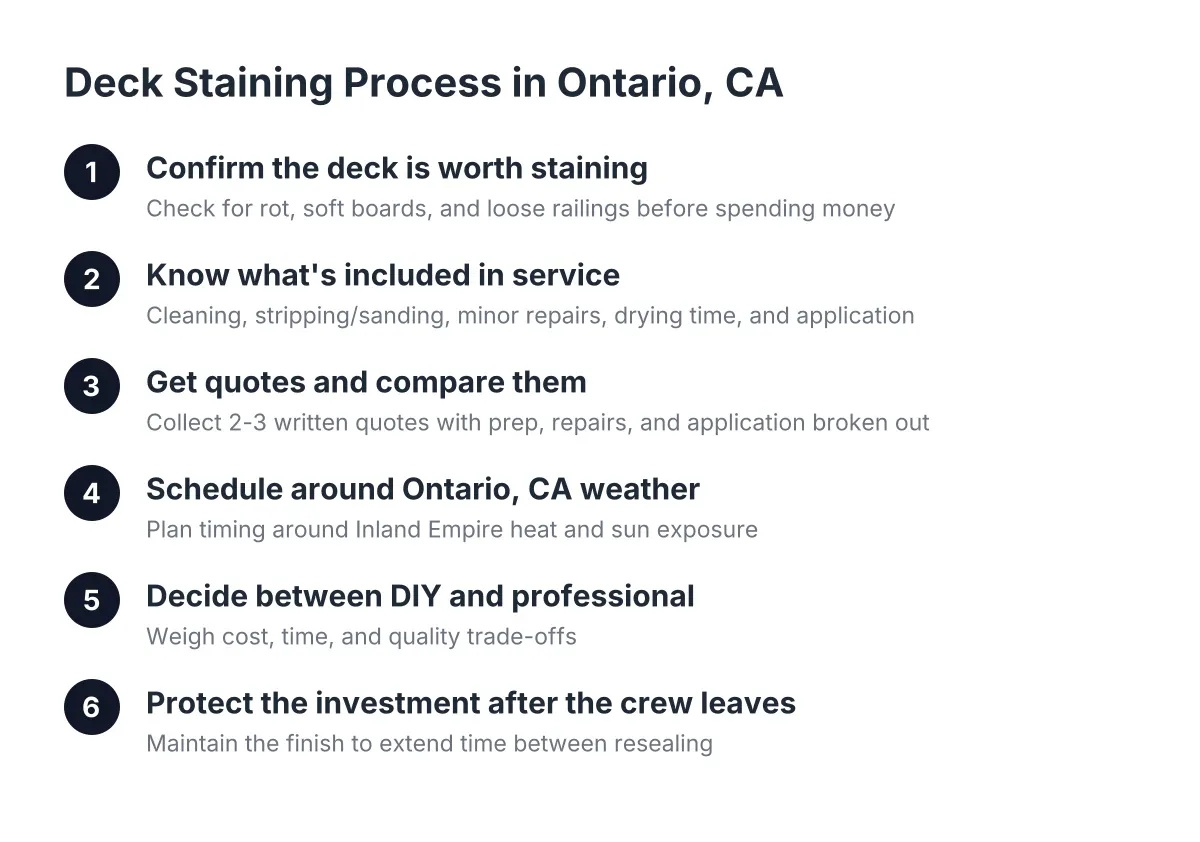
Step 1: Confirm Your Deck Is Worth Staining Before You Spend a Dollar
Staining protects sound wood. It does not fix rotten wood. So the first step is an honest walk-around of the deck before you book anything.
Press a screwdriver into boards near the house, around posts, and anywhere water pools. If the tip sinks in easily or the wood feels soft and spongy underfoot, you have rot, and stain will only hide the problem for a season. Grab each railing section and push. A railing that wiggles is a repair issue, not a finish issue.
Here is the honest trade-off: paying for deck staining services on a deck with structural rot is money spent in the wrong order. Suppose a homeowner in Rancho Cucamonga finds three soft boards and one loose post base during this check. In that scenario, the right sequence is deck board replacement and repair first, then staining and sealing the restored surface. A good local deck builder can handle both in one project, which usually costs less than two separate mobilizations.
If more than about a third of the boards are soft, cupped, or splintering, ask about deck resurfacing or deck replacement instead. It is worth knowing the scale of the alternative: a professionally built new deck averages $30 to $60 per square foot, according to Angi, and the National Association of Realtors' 2023 Remodeling Impact Report found homeowners recover 89% of the cost of a new wood deck through added home value. Staining a sound deck is far cheaper than that, which is exactly why it pays to keep a good deck protected.
Step 2: What's Included in Professional Deck Staining and Sealing Services
A legitimate stain and seal job in the Inland Empire has four parts: cleaning, prep, repair of minor defects, and application. If a quote only covers "spray on stain", you are not comparing the same service.
Here is the full scope a good provider delivers:
- Cleaning. Washing the deck with a deck pressure washer or a cleaner and scrub method to remove dirt, mildew, and failed finish. Pressure must be controlled; too much PSI on soft, sun-dried wood tears up the grain.
- Stripping and sanding. If an old finish is peeling, the crew applies a deck stain stripper or sands the surface so new stain can actually soak in. Stain applied over a failed coat peels within months.
- Minor repairs. Setting popped nails or screws, replacing a handful of split boards, and filling small cracks. Larger deck repair work is usually quoted separately.
- Drying time. Wood must dry fully after washing before stain goes on. In Ontario, CA summer heat that can be a day or two; in cooler months it takes longer.
- Application. Stain applied by brush, pad, or sprayer with back-brushing so it penetrates, plus a sealer topcoat if the product is not a combined stain and seal.
What usually costs extra: extensive board replacement, railing repair or railing installation, structural fixes to framing or footings, and multi-level or elevated decks that need ladder work. Ask the estimator to list these separately so the base staining price is clear.
What Drives the Cost of Deck Staining in the Inland Empire
Deck staining cost comes down to five factors: square footage, the condition of the existing finish, the stain type you choose, deck complexity, and access. A small, ground-level deck with a worn but intact finish sits at the low end. A large multi-level deck with peeling solid stain that needs full stripping sits at the high end.
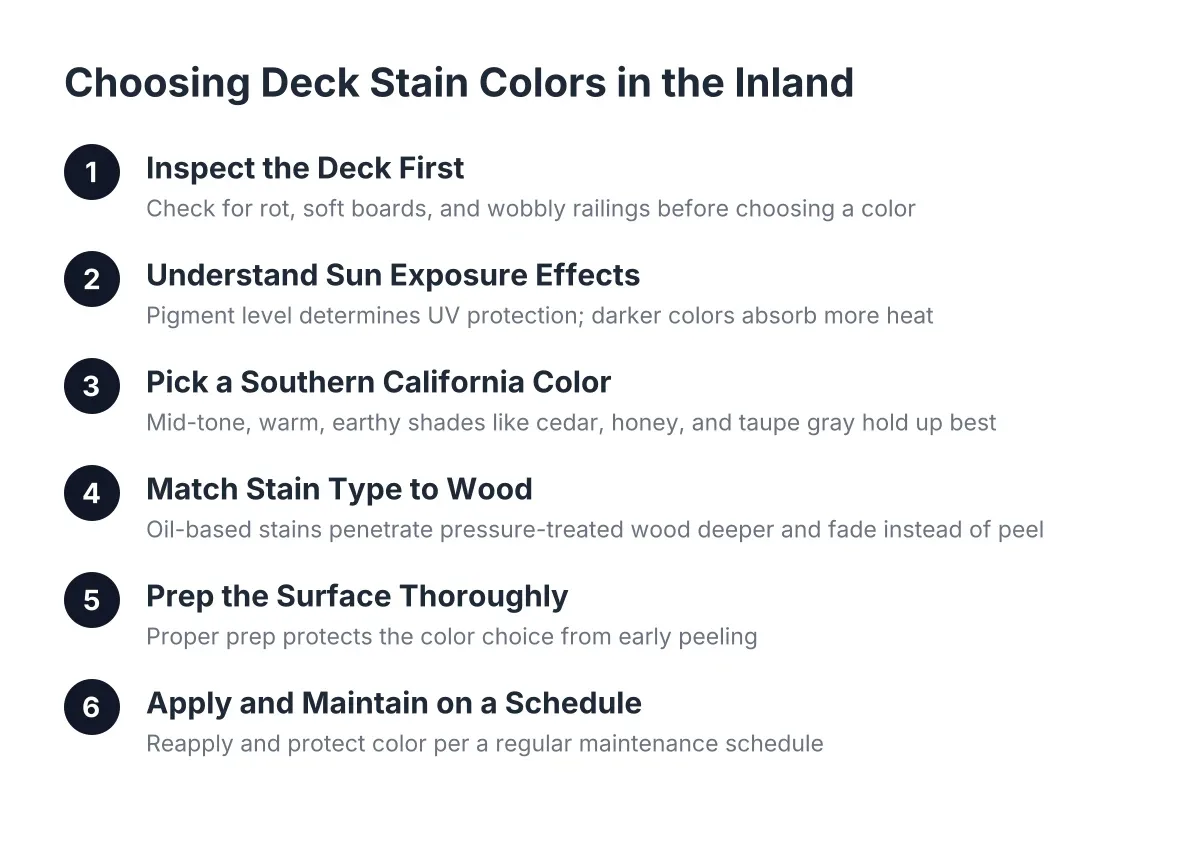
Stain type matters more than most homeowners expect. Transparent and semi-transparent penetrating stains cost less per coat and show off the wood grain, but they need reapplication more often under strong UV. Solid stains last longer on the surface and hide weathered gray wood, but they are more work to strip when they eventually peel. For California weather, many pros lean toward quality semi-transparent oil or hybrid stains with strong UV blockers, because sun damage, not moisture, is the main enemy here.
Railings and stairs add labor fast. Every baluster is hand-brushed detail work, so a deck with 40 feet of railing can take as long to finish as the entire floor surface. When you compare quotes, confirm whether railings, stairs, fascia, and the underside of visible framing are included.
Step 3: Get Quotes and Compare Them the Right Way
Collect two or three written quotes from local deck staining companies, and make sure each one breaks out prep, repairs, and application as separate line items. A single lump number tells you nothing about where corners might get cut.
Ask each estimator three questions:
- How will you prep the surface, and will you strip or sand the old finish if it is failing?
- What stain product and how many coats, and why that product for this sun exposure?
- What minor repairs are included, and what triggers an extra charge?
A fair quote names the product, states the coat count, describes the prep method, and gives a weather-dependent schedule window. Be cautious of a bid that skips prep entirely; stain over dirt and failed finish is the most common reason a job peels in the first year. Also favor a deck builder over a general handyman when your deck has soft boards or a loose railing, because the staining crew should be able to fix what they find underneath.
One more reassurance for anyone who has gotten conflicting opinions on an aging deck. A company that builds and repairs decks for a living has no reason to push a full replacement when a repair and restain will do, because the restain is paying work too. Ask the estimator to show you the specific boards or connections that concern them. A straight answer points at real wood, not at a sales script.
Step 4: Schedule Around Ontario, CA Weather
Timing is where Inland Empire advice differs from national advice. Most national guides tell you to seal the deck before winter snow. Here, the bigger threat is the stretch of 95 to 105 degree summer days that bake stain before it can penetrate.
For 2026 planning, the sweet spots are spring and fall. Stain needs moderate temperatures and dry wood; applying it on a 100 degree afternoon makes it flash-dry on the surface, which causes lap marks and weak penetration. Crews working summer jobs in Ontario, Fontana, or Corona often start early and chase the shade around the deck. Winter works too in Southern California, as long as the crew plans around rain and allows extra drying time after washing.
As a rough planning guide, expect this sequence for a typical single-level deck:
- Day 1: wash, strip if needed, and minor repairs
- Day 2 (or later): drying time, weather dependent
- Day 3: stain application, one or two coats
- 24 to 48 hours after: light foot traffic; longer before moving furniture back
Larger decks, heavy stripping, or added repair work stretch that timeline. Confirm the expected window with your contractor rather than assuming, since drying time swings with humidity and season.
How Often Should You Reseal a Deck in Southern California?
A wood deck in the Ontario, CA area generally needs resealing every two to three years, and sun-blasted south or west facing decks may need attention closer to every other year. Intense Inland Empire UV breaks down finishes faster than coastal or shaded climates, so local decks run on a shorter maintenance cycle than national guides suggest.
The simplest test is the water drop test. Sprinkle water on the boards; if it beads up, the seal is working. If it soaks in and darkens the wood within a minute or two, the deck is ready for another round of deck staining and sealing. Check high-sun sections separately, since one side of the deck often fails a year before the shaded side.
Staying on schedule is cheaper than falling behind. A deck that gets resealed on time needs a wash and one coat. A deck that goes five or six years turns gray, cracks, and needs stripping, sanding, and sometimes board replacement before it can be refinished. That gap is often the difference between a quick refresh and a full deck refinishing project.
Step 5: Decide Between DIY and Professional Deck Staining
DIY staining is realistic for a small, ground-level deck in decent shape. You need a cleaner or deck pressure washer used on a low setting, a stripper if the old finish is peeling, applicator pads, and two or three free days with cooperative weather. Done carefully, it works.
However, call a professional in these situations:
- The old finish is peeling and needs full chemical stripping or sanding
- Boards are soft, cracked, or cupped and need replacement first
- The deck is elevated, multi-level, or has stairs and long railing runs
- A home inspection flagged the deck before a sale or refinance
- You have already re-stained once and it peeled within a year
The most common DIY failure in this climate is staining too soon after washing or in direct heat, which traps moisture or flash-dries the finish. The second is skipping the stripper and layering new stain over a failed coat. Professional deck staining services cost more up front than a weekend of your own labor, but a properly prepped finish that lasts three years beats a shortcut that fails in one.
Safety is the other line. If anything structural moves, a wobbly railing, a bouncy section of floor, or posts that have shifted at the footing, stop and bring in a deck repair professional before anyone hosts a gathering out there. NADRA estimates that about half of the roughly 50 million decks in the U.S. are more than 25 years old, so an aging deck that needs more than a finish is common, not a sign you neglected your home.
Step 6: Protect the Investment After the Crew Leaves
A stain job lasts longest when you treat the first week carefully and the next two years consistently. Keep furniture off the surface until the finish fully cures, and use feet pads under heavy pieces so they do not grind through the finish.
Then put the deck on a simple maintenance schedule. Sweep off leaves and debris monthly, since trapped debris holds moisture against the wood. Rinse and wash the surface once or twice a year. Run the water drop test every spring, and book the next stain and seal when water stops beading instead of waiting for visible graying.
For example, say a family in Upland has a 300 square foot cedar-toned deck restained in spring 2026. In that scenario, a reasonable plan is a light wash each fall, a water test every March, and a single maintenance coat around 2028 before the finish fails. That rhythm keeps the deck out of the strip-and-sand cycle entirely, which is where most of the long-term cost hides.
Ready to Get the Deck Protected
Staining and sealing is the cheapest insurance a wood deck gets against Inland Empire sun, and it only works if the wood underneath is sound. If your deck in Ontario, Rancho Cucamonga, Fontana, Corona, Riverside, Chino, or Upland is due for a finish, or you are not sure whether it needs repair first, reach out to a local Ontario, CA deck builder for an estimate. One walk-through can tell you whether you need a restain, a few replaced boards, or a bigger conversation, and you will have a straight answer instead of a guess.
If you need custom deck design, Inland Empire Decks can help.
Prefer to talk it through? Call (909) 298-8578 — a quick call is usually the fastest way to get a straight answer for your situation.