How to Choose Deck Stain Colors That Survive Inland Empire Sun and Heat
Most advice about deck stain colors comes from places where the big enemy is rain and snow. In Ontario, California, the deck killer is the sun. Inland Empire summers push deck boards through long stretches of intense UV exposure and triple-digit heat, and that changes which stain colors hold up, which ones fade in a season, and which ones turn your deck into a griddle you cannot walk on barefoot in July.
This matters double if your deck is already showing its age. If you have gray, cracked, or soft boards, the right stain and sealer can buy years of life and make the deck presentable for a listing photo. The wrong color choice, applied over the wrong prep, peels within months. According to the North American Deck and Railing Association (NADRA), about half of the roughly 50 million decks in the U.S. are more than 25 years old, so if your deck falls in that group, you are in big company.
Here is a step-by-step guide to choosing and applying a stain color that works for Southern California conditions, written from an Inland Empire deck builder's point of view.
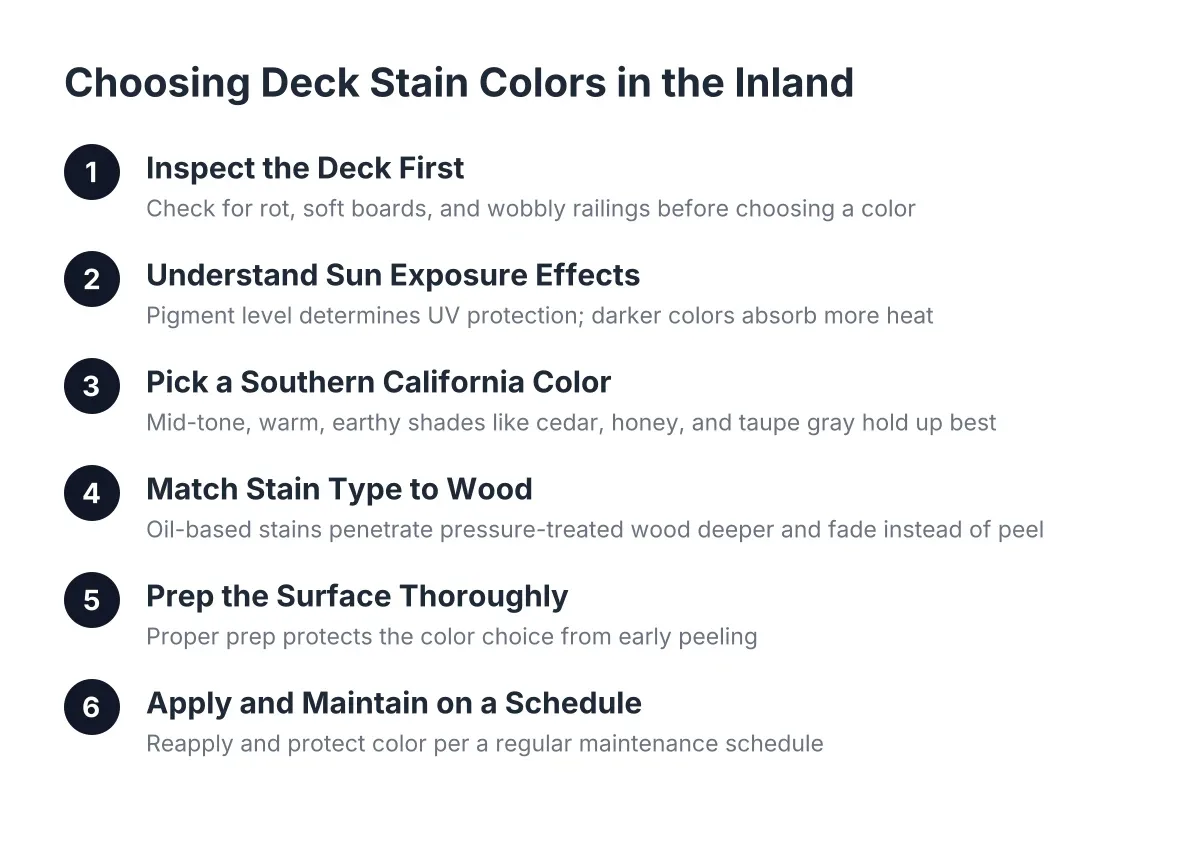
Step 1: Inspect the Deck Before You Fall in Love With a Color
No stain color fixes rot. Before you pull a single color chip, walk the deck and press on the boards near posts, stairs, and anywhere water pools. Soft, spongy spots mean the wood underneath is failing, and stain will only hide the problem until someone's foot finds it.
Check these spots first:
- Board ends and butt joints, where water soaks into end grain
- The ledger area where an attached deck meets the house
- Stair stringers and treads
- Railing posts at the base, especially if the deck railing wiggles when you lean on it
- Footings and support posts at ground level
If you find one or two bad boards, deck board replacement is a normal part of prep and a reasonable DIY or small repair job. If you find widespread softness, a bouncy feel underfoot, or a railing that moves, stop and get a professional deck repair assessment before spending money on stain. Staining a structurally failing deck is the one mistake that costs you twice.
Suppose a homeowner in Rancho Cucamonga is listing in eight weeks and the inspector flagged the deck. In that scenario, a deck repair contractor replaces a handful of rotted boards and tightens the railing, then stains and seals the whole surface. That package is usually a fraction of a full deck replacement and photographs like new wood.
Step 2: How Sun Exposure Affects Deck Stain Colors in the Inland Empire
UV exposure is the main thing that breaks down deck stain in Ontario, CA, so pigment matters more here than in milder climates. Pigment is what blocks UV. The more pigment a stain carries, the longer it protects the wood, but the more it hides the grain. That is the core trade-off behind every color decision.
There are three levels to choose from:
- Transparent and toner finishes show the most grain but carry the least pigment. In full Southern California sun, expect to recoat often, sometimes yearly on south- and west-facing decks.
- Semi-transparent deck stain colors are the sweet spot for most Inland Empire wood decks. You still see the grain, but there is enough pigment to slow UV damage to a reasonable recoat cycle.
- Solid deck stain colors act almost like paint. They give the longest UV protection and hide older, weathered boards, which makes them a common pick for home sellers. The trade-off is that solid stains show wear in traffic paths and can peel if the prep is rushed.
Heat is the second local factor. Dark colors absorb more heat, and a dark walnut or espresso deck in Fontana or Corona in August can get too hot for bare feet and pets. If your deck faces west with no patio cover, lean lighter.
Step 3: Pick From Deck Stain Colors That Work in Southern California
The best deck stain colors for Southern California are mid-tone, warm, earthy shades with enough pigment to fight UV without soaking up heat. Think cedar, light oak, warm honey, taupe gray, and sandy brown. These tones hide dust, fade gracefully instead of blotching, and stay walkable in summer.
A few practical guidelines for deck color ideas in our climate:
- Match the undertone to your house. Most Inland Empire stucco runs warm, so warm browns and tans usually look right. Cool grays suit newer homes with gray or white exteriors.
- Go one shade lighter than you think. Sun exposure deepens and then fades color. A mid-tone cedar reads richer outdoors in full sun than it does on the chip.
- Fading shows most on dark colors. A deep espresso that fades unevenly looks worse at year two than a honey tone that fades evenly.
- For a pre-sale refresh, favor a solid stain in a neutral tone. Taupe, warm gray, or medium brown hides 20 years of weathering in listing photos better than any transparent product.
Test before you commit. Brush two or three candidate colors on a hidden section or a spare board, let them dry, and look at them at noon in direct sun. Stain colors shift under bright Inland Empire light, and a sample that looks subtle indoors can read orange outside.
Step 4: Match the Stain Type to Your Wood
On pressure-treated wood, which covers most older decks around Ontario and Upland, an oil based stain for pressure treated wood penetrates deeper and tends to fade rather than peel. That makes maintenance easier, because you can clean and recoat without stripping. Water-based stains dry faster and hold color well, but they sit closer to the surface and demand cleaner prep.
Pressure-treated lumber also needs to be dry enough to take stain. New boards from a deck repair should weather before staining; sprinkle water on the surface, and if it beads instead of soaking in, the wood is not ready. In our dry climate that wait is often shorter than the national guidance suggests, but skipping it entirely leads to blotchy color.
If your deck is redwood or cedar, semi-transparent oil-based products show off the grain those species are known for. If the boards are badly weathered and sanding is not in the budget, a solid stain is the honest choice.
Step 5: Prep Like the Color Depends on It, Because It Does
Stain fails at the prep stage, not the color stage. A good deck staining and sealing job in Ontario, CA includes cleaning, brightening, repairs, and careful application, and that prep work is what separates a finish that lasts from one that peels by spring.
Work in this order:
- Replace any soft or cracked boards and reset popped fasteners.
- Wash the deck with a deck cleaner to remove gray fibers, dirt, and mildew.
- Apply a wood brightener to open the grain and neutralize the cleaner.
- Let the deck dry fully. In Inland Empire heat, that can be fast, but confirm with the water-bead test.
- Sand rough spots and railings so the stain absorbs evenly.
Timing matters more here than people expect. Avoid staining in direct midday sun or on days over about 90 degrees, because the stain flashes dry before it penetrates and leaves lap marks. Early morning in spring or fall is the best window in San Bernardino County and Riverside County. Fall staining also seals the wood before winter rains arrive, which is the closest thing Southern California has to a seasonal deadline.
Step 6: Apply It Right, Then Protect the Color on a Schedule
Staining a deck with a sprayer is fast for railings and spindles, but always back-brush, meaning follow the sprayer with a brush or pad to work the stain into the grain. Spray alone leaves a thin film that burns off quickly under our UV. On deck boards, a pad applicator with a brush for edges gives the most even color. Two thin coats beat one heavy coat, and wipe any puddles before they dry glossy.
Then put recoating on the calendar. How often should you reseal a deck in the Inland Empire? Plan on every one to two years for transparent and semi-transparent finishes on sun-exposed decks, and every three to five years for solid stains, adjusting based on how the surface looks. The simple test: if water stops beading on the boards, the sealer is done working.
A realistic maintenance schedule looks like this:
- Spring: rinse off winter grime, check for loose boards and fasteners
- Summer: sweep regularly; debris traps moisture and stains the finish
- Fall: do the water-bead test, and recoat before the rainy season if it fails
- Every few years: full clean, brighten, and recoat
When to Call a Deck Builder Instead of Buying Stain
Call a professional when the problem is structure, not color. Soft boards across large areas, a wobbly deck railing, rusted connectors, or movement underfoot are signs the deck needs repair or deck replacement, and stain will not fix any of it. According to the North American Deck and Railing Association (NADRA), an estimated 30 million of the more than 60 million residential and commercial decks in the U.S. are past their useful life, and some decks in that group are not worth staining.
A straight-shooting local deck builder in Ontario, CA should be able to tell you which camp your deck is in: a candidate for repair and stain, a candidate for deck resurfacing with new boards on a sound frame, or a candidate for replacement. If resurfacing comes up, it is also the natural moment to consider composite decking, which skips the staining cycle entirely; Grand View Research reports capped composite held 57.8% of the decking product market in 2025, largely because of that low-maintenance appeal.
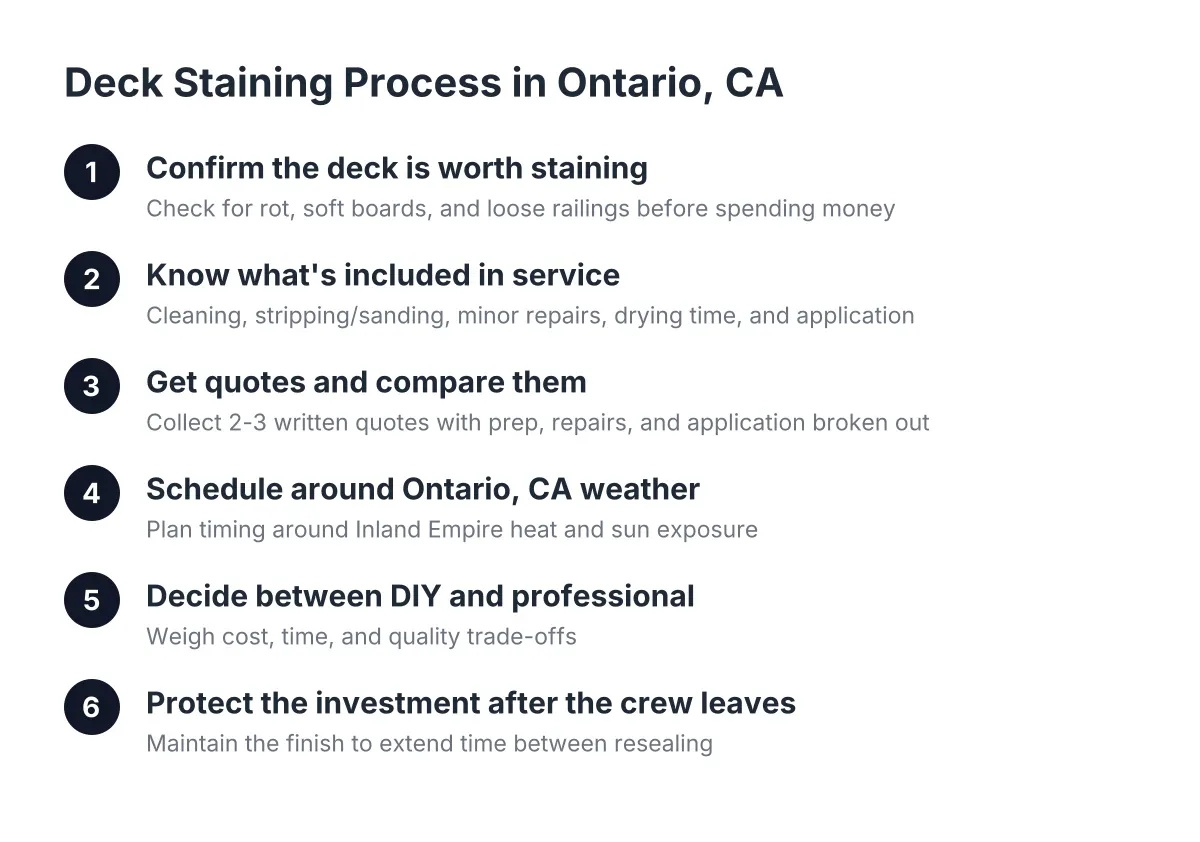
When you get quotes for staining and sealing, ask two questions. First, what prep is included, specifically cleaning, brightening, and board repairs, since those drive the result. Second, which stain type and color family they recommend for your deck's sun exposure, and why. A fair quote spells out prep, product, and number of coats rather than a single lump number.
If your deck in Ontario, Rancho Cucamonga, Fontana, Chino, or Upland is somewhere between "needs a refresh" and "scares me a little", have a local deck specialist look at it before you choose a color. An honest assessment and a free quote cost you nothing, and the right call now, whether that is stain, deck repair, or resurfacing, means you stop worrying every time family walks out the back door.
If you need custom deck design, Inland Empire Decks can help.
Prefer to talk it through? Call (909) 298-8578 — a quick call is usually the fastest way to get a straight answer for your situation.