When to Schedule a Deck Safety Inspection: A Timing and Frequency Guide
If your deck has soft boards, a railing that wiggles, or hardware that looks rusted through, the question is not whether to schedule a deck inspection. A proper deck inspection schedule ensures safety and catches problems before they become emergencies. The question is when, and how urgently. Some warning signs mean you can plan an inspection for next month. Others mean nobody walks on that deck until a professional looks at it. This guide sorts out the difference, so you can act on the right timeline instead of guessing.
We build and repair decks across Ontario, California and the Inland Empire, and most inspection calls we hear about start the same way. A homeowner steps on a spongy board, or a guest leans on a railing and feels it give, and suddenly every gathering on that deck feels like a gamble. The good news: timing an inspection well is straightforward once you know what to look for and how fast each problem tends to move.
Why Inspection Timing Matters More Than Most Homeowners Think
Deck problems rarely announce themselves all at once. Rot spreads quietly under paint and stain. A ledger board, the piece that attaches the deck to your house, can look fine from above while the connection behind it corrodes. By the time a board feels soft underfoot, the damage below has usually been building for years.
The scale of the problem is bigger than most people realize. According to the North American Deck and Railing Association (NADRA), an estimated 50 percent of the roughly 50 million residential and commercial decks in the U.S. are more than 25 years old. NADRA also estimates that of the more than 60 million decks nationwide, about 30 million are past their useful life and need repair or replacement.
The injury numbers back that up. A study using CPSC injury surveillance data found 224,000 people nationally were injured due to a deck or porch over the study's five-year period, with 33,000 of those injuries resulting from structural failure or collapse, according to Legacy Services LLC. Most collapses happen when decks are loaded with people, which is exactly why timing your inspection before a party or holiday season matters.
How Often Should a Deck Be Inspected?
A deck should get a homeowner walk-through inspection once a year, and a professional structural inspection every few years or whenever a warning sign appears. Decks older than 15 years, decks built before you bought the house, and decks with any history of rot deserve professional eyes more often. Age changes the math; an older wood deck can go from solid to unsafe within a season or two once rot takes hold.
Here is a practical schedule for Inland Empire homeowners:
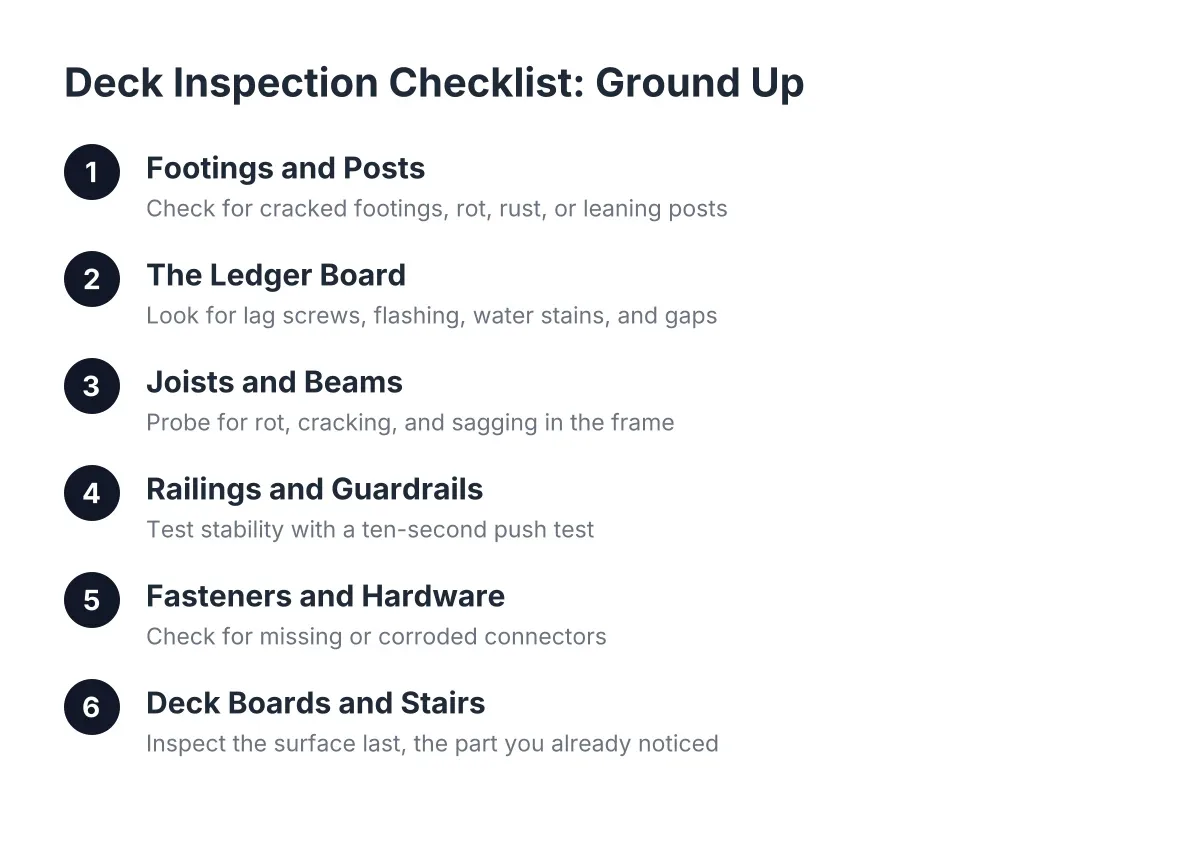
- Every year: Do your own visual check. Walk the deck, test the railings, look underneath at posts and framing, and probe suspect boards with a screwdriver.
- Every 2 to 3 years: Have a professional look at decks over 10 years old, even if nothing seems wrong. Hidden connections fail before visible surfaces do.
- Immediately: Schedule a professional inspection when you notice soft boards, movement in the railing, sagging, rusted hardware, or separation where the deck meets the house.
- Before major events: If you are hosting a graduation party, a wedding reception, or a big family gathering, get the deck checked first. Crowd loads are when marginal decks fail.
- Before selling or refinancing: Home inspectors flag deck issues constantly. Finding problems on your own timeline beats finding them in escrow.
The dry Southern California climate helps in some ways and hurts in others. We get less standing moisture than wetter regions, but intense sun breaks down wood deck sealant faster than many homeowners expect. Once the sealant fails, sprinkler overspray, winter rains, and shaded corners do the rest. UV damage also makes boards brittle, which is a different failure mode than rot but just as real underfoot.
Warning Signs That Set Your Inspection Timeline
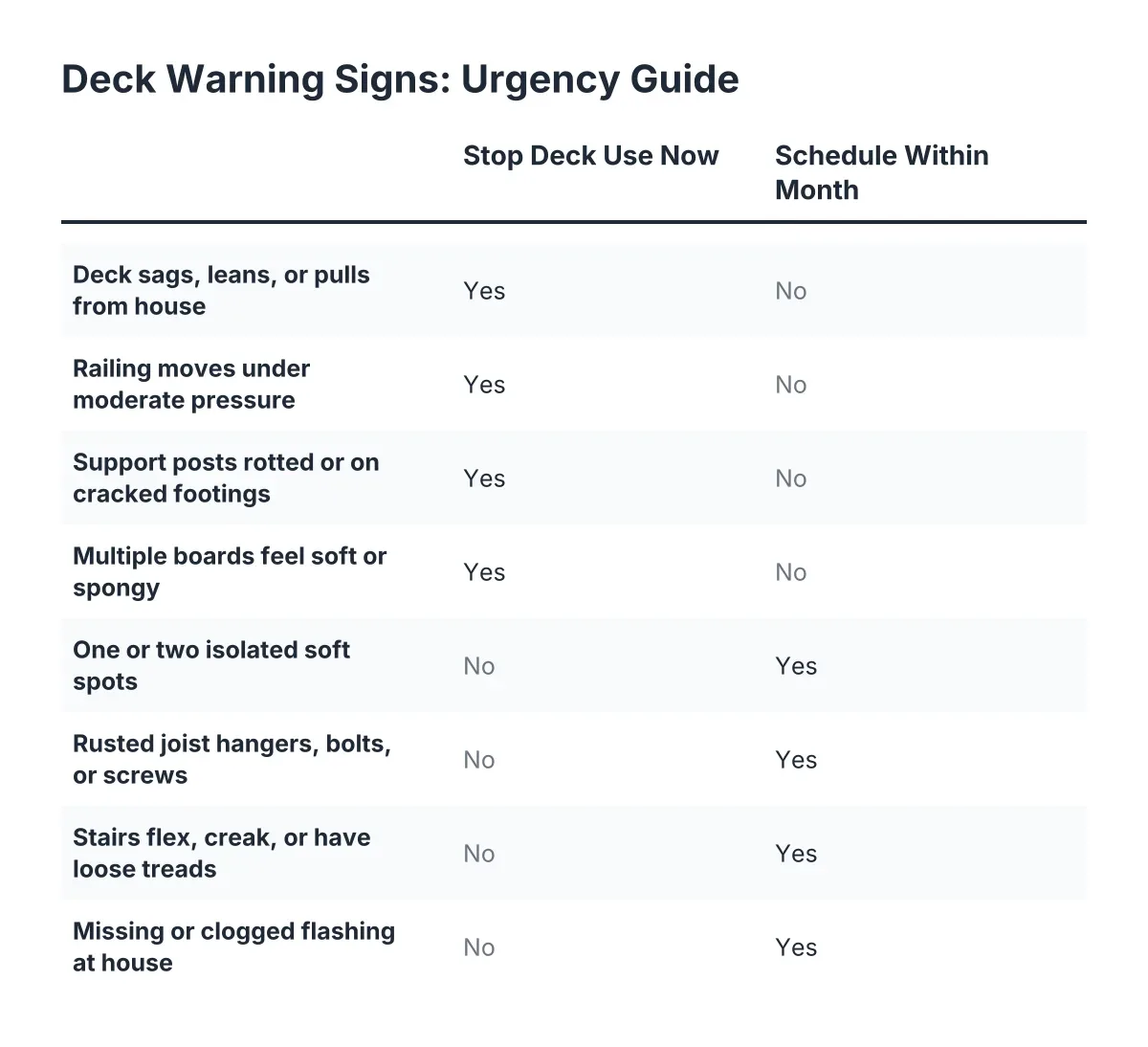
Not every deck problem carries the same urgency. Sorting your symptoms into the right bucket tells you whether to book an inspection this week or stop using the deck today.
Stop Using the Deck Now
Some signs mean the structure may already be compromised. If you see any of these, keep people off the deck and call a professional deck builder before anyone walks out there again:
- The deck visibly sags, leans, or has pulled away from the house, even slightly. Deck ledger board failure is the most common cause of full collapse, and a gap between the house and the deck is its calling card.
- A railing moves when you push on it with moderate pressure. Railings fail at the worst possible moment, when someone leans or falls against them.
- Support posts show rot at the base, sit on cracked footings, or rest directly on soil.
- Multiple boards feel soft or spongy, especially near the house or around the stairs. Widespread softness usually means the joists underneath are rotting too, not just the surface boards.
Schedule a Deck Safety Inspection Within the Month
Other signs point to problems that are developing but not yet an emergency. These justify booking a professional inspection soon, before the next rainy season or the next big gathering:
- One or two isolated soft spots on surface boards, with firm framing underneath.
- Rusted or corroded joist hangers, bolts, or screws visible from below.
- Nails backing out of boards, or boards that flex more than they used to.
- Wide cracks or splits in structural posts and beams, as opposed to surface checking in deck boards.
- Stairs that flex, creak loudly, or have loose treads.
- Flashing at the house connection that is missing, rusted, or clogged with debris.
Watch and Plan
Faded stain, minor surface cracks in deck boards, and mildew stains are maintenance items, not safety emergencies. They belong on your annual walk-through list and might point toward deck resurfacing or fresh staining and sealing. However, cosmetic problems left alone eventually become structural ones, because failed finish is how water reaches the framing.
What Happens When You Schedule a Deck Safety Inspection
A proper deck safety inspection covers the whole load path, from the boards you walk on down to the footings in the ground. Knowing the scope helps you judge whether the person you hire is doing a real inspection or a quick glance and a sales pitch. A thorough inspection should include:
- The ledger connection. The inspector checks how the deck attaches to the house, looking for proper bolts rather than nails alone, intact flashing, and any water damage to the house framing behind it.
- Posts and footings. Posts should sit on concrete footings with proper connectors, not buried in dirt. The inspector probes post bases for rot and checks footings for cracking or settling.
- Framing. Joists and beams get checked from below for rot, insect damage, sagging, and undersized spans. This is where a flashlight and a probing tool matter more than a walk across the surface.
- Hardware and fasteners. Joist hangers, bolts, and screws are checked for rust, corrosion, and missing pieces. In older decks, hardware failure is common even when the wood looks fine.
- Decking, stairs, and railings. The surface gets tested for soft spots, and stairs and railings get load-tested by hand. Under the California Building Code, most residential decks more than 30 inches above grade need guardrails at least 42 inches high, according to the California Building Standards Commission. Many older Inland Empire decks were built to lower standards and no longer meet code.
Expect a straight verdict at the end: the deck is sound, the deck needs specific repairs, or the deck needs replacement. A written summary with photos of problem areas is reasonable to ask for. What is usually extra: engineering reports for permit purposes, invasive testing that requires opening up finished surfaces, and detailed repair estimates, though many local deck builders fold the estimate in at no charge.
Most residential inspections take an hour or two on site. Multi-level decks, elevated decks, and decks with limited access underneath take longer.
Repair, Resurface, or Replace: What the Inspection Should Tell You
The inspection's real job is answering the question that brought you here: is this deck worth saving? The honest answer depends on where the damage lives, not how bad the surface looks.
If the framing, posts, and footings are sound and the damage is limited to surface boards, deck repair or deck board replacement solves it. If the frame is solid but most of the decking and railing is worn out, deck resurfacing lets you keep the structure and replace everything you see and touch, often with composite decking that stands up to Inland Empire sun better than wood. Additionally, if rot has reached the joists, beams, or ledger, patching the surface wastes money; deck replacement is the honest recommendation.
For example, suppose a homeowner in Rancho Cucamonga has a 20-year-old wood deck with three soft boards near the sliding door. If probing shows the joists underneath are still firm, that is a repair measured in boards, not a teardown. In that scenario, replacing the bad boards and re-sealing the deck buys years. But if the same probe sinks into the joist below, the water that ruined the boards has been ruining the frame too, and a quote for a full rebuild is not an upsell. It is the truth.
This is also the fair test for whichever company you hire. A trustworthy deck builder should be able to show you the damage, not just describe it. Ask them to point out the rot, tap the soft framing, and photograph the failed hardware. If they recommend replacement, the evidence should be visible to you, not just to them.
Deck Inspections and Permits in Ontario, California
Inspections and permits connect more often than homeowners expect, especially in San Bernardino County and Riverside County. If your inspection leads to structural repairs, a new railing system, or a full deck replacement, permits usually enter the picture. New deck construction in Ontario, CA typically requires a building permit, and railing height, footing depth, and ledger attachment all get reviewed against current California code.
Budget accordingly. A deck building permit typically costs between $230 and $500 depending on location, according to HomeAdvisor. That is a small line item next to the cost of rebuilding a deck twice because unpermitted work failed a later home inspection.
Timing matters here too. If you plan to sell within the next year or two, schedule the deck safety inspection now rather than during escrow. Buyers' inspectors flag deck problems constantly, and a flagged deck in escrow means negotiating repairs under deadline pressure. Handling it in advance, on your own schedule, keeps you in control of the scope and the contractor choice.
What You Can Check Yourself Before Calling Anyone
You do not need to pay anyone to get a first read on your deck. An annual self-check takes 30 minutes and a screwdriver. Press the screwdriver tip into boards, post bases, and the ends of joists; sound wood resists, rotted wood gives. Push firmly on every railing section. Look under the deck with a flashlight for rusted hangers, water stains, and daylight where the ledger meets the house.
What you should not do yourself is diagnose structural adequacy. Whether a ledger connection can carry a loaded deck, whether a cracked beam still has capacity, and whether footings meet current code are judgment calls that require training and experience. A confident DIY check tells you when to call; it does not replace the call. If your self-check turns up anything from the stop-now list above, or if a home inspector has already flagged the deck, bring in a professional rather than betting on your own read.
One more honest limitation: even a thorough professional inspection cannot see inside a sealed ledger connection without opening it up. If the visible evidence is ambiguous on an older attached deck, an inspector may recommend removing trim or siding to confirm what is behind it. That costs a little more but beats guessing about the single most failure-prone connection on the deck.
Choosing Who Does the Inspection
The right inspector for a worried deck owner is usually someone who repairs and builds decks for a living, because they know exactly how decks fail and what fixing each failure costs. Before you book, ask two or three questions:
- Will you show me what you find? The answer should be yes, with photos or a walk-through of the problem areas.
- Do you give repair and replacement options, or only one? A fair evaluation prices the repair path and the replacement path when both are viable, so you can compare.
- Will the repair meet current code? Railing heights, footing requirements, and ledger attachment standards have changed over the years. As of 2026, repairs should bring the affected parts of the deck up to current California requirements, not just restore what was there.
A fair quote itemizes the work: which boards, which framing members, which hardware, and whether permits apply. Be cautious with anyone who quotes a full replacement without getting under the deck, and equally cautious with anyone who declares an old, soft deck fine after a two-minute glance. You have probably heard both already; the inspector who shows evidence is the one to trust.
If you are in Ontario, Rancho Cucamonga, Fontana, Upland, Chino, Corona, or anywhere else in the Inland Empire and your deck has you second-guessing every step, get it looked at before the next gathering, not after. Reach out to a local Ontario, CA deck builder to book an inspection and get a straight answer on whether your deck needs repair, resurfacing, or replacement, along with an estimate for whichever path makes sense.
If you need custom deck design, Inland Empire Decks can help.
Prefer to talk it through? Call (909) 298-8578 — a quick call is usually the fastest way to get a straight answer for your situation.