Patio Cover vs. Pergola: Which Is Right for You?
If you're deciding between a patio cover and a pergola for your Ontario, CA backyard, the choice comes down to how much shade and weather protection you want. The short answer in the patio cover vs pergola debate: a patio cover wins if you want full shade and a dry outdoor living space you can use year-round, while a pergola wins if you want filtered light, open airflow, and a lower upfront cost. Both can be built to match your home and your deck. Both add usable outdoor space in a climate where you'll spend a lot of the year outside. Here is how they compare, criterion by criterion, so you can spend your money on the right one.
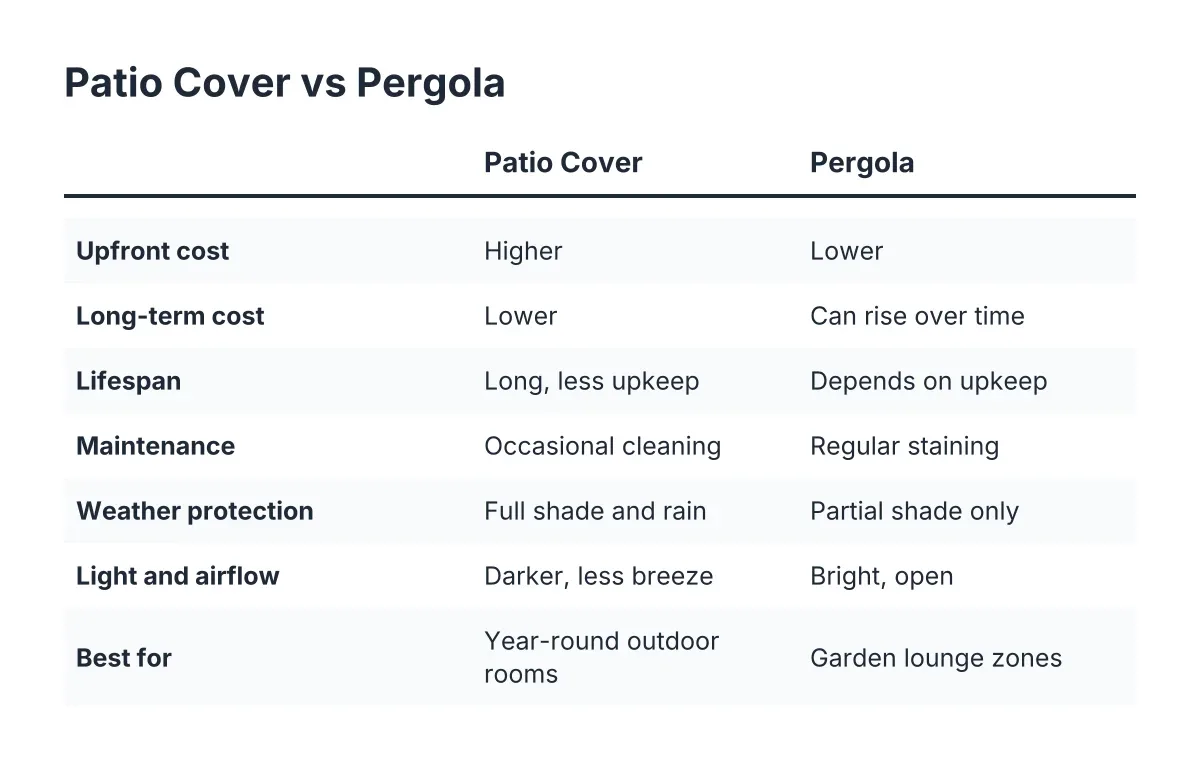
| Criterion | Patio Cover | Pergola |
|---|---|---|
| Upfront cost | Higher, more material and engineering | Lower for a comparable footprint |
| Long-term cost | Lower, protects furniture and reduces sun damage | Can rise if you add shade cloth, panels, or covers later |
| Lifespan | Long with a solid roof and proper flashing | Long if maintained, open slats weather faster |
| Maintenance | Occasional cleaning, roof and gutter checks | Regular staining or sealing for wood, slat upkeep |
| Weather protection | Full shade and rain protection | Partial shade, no rain protection |
| Light and airflow | Darker underneath, less breeze | Bright, open, excellent airflow |
| Best for | Year-round outdoor rooms, dining areas, hot west-facing patios | Garden features, defined lounge zones, homes that need light indoors |
Patio Cover: Strengths and Trade-offs
A patio cover is a solid-roof structure, either attached to your house or freestanding, that puts real shade and rain protection over your patio or deck. Think of it as adding a roof to an outdoor room. In the Inland Empire, where summer afternoons regularly push triple digits, that solid roof is the difference between a patio you avoid from noon to sunset and one you actually use. It also keeps rain off your outdoor furniture during the wet months, so cushions, rugs, and a dining set can stay out all year.
The trade-offs are cost and light. A patio cover takes more material, more structural work, and often more permitting attention than a pergola, so the upfront price is higher. We cover what drives that price in our guide to how much patio covers cost. A solid roof also blocks light to the rooms behind it. If your patio sits outside a kitchen or family room window, a full cover can make that interior space noticeably darker. On a north-facing patio that already stays cool, a solid cover can feel like overkill.
Where patio covers shine most in Ontario, California is on west and south exposures. Those patios take the full force of afternoon sun, and a solid roof drops the temperature underneath enough to make dinner outside comfortable in July. If your goal is an outdoor dining room or a shaded spot for a TV or seating area, this is the stronger choice.
Pergola: Strengths and Trade-offs
A pergola is an open-roof structure, posts supporting beams and spaced slats or rafters overhead. It filters sunlight rather than blocking it. Underneath, you get a pattern of light and shade that shifts through the day, plus full airflow. Pergolas look great over a deck or a garden seating area, and they define a space without closing it in. For many Inland Empire homeowners, that openness is the point: you get structure and style without losing the sky.
The trade-off is protection. A standard pergola does not stop rain, and on a 100-degree afternoon the filtered shade helps but does not solve the heat problem the way a solid roof does. Many homeowners end up adding shade cloth, climbing vines, or retractable canopies later, which closes part of the cost gap with a patio cover. Wood pergolas also need regular staining and sealing, since every slat is exposed to sun and weather on all sides. Skip that upkeep in Southern California sun and the wood grays, checks, and splits faster than you'd expect.
Where a pergola wins is on patios with decent natural shade, east-facing spaces that only get morning sun, and homes where blocking window light would be a real loss. It is also the better pick when budget is tight and full weather protection is a nice-to-have rather than a need.
Patio Cover vs Pergola: The Deciding Factors
Cost drivers
A pergola costs less upfront for the same footprint; a patio cover costs less over time if you'd otherwise replace sun-damaged furniture and add shade products to the pergola anyway. The big cost drivers for both are size, material, whether the structure attaches to the house, and footing requirements. Attached structures need proper connection to your home's framing, and solid roofs need engineering for weight. We break down the cost factors in detail in our patio cover cost guide.
Lifespan
Both structures last a long time when built right; the difference is how they age. A patio cover with a properly flashed solid roof protects its own framing from sun and rain, so it tends to hold up with less intervention. A pergola's open slats take weather from every angle, so its lifespan depends more on the material you choose and how faithfully you maintain it. Composite and aluminum options for either structure cut that maintenance burden.
Installation
A pergola is usually the simpler build; a patio cover involves more structural and permitting work. Both need solid footings and, if attached to the house, a sound connection to the existing framing. In San Bernardino County, permanent structures like these typically need a permit, and a solid-roof attached cover gets more scrutiny than a freestanding pergola. A local deck builder who handles permits and planning can sort that out before any concrete gets poured.
Maintenance
The patio cover asks less of you year to year. Expect occasional cleaning and a check of the roof and any gutters after storms. A wood pergola needs staining or sealing on a regular schedule to survive Inland Empire sun, the same way a wood deck does. If you want a pergola with less upkeep, aluminum or composite materials solve most of that, at a higher upfront price.
Situational fit
Match the structure to your exposure and how you'll use the space. West or south-facing patio you want to use for dinner in summer: patio cover. East-facing deck used mostly in the morning, or a garden corner you want to define without darkening the house: pergola. If you're building a new deck at the same time, plan the structure and the deck framing together, since posts, footings, and load paths are easier and cheaper to get right in one project than to retrofit later.
Which Should You Choose?
Choose Patio Cover if:
- Your patio faces west or south and bakes in afternoon sun
- You want to use the space for dining, entertaining, or a TV area year-round
- You want rain protection so furniture can stay out through winter
- You'd rather pay more upfront and do less maintenance later
Choose Pergola if:
- Your budget is tighter and full weather protection isn't a must
- Your patio gets manageable sun, or faces east or north
- The rooms behind the patio need natural light
- You want an open, garden-style look and don't mind routine staining and sealing
If you're stuck between the two, start with exposure. In Ontario, California and the rest of the Inland Empire, a west-facing patio almost always justifies the solid roof. Everywhere else, the pergola's lower cost and open feel make it the smarter default.
Common Questions
What is the typical cost of a 20×20 covered patio?
It depends on material, roof type, and whether the cover attaches to your house, so there's no honest single number. A 20×20 footprint is on the larger side, which means more posts, deeper footings, and more roofing material than a standard cover. The best move is a free quote based on your actual site, since footing conditions and attachment points change the price. Our patio cover cost guide walks through every factor that moves the number.
Do I need a permit to build a patio cover in San Bernardino County?
In most cases, yes. Permanent structures like solid-roof patio covers typically require a building permit in San Bernardino County, and attached structures get closer review than freestanding ones. Rules vary by city, so check with your local building department, or work with a local deck builder who handles deck permits and planning as part of the job.
Which is cheaper, a patio cover or a pergola?
For the same size, a pergola usually costs less upfront because it uses less material and simpler engineering. The gap narrows if you later add shade cloth, panels, or a canopy to the pergola to get more protection. When weighing patio cover vs pergola costs, compare the total you'll spend to get the shade level you actually want, not just the base structure price.
Can I add a patio cover or pergola to an existing deck?
Often yes, but the deck has to carry the load. Posts for either structure need proper footings, and an existing deck's framing may need reinforcement to support a roof. A deck builder can inspect your framing and footings first, which is cheaper than discovering a problem mid-build. If you're planning a deck replacement anyway, designing both at once saves money.
If you need custom deck design, Inland Empire Decks can help.
Prefer to talk it through? Call (909) 298-8578 — a quick call is usually the fastest way to get a straight answer for your situation.