Best Composite Decking Material for Ontario, CA Heat: 8 Picks That Hold Up
If your old wood deck has soft boards and a wobbly railing, you have probably already decided the replacement will be composite. The next question is harder: which is the best composite decking material for a backyard in Ontario, California, where summer afternoons regularly push past 100 degrees and the sun beats down most of the year? Inland Empire heat is a different test than the mild coastal weather most national buying guides assume. This list walks through eight material choices and features that actually matter in San Bernardino County and Riverside County, written from a local deck builder's point of view rather than a brand's marketing page.
One note before the list. "Best" here does not mean one brand name. Most major manufacturers make good boards and bad boards. What separates a deck that still looks right in year fifteen from one that fades and sags by year five is the type of composite, the color, the installation, and the framing underneath it. Those are the things you can control, so that is what this list covers.
1. Choose Capped Composite, Not Older Uncapped Boards
Capped composite is the single most important choice you will make, and for Inland Empire sun it is not optional. These boards wrap the wood-plastic core in a protective polymer shell that resists fading, staining, and moisture. Uncapped first-generation composite, the kind that gave the material a bad name in the 2000s, fades fast and can absorb water much like the wood deck you are tearing out.
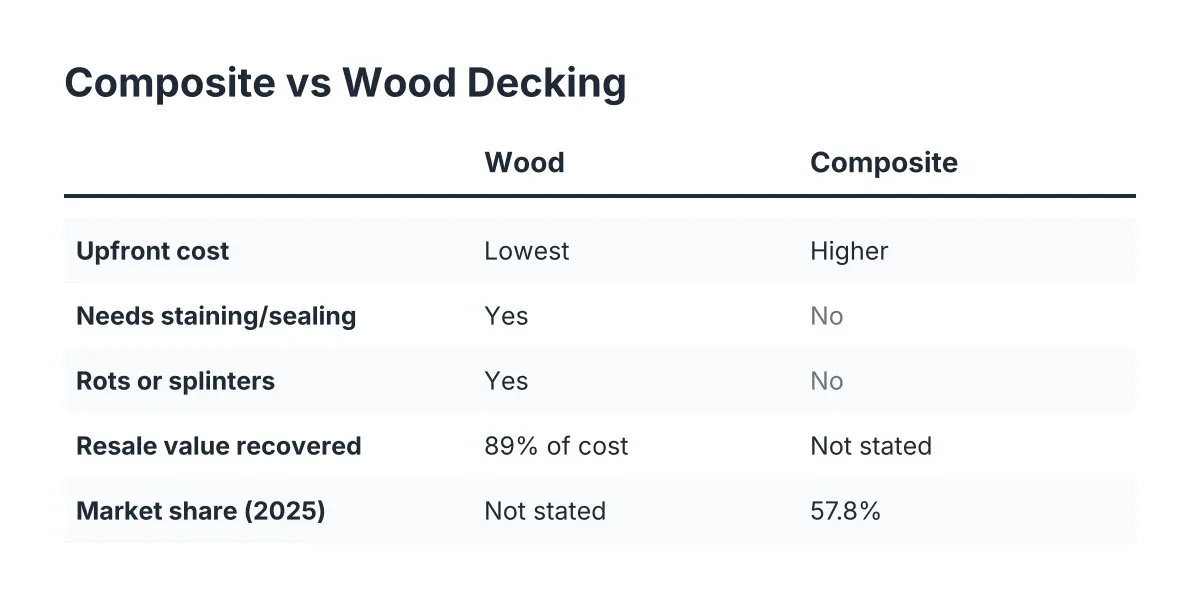
The market has already voted on this. According to Grand View Research, capped composite decking and railing held 57.8% of the product market in 2025, the largest share of any category. For a replacement deck in Ontario, CA, treat capping as the baseline, then compare brands and lines from there. If a bid comes in surprisingly low, ask whether the board is capped on all four sides or only three; four-sided capping costs more but handles our dry heat and occasional winter rain better.
2. For Full Sun, Pick Heat-Smart Colors Over the Color You Love Most
Dark composite boards in direct Southern California sun get hot enough to be uncomfortable barefoot by early afternoon. If your deck faces south or west with no shade, lighter tones such as gray, sand, or weathered driftwood will stay noticeably cooler than espresso or slate. Some manufacturers now offer heat-mitigating lines designed to reflect more sunlight, and those are worth asking about by name when you compare samples.
Here is a practical test any homeowner can run. Get sample boards from two or three product lines, set them on your existing deck for a week in July, and touch them at 3 p.m. The difference between colors is immediate and obvious. A deck you cannot walk on from June through September is not a deck you will use, no matter how good it looks in photos.
3. Mineral-Based and PVC Boards: The Premium Tier for Extreme Heat
Mineral-based composite and fully synthetic PVC boards sit at the top of the price range, and for some Inland Empire yards they earn it. These boards expand and contract less in temperature swings, resist heat distortion better, and weigh less than traditional wood-plastic composite. If your deck is elevated, faces west, or sits over a pool deck with reflected glare, this tier deserves a look.
The trade-off is cost and feel. The best plastic decking material options can run 20 to 40 percent more than mid-tier capped composite, and some homeowners find the sound and flex underfoot less wood-like. For a shaded or partially covered deck in Ontario or Rancho Cucamonga, mid-tier capped composite usually delivers better value for the money.
4. Compare the Cost of Trex Decking and Other Big Brands by Line, Not Logo
Every major brand sells an entry line, a mid line, and a premium line, and the gap between lines inside one brand is often bigger than the gap between brands. The cost of Trex decking, for example, varies widely depending on whether you are pricing the entry-level line or the top-shelf product, and the same is true of its competitors. When a neighbor tells you what they paid, find out which line they bought before you compare.
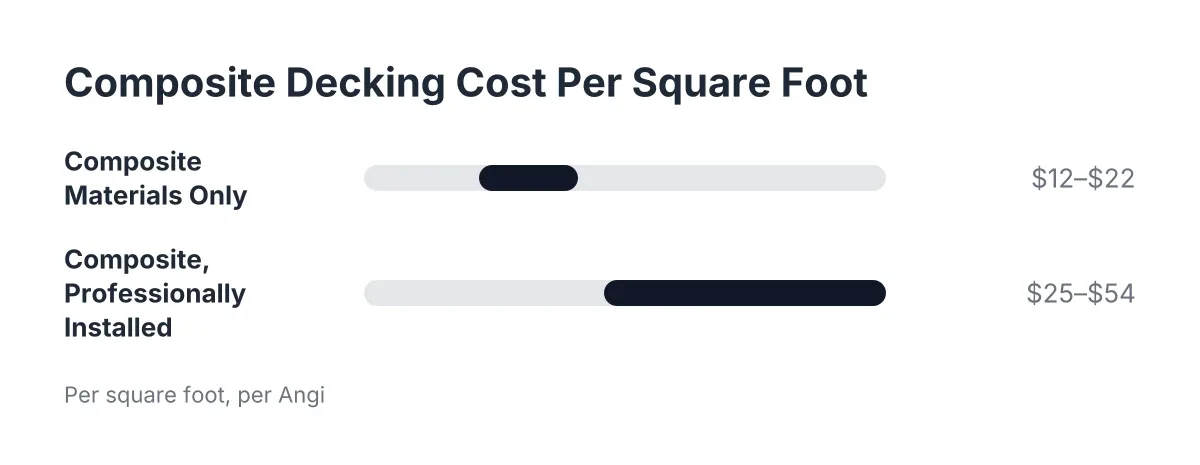
As a general benchmark, Angi reports composite deck materials run $12 to $22 per square foot for materials alone, or $25 to $54 per square foot professionally installed. Trex decking cost per square foot lands inside that range, with entry lines near the bottom and premium capped lines near the top. Get your deck builder to quote two product tiers side by side so you can see exactly what the upgrade buys you.
What Actually Separates the Best Composite Decking Materials in 2026
By 2026, the honest answer is that the top four or five manufacturers all make durable capped boards, and warranty terms have largely converged at 25 to 50 years on fade and stain for premium lines. The real separators are cap quality on the board edges, color stability in high-UV climates, heat retention, and local availability when you need a matching board for a repair in year eight. A local deck builder who installs composite decking weekly in Ontario, Fontana, and Corona will know which lines have held their color through multiple Inland Empire summers and which ones generate callback requests.
5. Do Not Reuse Rotted Framing Under New Composite Boards
This one matters most for anyone replacing a failing wood deck. Composite boards can last decades, but they are only as good as the joists and posts under them. If your current deck has soft boards, there is a real chance the framing below has rot too, especially around the ledger board where the deck attaches to the house and at the post bases. Screwing new composite over compromised framing wastes the money you spent on good boards.
Suppose a homeowner in Ontario has a 20-year-old, 300-square-foot wood deck with spongy boards near the stairs. In that scenario, a resurfacing quote that reuses the frame might look attractive, but if an inspection finds rot in two joists and a ledger pulling away from the house, full deck replacement is the honest recommendation, not an upsell. A trustworthy deck builder will show you the damaged framing before asking you to pay for new structure. If you cannot see the rot yourself, ask for photos. This is also the point where a professional assessment matters; hidden ledger and footing damage is not something to judge from the surface, and getting it wrong is a safety issue, not a cosmetic one.
6. Match Fastening and Gapping to Inland Empire Temperature Swings
Composite boards expand and contract with temperature more than wood does, and Ontario, California sees big swings, from 40-degree winter mornings to 105-degree summer afternoons. Proper composite deck installation accounts for this with manufacturer-specified end gaps and side gaps, hidden fastener systems rated for the specific board, and correct joist spacing, often 16 inches on center or tighter for diagonal patterns.
Skipping these details causes most composite deck complaints: buckled boards, popped fasteners, and wavy deck surfaces. The board did not fail; the installation did. When you compare bids, ask each deck builder these questions:
- Which hidden fastener system do you use, and is it approved by the board manufacturer?
- What joist spacing are you framing to for this specific board?
- How do you handle expansion gaps at board ends and against the house?
- Will the installation preserve the manufacturer's warranty?
Clear answers signal a crew that installs composite regularly. Vague answers signal a crew that mostly builds wood decks and treats composite the same way.
7. Pick Railing at the Same Time as Decking, and Mind the Code
Railing is where many replacement projects go sideways on budget and looks. Composite and aluminum railing systems are sold to pair with specific board lines, and mixing brands can leave you with colors that almost match, which reads worse than an intentional contrast. If a loose railing is part of what triggered this project, plan the railing system with the decking, not after.
Code matters here too. The California Building Code requires a minimum guardrail height of 42 inches for most residential decks more than 30 inches above grade, according to the California Building Standards Commission. That is taller than the 36-inch rails common on older decks, so your replacement railing may legally need to be taller than what it replaces. A local builder who handles deck permits and planning in San Bernardino County will fold this into the design instead of discovering it at inspection.
8. Weigh Lifetime Cost, Not Just the Bid Price
Composite costs more upfront than pressure-treated wood, and there is no way around that. The payback comes from what you stop doing: no sanding, no staining and sealing every other year, no board replacement from rot. For a homeowner who has spent the last five years watching a wood deck decay, that maintenance math is usually the whole reason for switching.
The category is growing for exactly this reason. Grand View Research values the global composite railing and decking market at $4.7 billion in 2025, projected to reach $12.6 billion by 2033, with North America holding the largest regional share at 29.2%. More demand has meant more product lines and better caps, which is good news for anyone shopping the best composite decking material for the money in 2026. Just run the comparison honestly: a quality capped composite deck should outlast two cycles of a budget wood deck, so compare total cost over 20 years, not just the first invoice.
How a Local Builder Narrows the Best Composite Decking Material for Your Yard
The right board for your project depends on four things a brand website cannot see: your sun exposure, the condition of your existing structure, your budget band, and how the deck connects to your house. A deck builder working in Ontario, Rancho Cucamonga, Fontana, Corona, Riverside, Chino, and Upland sees how specific lines age in this exact climate, which is more useful than any national ranking.
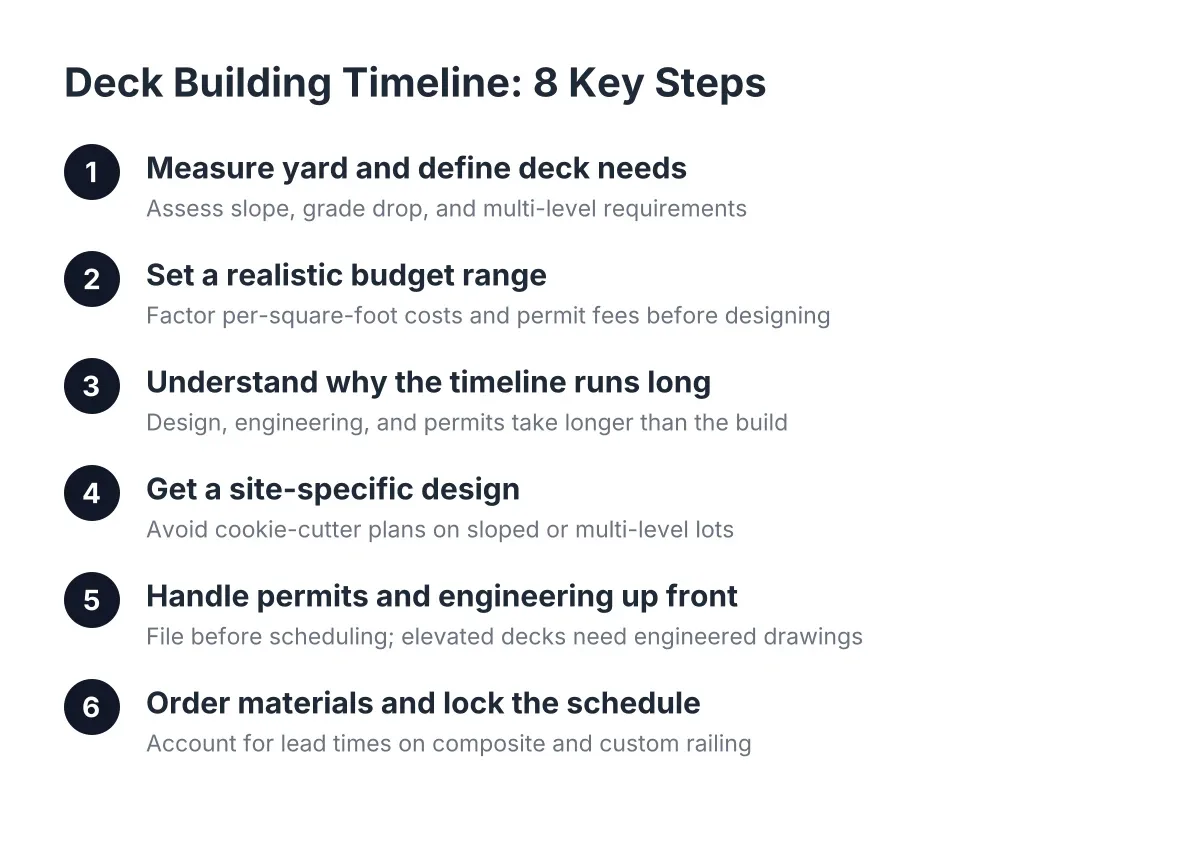
Deck building in the Inland Empire also runs through local permitting, setback rules, and footing requirements that vary by city, so the material decision and the structural plan should happen together. Bring your top two or three board samples to the site visit, walk the existing deck with the builder, and get the repair-versus-replace question answered with photos of the framing before anyone talks product lines. Once the structure is settled, choosing between two good capped boards is the easy part. Pick the color that stays cool, the line your builder can source locally for future repairs, and the fastening system the manufacturer backs, and your new outdoor living space will outlast the one you are tearing out by a wide margin.
If you need custom deck design, Inland Empire Decks can help.
Prefer to talk it through? Call (909) 298-8578 — a quick call is usually the fastest way to get a straight answer for your situation.