Composite vs. Wood vs. Vinyl Decking: Which Lasts Longest in Ontario, CA?
If you are planning a deck in Ontario, CA, the composite wood vinyl decking question comes up in nearly every first conversation. All three materials can build a good deck. They just age differently, cost differently, and handle Inland Empire heat differently. This guide presents a decking material durability comparison to walk through durability, maintenance, cost, and how each material performs on the sloped and elevated lots common around Ontario, Rancho Cucamonga, and Upland, so you can pick the surface that fits your yard and your budget.
One note before we compare: the decking board is only half the durability story. The framing, footings, and posts underneath carry the load for decades. That matters double if your backyard slopes or you need an elevated deck off a second story, because the structure underneath does more work than the boards on top.
Why Material Choice Matters More in Southern California
Ontario, California sits in the Inland Empire, where summer afternoons regularly push past 100 degrees and the sun is direct for most of the year. That climate punishes deck surfaces in a specific way. Moisture and rot, the classic deck killers in wetter regions, matter less here. UV exposure, heat expansion, surface temperature, and dried-out wood matter more.
So when you read national comparisons of composite, wood, and vinyl decking, keep in mind that most of them are written for climates with snow and constant rain. In San Bernardino County and Riverside County, the durability rankings shift. A material that survives a Michigan winter is not automatically the right pick for a west-facing deck in Fontana.
There is also a scale problem worth knowing about. According to the North American Deck and Railing Association (NADRA), about 50 percent of the roughly 50 million decks in the U.S. are more than 25 years old. Many of those are wood decks built before modern composites existed. If you are replacing one of them, you are choosing your material with 25 more years in mind, not five.
Wood Decking: The Traditional Choice
Wood is still the material most people picture when they think about deck building, and it earns its place. Pressure-treated pine, redwood, and cedar are all common on wood deck projects across the Inland Empire.
Durability in the Inland Empire
Wood handles structural loads well and is easy to repair board by board. However, our dry heat pulls moisture out of wood fast. Untreated or poorly maintained boards crack, cup, and splinter sooner here than they would in a milder coastal climate. A wood deck in Ontario, CA that gets stained and sealed on a regular schedule can serve for decades. One that gets ignored often shows surface failure within a handful of years.
Maintenance and Cost
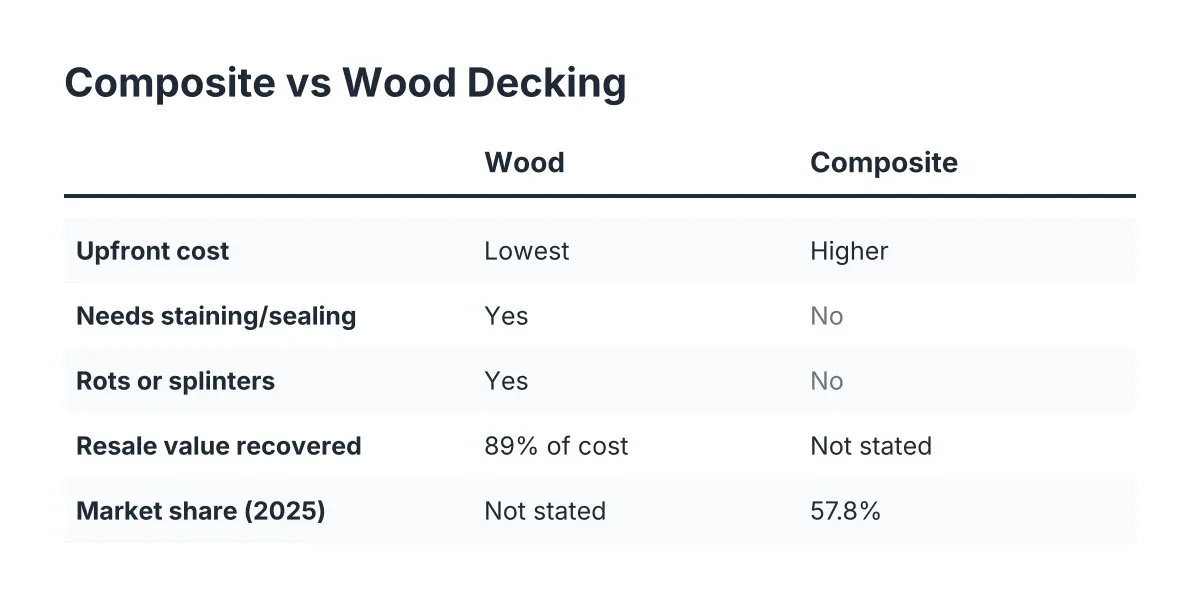
Wood is usually the lowest upfront cost of the three materials, which is why it stays popular with homeowners building a first deck on a new-construction lot. The trade-off is ongoing work. Plan on cleaning, staining, and sealing on a recurring cycle for the life of the deck. Skip that maintenance in our sun, and the boards gray, dry, and split.
Wood also holds resale value well. According to the National Association of Realtors' 2023 Remodeling Impact Report, homeowners recover 89% of the cost of a new wood deck through added home value. For a budget-conscious buyer who does not mind the upkeep, wood remains a defensible pick.
Composite Decking: The Low-Maintenance Middle Ground
Composite boards blend wood fibers with plastic, and most modern boards add a protective outer cap. That cap is the reason composite has taken over so much of the market. According to Grand View Research, capped composite decking and railing held 57.8% of the product market in 2025, the largest share of any category.
Decking Material Durability Comparison: Composite Performance in the Inland Empire
Composite does not rot, does not splinter, and never needs stain or sealant. For Inland Empire sun, the main questions are fade resistance and heat. Quality capped boards in 2026 resist UV fading far better than early-generation composite did, and most carry long fade and stain warranties from the manufacturer. Darker composite colors do get hot underfoot in direct summer sun, so on a west-facing Ontario backyard, lighter board colors are the smarter choice.
Composite also expands and contracts with temperature swings more than wood does. That is not a durability flaw; it is an installation detail. Proper composite decking installation accounts for gapping and fastener choice so the boards move without buckling. This is one place where an experienced local deck builder earns their fee, because a board installed for a mild climate spec can misbehave in a 105-degree August.
Maintenance and Cost
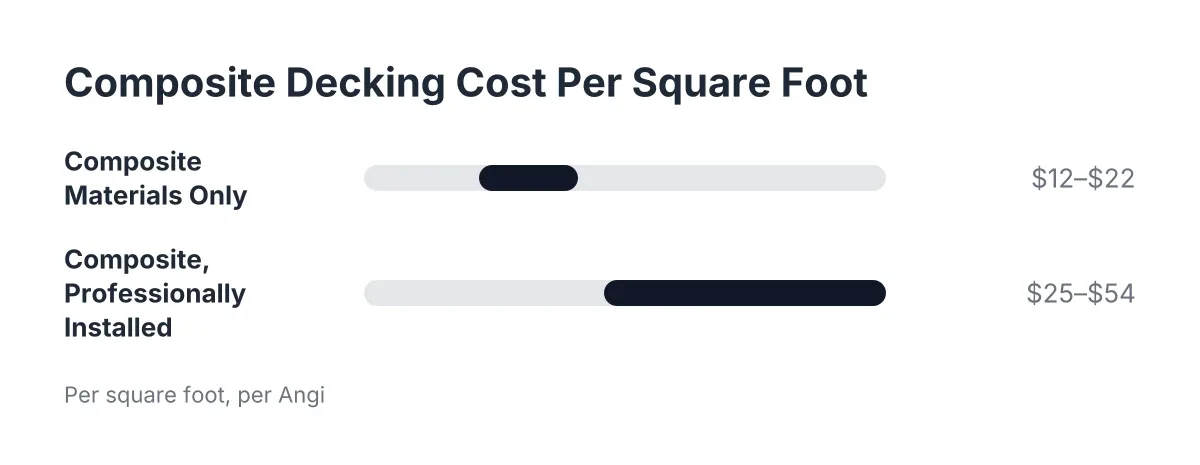
Maintenance is the composite selling point: an occasional wash with soap and water, and that is the whole program. No staining, no sealing, no sanding. The cost sits higher than wood upfront. According to Angi, composite deck cost runs $25 to $54 per square foot professionally installed, or $12 to $22 per square foot for materials alone. Over the life of the deck, the gap narrows once you count the stain, sealant, and weekends that wood demands.
If you are researching the best composite decking for your project, focus less on brand names and more on the cap quality, the fade warranty, and the color's heat performance. Those three factors decide how the deck looks in year ten.
Vinyl (PVC) Decking: All Plastic, No Wood
Vinyl decking, often sold as PVC decking, contains no wood fiber at all. That distinction matters. In the composite wood vinyl decking lineup, vinyl is the only option with zero organic material, which makes it the most resistant to moisture, mold, and insects.
How Decking Material Durability Comparison Shapes Vinyl's Place
For Ontario, CA yards, vinyl's moisture resistance is less of an advantage than it would be in a wet climate, since rot is rarely our failure mode. Where vinyl earns its keep locally is weight and consistency. PVC boards are lighter than composite, which can matter on elevated deck construction where every pound on the frame counts. Quality PVC also resists staining and scratching well. When comparing decking material durability across vinyl, composite, and wood options, the trade-offs become clear.
The trade-offs are real, though. Vinyl expands and contracts with heat more than composite does, so hot Inland Empire summers demand careful installation and honest spacing. Cheaper vinyl boards can also look plastic-like compared to modern capped composite, and premium PVC often costs as much as or more than high-end composite.
Maintenance and Cost
Like composite, vinyl needs only periodic washing. There is no stain cycle and no sealing. Upfront cost typically lands at or above composite pricing, which is why vinyl tends to make the most sense for homeowners who want maximum low-maintenance performance and are less concerned about a wood-grain look.
Composite, Wood, and Vinyl Decking Side by Side
Here is how the three materials stack up on the factors that matter most for a deck in San Bernardino County:
- Upfront cost: Wood is lowest. Composite is mid to high. Vinyl is comparable to composite or higher.
- Ongoing maintenance: Wood needs regular staining and sealing. Composite and vinyl need only washing.
- Sun and heat performance: Wood dries and cracks without upkeep. Capped composite resists fade well; dark colors run hot. Vinyl resists fading but expands most in heat.
- Repairability: Wood is easiest to repair board by board. Composite and vinyl boards can be swapped, but matching an older color lot can be tricky.
- Feel and appearance: Wood is the natural benchmark. Modern capped composite comes close. Vinyl varies widely by product tier.
- Weight on elevated frames: Vinyl is lightest, wood is moderate, and composite is heaviest per board.
The market is voting with its wallet, for what it is worth. Grand View Research valued the global composite railing and decking market at $4.7 billion in 2025, projected to reach $12.6 billion by 2033. Low-maintenance boards are winning, but that does not automatically mean composite is right for your specific lot.
What Changes on a Sloped or Elevated Lot
If your backyard drops away from the house or you are connecting a second-story door to the yard, material choice interacts with structure. Suppose a homeowner in Rancho Cucamonga has a lot that falls several feet from the back door to the fence line. A ground-level deck design will not work there. The realistic options are an elevated deck on engineered footings and posts, or a multi-level deck that steps down the grade in stages.
In that scenario, three material considerations move to the front:
- Board weight. Composite is the heaviest surface option, so the deck framing and footing plan must account for it. This is normal engineering, not a reason to avoid composite, but it needs to be in the plan from day one.
- Span ratings. Composite and vinyl boards often require closer joist spacing than wood. On a multi-level build, that changes the framing layout and the framing cost.
- Repairs and access. An elevated deck is harder to work under later. A surface you will not need to re-stain every few years, like composite or vinyl, reduces how often anyone has to deal with the height at all.
Homeowners with tricky lots sometimes worry that any builder they call will only quote flat, ground-level decks. That is a fair concern, and it is why the footing and framing conversation should happen before the board-color conversation. A deck builder who starts by asking about your grade, your soil, and your permit situation is thinking about the part of the deck that actually determines how long it lasts.
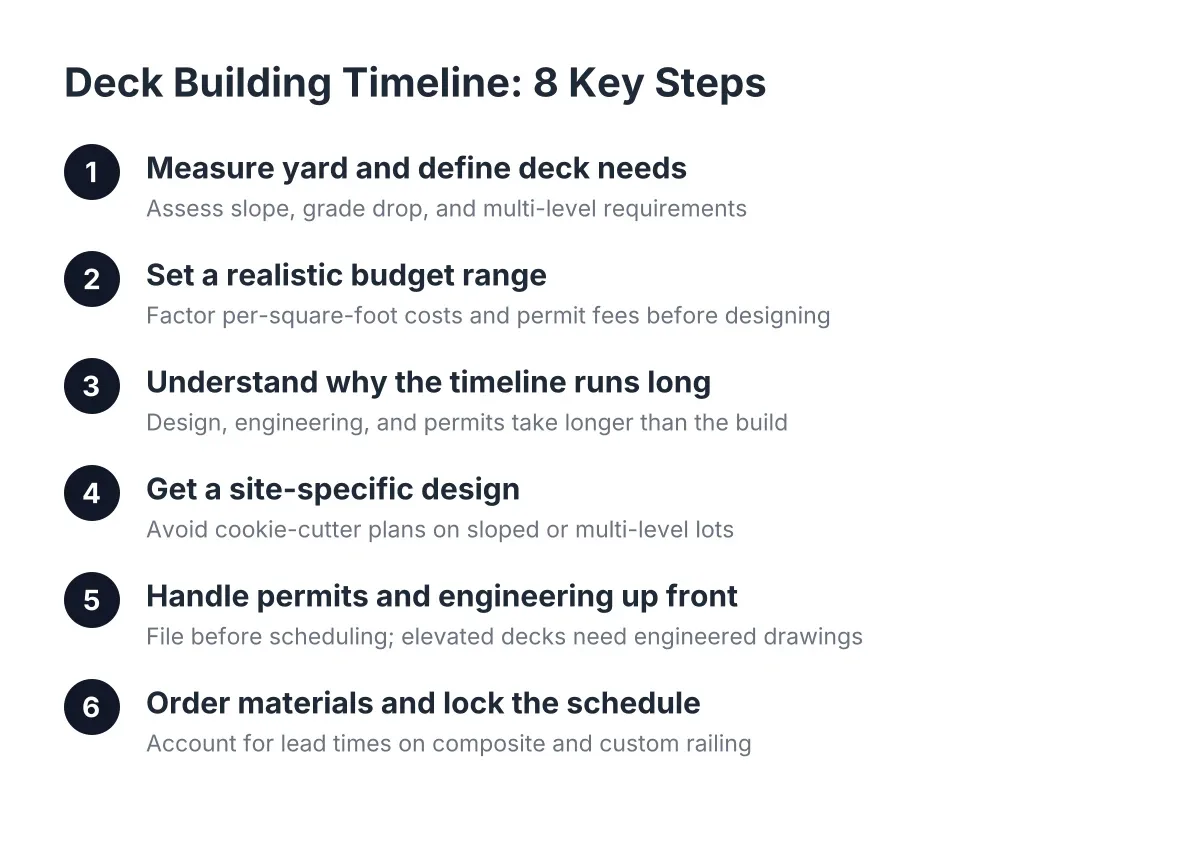
One honest caveat: elevated and multi-level decks in Ontario, CA typically require permits, and some need structural engineering depending on height and attachment. That is not a corner to cut. If your deck stands more than a few feet off grade, have a professional evaluate the footing and post design rather than sizing it from a generic span table.
How to Choose for Your Ontario, CA Backyard
There is no single winner in the composite versus wood versus vinyl decking debate, only a best fit for your yard, budget, and tolerance for maintenance. A short way to decide:
- Choose wood if upfront cost is the priority, you are comfortable with a staining and sealing routine, and you like the option of easy board-by-board repairs.
- Choose composite if you want a wood look without the maintenance cycle, you plan to stay in the home long enough for the lower upkeep to pay off, and you pick a lighter color for our sun.
- Choose vinyl if maximum low maintenance matters more than a natural-wood look, or if board weight is a factor on a tall elevated frame.
Whatever surface you land on, spend at least as much attention on the structure underneath. In the Inland Empire, the boards you walk on are the part you see; the footings, posts, and framing are the part that decides whether the deck is still solid in 25 years. Get the structural design right for your specific lot, then pick the composite, wood, or vinyl surface that fits how you actually want to live outside.
If you need custom deck design, Inland Empire Decks can help.
Prefer to talk it through? Call (909) 298-8578 — a quick call is usually the fastest way to get a straight answer for your situation.