Wood vs. Vinyl vs. Composite Deck Railing: Durability and Cost Compared
If you are planning your first deck in Ontario, California, the railing decision matters more than most people expect. A wood deck railing costs less up front but asks for regular upkeep; vinyl and composite cost more but shrug off the Inland Empire sun. This guide walks you through the comparison step by step, covering durability, cost, safety code, and when to hire a deck builder instead of tackling it yourself.
The recommendations here come from railing installs across every deck type a local builder handles, from ground-level wood decks in Chino to elevated composite decks in Rancho Cucamonga. By the end, you should be able to walk into a phone call with a deck builder and ask sharp questions instead of guessing.
Step 1: Confirm Whether Your Railing Needs Replacing at All
Before comparing materials, figure out if you need a new railing or a repair. According to the North American Deck and Railing Association (NADRA), about 50 percent of the roughly 50 million decks in the U.S. are more than 25 years old. Older railings are the most common failure point on those decks.
Grab the top rail and push hard, the way a guest leaning against it would. Then check these warning signs:
- Posts that wobble or flex more than a slight give under pressure
- Rot, soft spots, or insect damage at the post bases where they meet the deck
- Rusted, loose, or missing fasteners and brackets
- Balusters spaced wide enough that a 4-inch sphere could pass between them
- Cracks running through posts rather than surface checking along the grain
A wobbly deck railing with solid posts often just needs new hardware or blocking, which keeps the project in repair territory. However, if the posts themselves are rotted or the framing they attach to is compromised, replacement is the safer call. This distinction matters for home sellers especially; an inspector who flags a loose railing before listing can usually be satisfied with a targeted repair rather than a full rebuild, which keeps the cost and timeline down.
Step 2: Learn the Code Requirements Before You Pick a Style
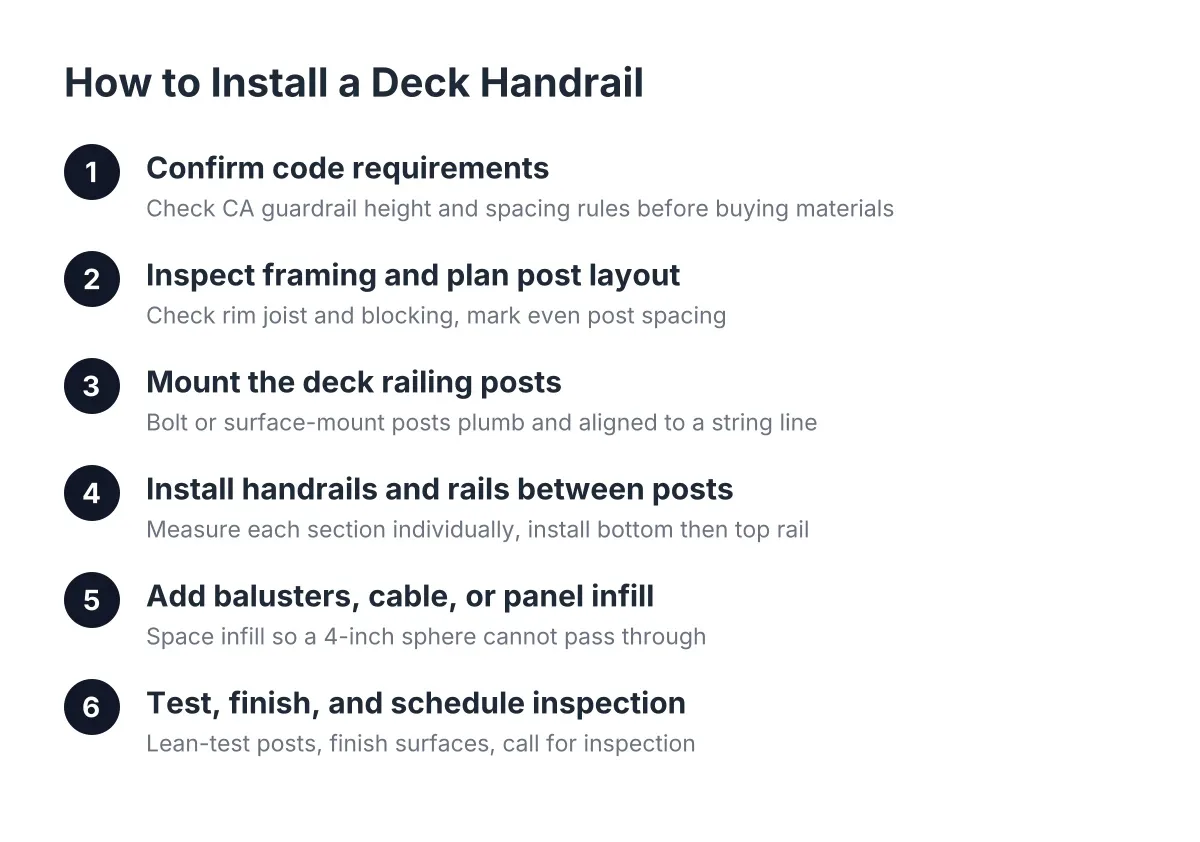
Railing code in Ontario, California follows the California Residential Code, and it applies no matter which material you choose. In general terms, decks above a certain height off the ground require a guardrail, the railing must meet a minimum height, openings between balusters must be small enough to stop a small child from slipping through, and the assembly must resist a defined lateral load.
Stairs carry their own rules. A deck railing for stairs typically needs a graspable handrail at a set height above the stair nosings, which is a separate requirement from the guardrail around the deck itself. Stair railing installation is where DIY projects most often fail inspection, because the geometry of posts, angles, and handrail returns is less forgiving than a straight run.
Therefore, confirm the current 2026 requirements with the City of Ontario building department or let your deck builder handle permits and planning as part of the job. A reputable local builder in San Bernardino County deals with these inspections weekly and will design the railing to pass the first time.
Step 3: Wood Deck Railing Durability and Material Costs
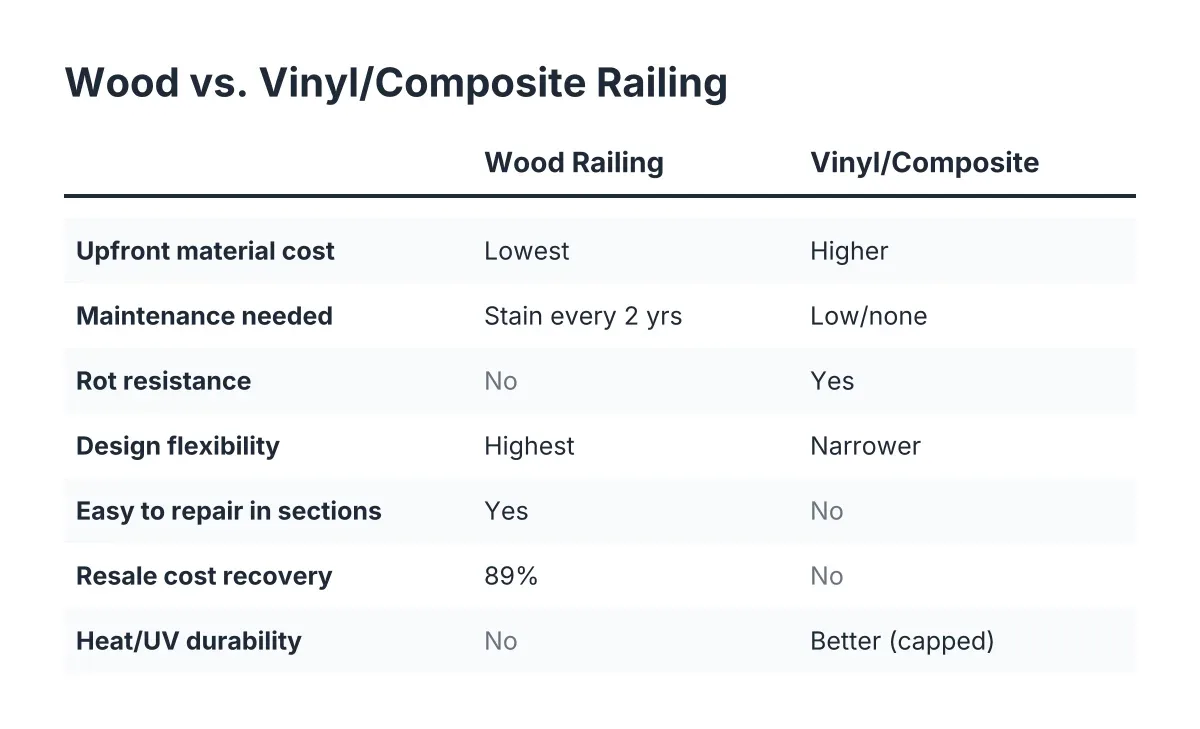
A wood deck railing is the lowest-cost option up front and the easiest to customize, but it demands the most maintenance over its life. In the Inland Empire, intense sun and dry heat are harder on wood than rain is; UV exposure fades stain, dries out the surface, and opens cracks that let moisture in when winter rains arrive.
Pressure-treated pine and cedar are the common choices. Both need staining and sealing every couple of years to hold up in Southern California conditions. Skip that upkeep and you will see graying, splintering, and loose fasteners well before the deck boards themselves wear out.
On the plus side, wood wins on flexibility and looks. Simple deck railing designs, chunky farmhouse posts, or custom top rails are all straightforward in wood, and any competent deck builder can match an existing style. Wood is also the easiest railing to repair in sections, which is why sellers prepping a house for listing often choose it; replacing a few posts and restaining the whole run is a fast, budget-friendly way to make an older deck presentable.
There is also a resale argument for wood generally. According to the National Association of Realtors' 2023 Remodeling Impact Report, homeowners recover 89 percent of the cost of a new wood deck through added home value. Wood deck railing costs are usually quoted per linear foot, and they vary with lumber grade, post spacing, and design complexity, so get the number broken out on any quote you receive.
Step 4: Weigh Vinyl and Composite Railing Against Wood
Vinyl and composite railings flip the equation: higher material cost, lower lifetime effort. Vinyl (PVC) railing never needs staining, will not rot, and cleans up with a hose. Its trade-offs are a narrower range of looks, mostly white and tan, and a tendency to feel lighter or hollower than wood. In extreme heat, lower-grade vinyl can also become brittle over many years.
Composite railing splits the difference. It has the mass and profile of wood with the low maintenance of vinyl, and capped composite products add a protective outer layer that resists fading. Homeowners have noticed; capped composite held a 57.8 percent product market share in 2025 according to Grand View Research, and the same firm valued the composite railing and decking market at $4.7 billion in 2025, projected to reach $12.6 billion by 2033.
For cost context, Angi reports composite deck materials run $12 to $22 per square foot for materials alone, or $25 to $54 per square foot professionally installed. Railing is priced separately by the linear foot, but the same pattern holds: composite runs meaningfully higher than a wood deck railing up front, then costs almost nothing to maintain.
Here is an illustrative scenario. Suppose a homeowner in Upland is comparing 40 feet of railing on a new backyard deck. Wood might come in lowest on the initial quote, but add a staining and sealing cycle every two to three years for fifteen years and the gap narrows considerably. If that homeowner plans to stay in the house long term, composite often wins the math. If they are selling within six months, wood usually makes more sense.
What About Cable and Glass Options?
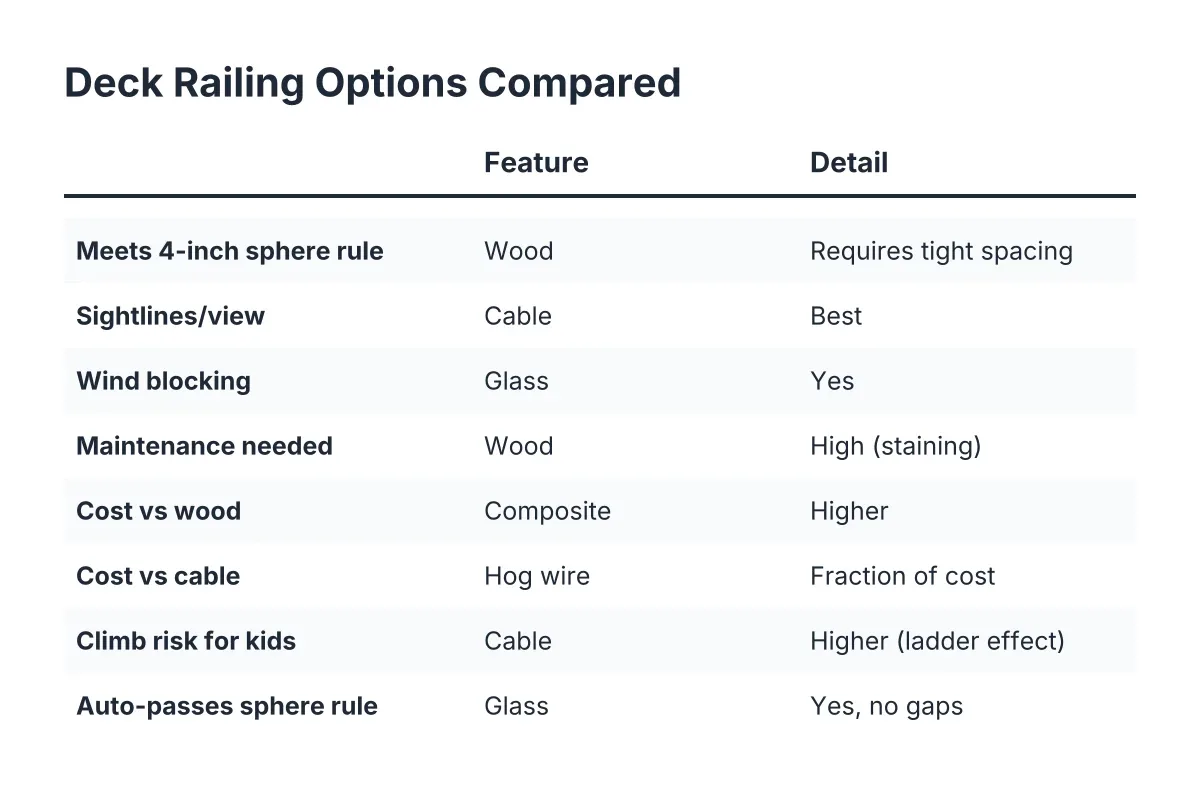
Cable railing and glass panel railing sit in a different category: view-first systems that pair a metal or wood frame with stainless cables or tempered glass infill. Cable railing versus wood railing is mostly a question of sightlines and budget; cable preserves the view and costs more. Glass panels block wind and look clean but need regular cleaning in dusty Inland Empire conditions. Both are worth considering on elevated decks with a view, and both are covered in more depth in our ranked guide to railing ideas that meet Ontario, CA code.
Step 5: Decide Between DIY and a Professional Install
A confident DIYer can handle swapping balusters or tightening hardware on a structurally sound railing. Full deck railing installation is a different job. Railing posts carry the entire load when someone falls against them, and the strength of the system lives in how the posts connect to the deck framing, not in the rails you see. Get that connection wrong and the railing can pass a glance test yet fail when it matters.
Hire a professional when any of these apply:
- Posts or framing show rot, and you cannot tell how far it extends
- The deck is elevated, or the railing protects a drop of more than a few feet
- The project needs a permit and inspection, which most replacements in Ontario, CA do
- You are installing on stairs, where angles and handrail rules complicate the work
- You are selling the home and need the work done and documented in weeks, not months
A good deck builder's scope for railing work includes assessing the framing, pulling any required permit, setting or reinforcing posts, installing rails and infill to code, and hauling away the old material. Staining and sealing a new wood railing is sometimes a separate line item, so ask.
Step 6: Get Quotes and Ask the Right Questions
When you compare quotes from local deck builders, price per linear foot only tells part of the story. Ask these three questions:
- How will the posts attach to the framing, and will you add blocking or hardware to meet the load requirement?
- Does the quote include the permit, inspection, and any stair handrail work, or are those extra?
- What does maintenance look like for this material over ten years in Inland Empire sun?
A fair quote itemizes materials, labor, permit costs, and disposal, and it names the specific railing product rather than a generic category. Be cautious with any bid that skips the permit conversation entirely.
One honest limitation: no article can inspect your deck. If your railing moves, if the posts are soft at the base, or if you are unsure whether your setup meets current code, have a local professional look at it before anyone leans on it.
If you are in Ontario, Rancho Cucamonga, Fontana, Corona, Riverside, Chino, or Upland and want a straight answer on repairing versus replacing your railing, reach out to a local Ontario, CA deck builder for an on-site look and a written estimate. A short visit will tell you more than a week of research, and you will get real numbers for your deck instead of internet ranges.
If you need custom deck design, Inland Empire Decks can help.
Prefer to talk it through? Call (909) 298-8578 — a quick call is usually the fastest way to get a straight answer for your situation.