Trex Decking Colors and Finishes: An Ontario, CA Contractor’s Palette Guide
Picking composite decking colors sounds like the fun part of a deck project, right up until you're staring at forty sample boards in a parking lot wondering which brown is the right brown. If you're building or replacing a deck in Ontario, California, the choice matters more than it would in a milder climate. Inland Empire sun is intense, surface heat is real, and the color you pick affects how the deck feels under bare feet in August. This guide walks through the full Trex color palette, plus the finish and style decisions that go with it, from the perspective of a local deck builder who installs these boards in San Bernardino County and Riverside County yards all year.
One note before the list: Trex organizes its boards into tiered lines. The entry line offers fewer colors with a simpler finish, the mid-tier adds more realistic wood-grain streaking, and the premium line gives you the widest color range and the most convincing woodgrain look. Every tier is capped composite, meaning a protective plastic shell wraps the board. That cap is what holds the color, so the tier you choose shapes both your palette and your deck cost. Capped composite is where most of the market has gone; according to Grand View Research, capped composite decking and railing held 57.8% of the product market in 2025.
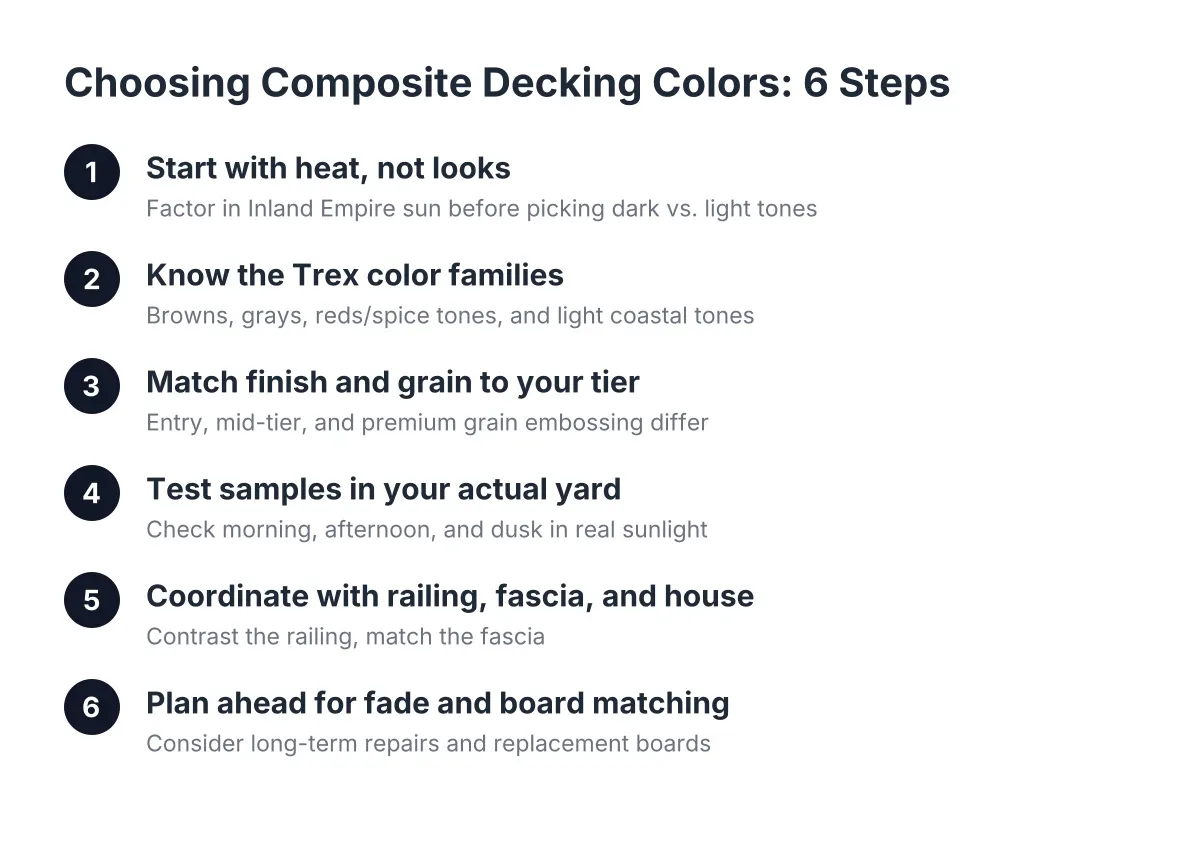
Here are eight things to work through, in order, as you lock in your color.
1. Start With Heat, Not Looks: Why Composite Decking Color Choices Hit Differently in the Inland Empire
Dark composite deck boards absorb more sun and run hotter underfoot than light ones, and in Ontario, CA that gap is not a footnote. A deep espresso board that looks sharp in a Pacific Northwest catalog photo can be uncomfortable to stand on barefoot during a Southern California summer afternoon. Lighter grays, tans, and weathered-driftwood tones reflect more light and stay noticeably more walkable.
This does not mean dark colors are off the table. It means you should decide where the deck sits first. A west-facing deck in Fontana with zero shade is a different situation than a covered deck in Upland under a patio cover. If your deck will bake in full afternoon sun, weight your shortlist toward the lighter half of the palette, or plan shade into the design.
2. Know the Trex Color Families Before You Shop
Trex composite decking colors fall into four rough families, and sorting samples this way is faster than comparing forty individual names. Most homeowners land in one family within ten minutes once they see them grouped.
- Browns and earth tones: classic wood-look shades from light honey to dark walnut. These hide dust well, which matters in a region with dry, dusty summers.
- Grays: from pale silver to deep charcoal. Gray is the most requested family we see on modern homes in Rancho Cucamonga and Chino, and it pairs cleanly with white or black deck railing.
- Reds and warm spice tones: rusty, tropical-leaning colors that echo redwood, a nod to the wood decks many Inland Empire homeowners are replacing. True composite decking colors in red are rarer than browns, so if this is your lane, confirm availability in your chosen tier.
- Light coastal tones: driftwood, sand, and whitewashed looks. These run coolest underfoot and brighten small or shaded yards.
The premium Trex line also offers multi-tonal boards that blend several shades in one plank, which reads more like real hardwood and less like plastic decking from older generations.
3. Match the Finish and Grain Pattern to the Tier You Can Afford
Color is only half the visual. The other half is the grain embossing and the sheen of the cap. Entry-level boards carry a simpler, more repetitive grain pattern and a slightly flatter finish. Mid-tier and premium boards use deeper embossing and streaked color variation, so no two boards look identical once they're down.
Here is the honest trade-off: on a 300-square-foot deck viewed from a patio door, the mid-tier grain looks excellent and the premium upgrade is mostly about color selection. On a large multi-level deck that's the centerpiece of the backyard, the premium boards earn their cost. As a reference point, Angi puts professionally installed composite decking at $25 to $54 per square foot, and where you land in that range depends partly on the tier and color line you pick.
4. Test Samples in Your Actual Yard, in Afternoon Sun
Never choose from a screen. Composite decking color charts and website selectors are useful for narrowing the field, but monitor colors lie, and showroom lighting lies worse. Order or pick up physical sample boards, then set them on the ground where the deck will go.
Check them three times: morning, mid-afternoon, and dusk. Inland Empire afternoon light is bright and warm, and it shifts colors a full shade. A gray that looked cool and neutral at the big-box store can pull brown at 3 p.m. in your yard. While you're at it, leave the samples out on a hot day and touch them barefoot. That one test settles more color debates than any brochure.
5. Coordinate Decking Color With Railing, Fascia, and the House
A deck is not just a floor. Railing color, fascia boards, and stair risers all show, and the combinations change the whole look. The most common pairings we install across Ontario, Corona, and Riverside follow a simple rule: contrast the railing, match the fascia.
- Gray decking with black aluminum or black composite railing reads modern and hides dust on the rail.
- Brown decking with white railing suits traditional stucco homes common in older San Bernardino County neighborhoods.
- Matching fascia to the deck boards makes the structure look intentional; a mismatched fascia is the detail people notice without knowing why.
Also hold your samples against your home's stucco or siding. The deck should complement the house, not fight it. A warm tan deck against cool gray stucco clashes in a way no amount of furniture fixes.
6. Pick a Color That Hides What Your Yard Throws at It
Every yard has a dominant mess, and the right color hides yours. Here in the Inland Empire, the usual suspects are dry dust, pollen in spring, and leaf litter from whatever shade trees you've got. Mid-tone browns and streaked grays hide dust best. Solid pale boards show dirt faster but hide pollen and water spots. Dark charcoal shows every speck of dust but hides shadows and furniture scuffs.
Composite deck maintenance is light either way; you're washing, not staining and sealing like a wood deck. However, the color you choose decides how often the deck looks like it needs that wash. If you're replacing a 15-year-old wood deck specifically to stop maintaining it, lean toward the mid-tone streaked colors. They go the longest between cleanings while still looking kept.
7. Compare Trex Composite Decking Colors Against Other Brands Before Committing
Trex has the widest name recognition, but it is not the only palette. Fiberon composite decking runs its own color lines with strong multi-tonal options, and other capped composite brands cover similar ground. Big-box retailers stock house selections too; composite decking colors at Home Depot or Lowe's often include store-exclusive shades alongside the national brands.
Two cautions from the installation side. First, stock colors at retail stores rotate, so a color you love in the aisle may not be orderable in the quantity a full deck needs. Second, color consistency across production runs matters on large decks, which is one reason a local deck builder orders full jobs from one batch through a dealer rather than piecing together store stock. If you're comparing composite decking materials across brands, compare the warranty terms on fade and stain too, since those warranties are tied to the cap that carries the color.
8. Think Ahead to Fade, Repairs, and Board Matching
All composite decking colors shift slightly in their first few months as the cap weathers to its final shade, then hold steady. Manufacturers publish fade and stain warranties for exactly this reason, and Southern California sun is the stress test those warranties exist for. Read the fade terms for the specific line you choose, not just the brand.
The longer-term issue is matching. Say a homeowner in Ontario, CA builds a deck in 2026 in a mid-tier gray, then needs a deck board replacement in 2033 after a planter leak stains two planks. If that color was discontinued, the repair boards will not match, and the fix becomes a visible patch or a larger resurfacing job. In that scenario, two habits help: choose a core color from the brand's long-running palette rather than a trendy limited shade, and keep two or three spare boards from the original order in the garage. Your installer can store cut-offs for small repairs too.
Where a Local Deck Builder Fits Into the Color Decision
You can do most of this list on your own with sample boards and patience. The parts worth a professional's eye are structural and situational: whether your sun exposure argues for a lighter color or a shade structure, how railing and fascia choices affect the deck cost, and whether your existing deck framing can be reused in a resurfacing with new composite deck boards or needs full deck replacement. A builder who works Inland Empire yards every week has watched these colors age in this exact sun, which is context no national color selector gives you.
Take the shortlist, get the samples, and stand on them in July-grade heat if you can. The right color is the one that still looks good, and feels fine underfoot, after a full Ontario, California summer.
If you need custom deck design, Inland Empire Decks can help.
Prefer to talk it through? Call (909) 298-8578 — a quick call is usually the fastest way to get a straight answer for your situation.