Deck Resurfacer or New Boards? How to Choose the Right Fix for an Aging Deck
If your deck boards are soft in spots but the frame still feels solid, you have two real options: a deck resurfacer coating that fills cracks and hides wear, or full board replacement with new wood or composite decking over the existing frame. One is a cosmetic fix. The other is a structural one. Choosing wrong in either direction wastes money, so this guide walks you through how to evaluate your deck step by step, the way a deck builder in Ontario, California would during an on-site inspection.
The stakes are real. According to the North American Deck and Railing Association (NADRA), an estimated 30 million of the more than 60 million decks in the U.S. are past their useful life and need repair or replacement. Many of those are wood decks here in Southern California, baked by Inland Empire sun for 15 or 20 years. Here is how to figure out where yours falls.
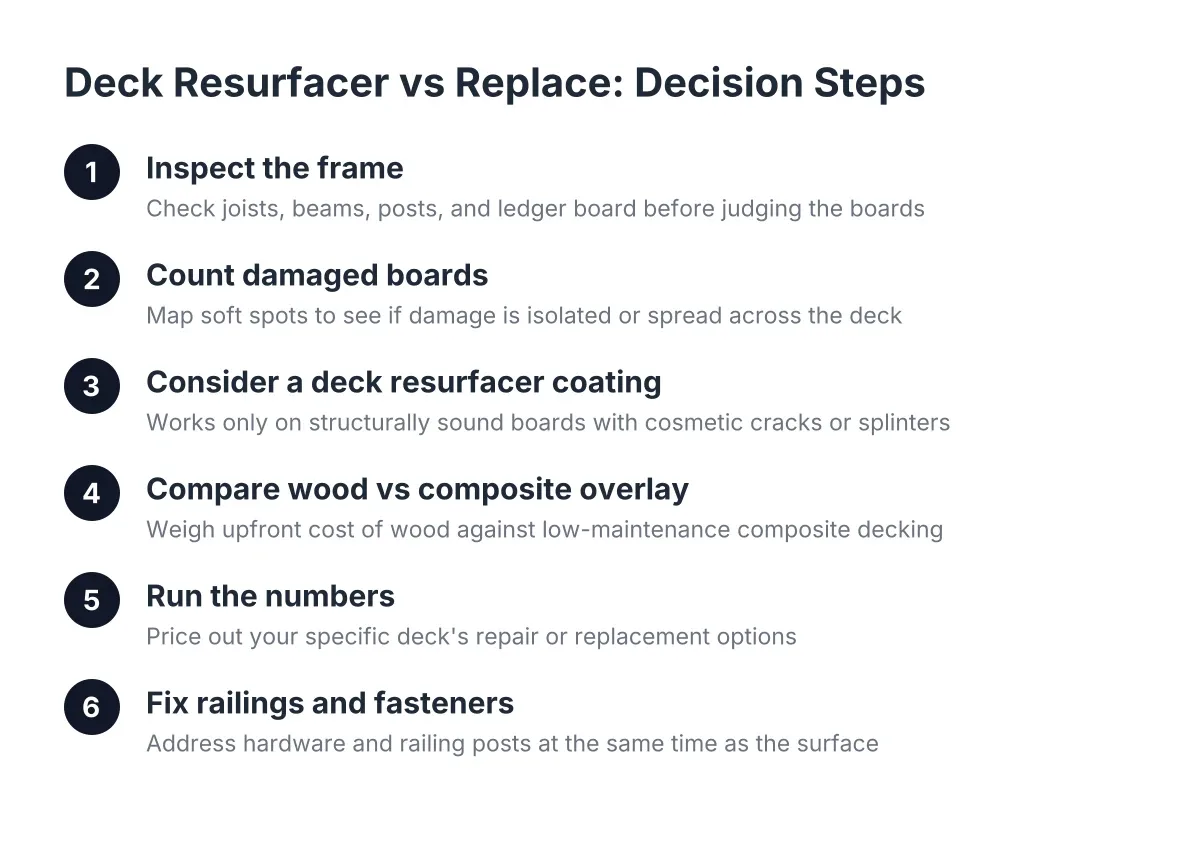
Step 1: Inspect the Frame Before You Judge the Boards
Everything starts underneath. The joists, beams, posts, and ledger board carry the load; the deck boards are just the walking surface. If the frame is sound, resurfacing in some form is on the table. If the frame is failing, no coating or new boards will fix it, and you are looking at deck replacement.
Crawl under the deck or view it from the side with a flashlight and a screwdriver. Press the screwdriver tip into the joists, especially where they meet the ledger board against the house and at the tops where boards are fastened. Solid wood resists. Rotten wood gives way with light pressure.
Check these specific points:
- Ledger board connection: look for rust-streaked fasteners, gaps, or soft wood where the deck attaches to the house
- Joist tops: rot often starts where water sits under the deck boards
- Post bases: probe where posts meet footings or concrete, the most common rot zone in older Inland Empire decks
- Beam-to-post connections: look for crushed wood, splits, or shifted hardware
- Railing posts: grab each one and push hard; movement means the connection has weakened
If the frame passes, move to Step 2. If joists crumble or the ledger is compromised, stop here and get a professional inspection. A failed ledger is how decks collapse, and that is not a judgment call a homeowner should make alone.
Step 2: Count the Damaged Boards and Map the Soft Spots
Walk the entire surface slowly and mark every soft, cracked, cupped, or splintered board with chalk or painter's tape. This count drives the whole decision. A handful of bad boards means spot deck board replacement for a few hundred dollars. Damage spread across a third or more of the surface means the boards have reached the end of their life as a group, not as individuals.
Pay attention to the pattern. Boards failing randomly across the deck usually means age and sun exposure, which full resurfacing solves. Boards failing in one zone, like near a downspout or a shaded corner, often points to a moisture problem that will keep killing new boards until you fix the drainage.
NADRA estimates that half of the roughly 50 million residential and commercial decks in the U.S. are more than 25 years old. If your deck is in that group and most boards show damage, lean toward replacing the surface rather than patching it.
Step 3: When a Deck Resurfacer Coating Makes Sense
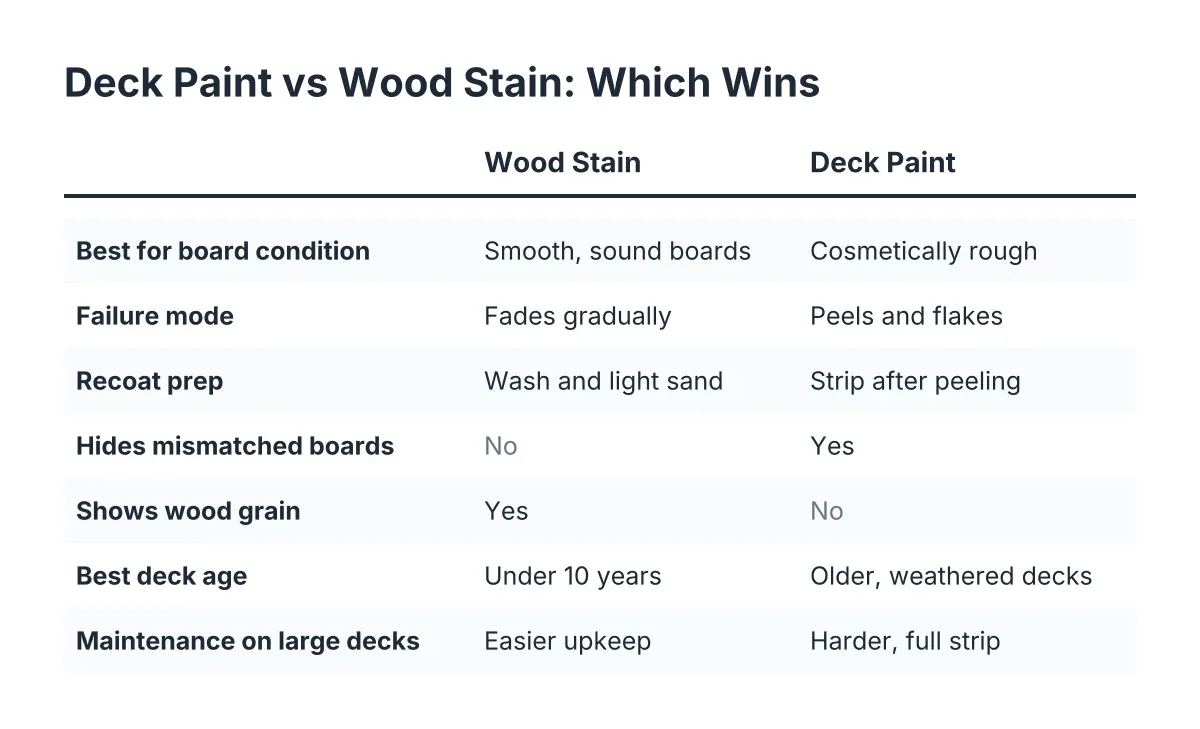
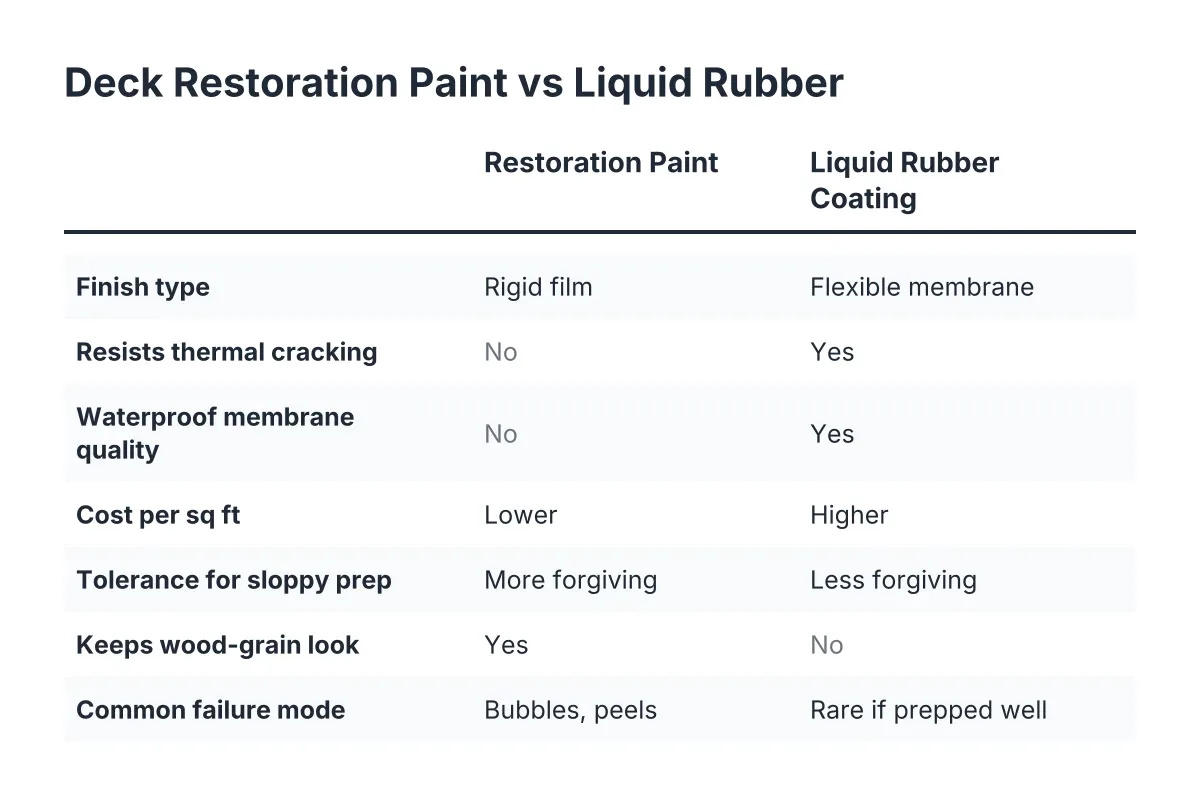
A deck resurfacer coating, the thick textured product sold in gallon buckets at home centers, works only on structurally sound boards with cosmetic problems. These 20x-style resurfacer paints fill cracks up to about a quarter inch, lock down minor splinters, and give an old gray deck a uniform solid color. Compared with solid stain, a resurfacer builds a far thicker film, which is why it hides more damage.
However, the limits matter more than the marketing. A coating cannot stiffen a spongy board, stop active rot, or hold together a board that flexes underfoot. It bonds to the wood surface, so if the wood beneath keeps deteriorating, the coating cracks and peels with it. On a high-sun Ontario, CA deck, that peeling often shows up within a few seasons, and removing a failed thick coating is a miserable sanding job.
Use a coating-style deck resurfacer when all of the following are true:
- Every board is structurally solid with no soft spots or rot
- Damage is limited to surface cracks, splinters, and faded color
- You accept recoating as ongoing maintenance, not a one-time fix
- You are buying a few more years, not another decade
If even one of those is false, a bucket of resurfacer is a short-term patch on a long-term problem. Move to Step 4.
Step 4: Compare New Wood Boards Against a Composite Overlay
Full board replacement means stripping every deck board and railing down to the frame, then installing a new surface. This is true deck resurfacing: the structure stays, the surface is new. In 2026, your two main material paths are pressure-treated or redwood lumber, and composite decking installed over the existing wood frame.
New wood boards cost less up front and keep the traditional look. The trade-off is maintenance. In the Inland Empire, between summer heat in Ontario and Fontana and the dry winds that pull moisture out of lumber, wood needs staining and sealing on a regular cycle or it grays, checks, and splinters again. You restart the same clock that brought you here.
A composite overlay over the wood frame ends that cycle. Composite boards do not rot, do not splinter, and never need stain. The market reflects that shift: capped composite decking and railing held 57.8% of product market share in 2025, according to Grand View Research. The cost is higher; Angi puts professionally installed composite at $25 to $54 per square foot, with materials alone running $12 to $22 per square foot.
One caution on composite over an old frame. Composite boards flex more than wood and often require tighter joist spacing, usually 16 inches on center or less. An older frame built at wider spacing may need added joists, called sistering, before composite goes down. A deck builder can confirm spacing and frame condition during an inspection, and this is worth a professional look rather than a guess.
Step 5: Run the Numbers for Your Specific Deck
Put rough figures beside each option before deciding. Suppose a homeowner in Rancho Cucamonga has a 300-square-foot wood deck, about 18 years old, with a solid frame but widespread board damage and one wobbly railing section. In that scenario, the comparison might look like this, as illustrative estimates only:
- Resurfacer coating: a few hundred dollars in materials plus a weekend of prep and rolling, lasting a few seasons at best on boards that old
- New wood boards and railing: a mid-range project cost, with staining and sealing every couple of years afterward
- Composite overlay on the existing frame: the highest upfront cost, likely in the range Angi cites, with little maintenance beyond rinsing
Weigh timeline against money. If you plan to sell within a year or two, a coating or budget wood replacement may be the rational play. If you are staying put, composite usually wins the ten-year math because you stop paying for stain, sealant, and repeat repairs. Resale value helps either way; the National Association of Realtors' 2023 Remodeling Impact Report found homeowners recover 89% of the cost of a new wood deck in added home value.
Step 6: Fix the Railings and Fasteners at the Same Time
Whatever surface you choose, do not reinstall a failing railing on top of it. Railings take the hardest safety load on a deck, and a post that wiggles when someone leans on it is a hazard regardless of how good the new boards look. During any board replacement, have railing posts re-anchored to the frame with proper hardware, not just screwed back to the new surface boards.
Fasteners matter too. Old nails back out as boards age, which causes half the trip hazards on older decks. New boards should go down with coated deck screws or hidden fasteners, which also makes future deck repair simpler.
Step 7: Get a Straight Repair-or-Replace Opinion in Writing
If you have heard "it's fine" from one contractor and "it's a hazard" from another, ask each one to put specifics in writing: which joists are compromised, where the rot is, and what the ledger connection looks like. Vague verdicts in either direction are a red flag. A deck builder who inspects the frame, shows you the soft spots, and explains why the structure does or does not support new boards is giving you something you can verify yourself with a screwdriver.
For Ontario, California homeowners, also ask about permits. Structural work, railing changes, and full deck replacement in San Bernardino County and Riverside County can require permits and inspections, and a local deck builder who works in Ontario, Chino, Upland, and Corona should handle that planning as part of the job.
The short version: a deck resurfacer coating buys time on a sound deck with cosmetic wear. New boards over a healthy frame give you a new deck surface at a fraction of full replacement cost. And a bad frame means neither option is honest money. Start with the screwdriver, and let the frame make the call.
If you need custom deck design, Inland Empire Decks can help.
Prefer to talk it through? Call (909) 298-8578 — a quick call is usually the fastest way to get a straight answer for your situation.