
Deck Resurfacing — Complete Guide
Your deck looks tired, but the frame underneath might still have decades of life left. Deck resurfacing replaces the worn boards, railings, and surface materials on top of a sound structure, so you skip the expense of a full rebuild. For many Ontario, California homeowners, that makes it the smartest middle path between endless repairs and total deck replacement. This guide explains how resurfacing works, what drives deck refinishing cost, and how to know whether your frame qualifies. By the end, you will have clear criteria for choosing between resurfacing, repair, and replacement.
What You'll Find in This Guide
Prefer to have a pro handle it? Deck Resurfacing is one call away.
Resurfacing vs Replacement: How to Know If Your Frame Is Still Good
The single question that decides everything is this: can your existing frame carry another 15 to 25 years of use? If the answer is yes, resurfacing makes sense. If the answer is no, new boards on a failing frame are money wasted.
You are not alone in facing this decision. According to the North American Deck and Railing Association (NADRA), roughly 30 million of the more than 60 million decks in the U.S. are past their useful life and need repair or replacement. Here in the Inland Empire, intense sun and dry heat punish deck surfaces faster than they punish the structure below. As a result, we often find frames in San Bernardino County and Riverside County that are perfectly sound under badly weathered boards.
What a Frame Inspection Actually Checks
A proper inspection goes beyond a quick glance from the yard. First, we probe the joists, beams, and ledger board with a screwdriver or awl. Solid wood resists the tip, while rotted wood gives way with little pressure. Next, we check the ledger connection where an attached deck meets your house, because ledger failure causes most serious deck collapses. Beyond that, we examine footings and posts for shifting, cracking, or ground contact rot, and we look at every joist hanger and fastener for rust or pull-out.
Certain findings point clearly toward resurfacing. For example, faded or splintered boards, popped nails, cracked railings, and surface-level checking are all cosmetic or board-level problems. However, soft joists, a compromised ledger, sinking footings, or widespread fastener corrosion push you toward replacement. In practice, most decks fall somewhere in between, which is why an honest, experienced inspection matters more than any online checklist.
If your frame passes, our deck resurfacing service in Ontario, CA swaps the old surface for new wood or composite decking at a fraction of full replacement cost. If it fails, you will know before you spend a dollar on new boards. That said, a failed inspection is not always bad news. New wood decks recover 89% of their cost through added home value, according to the National Association of Realtors' 2023 Remodeling Impact Report, so replacement pays back more than most remodeling projects.
What Drives Deck Refinishing Cost in Ontario, California
Homeowners searching for a deck refinishing cost figure usually find wildly different numbers, and there is a good reason. The price depends on three variables: the square footage of your deck, the condition of the frame once the old boards come off, and the material you choose for the new surface. To put it simply, a 200 square foot resurfacing job with pressure-treated pine and a clean frame sits at the bottom of the range. Meanwhile, a 500 square foot composite resurfacing with a few joists to sister sits much higher.
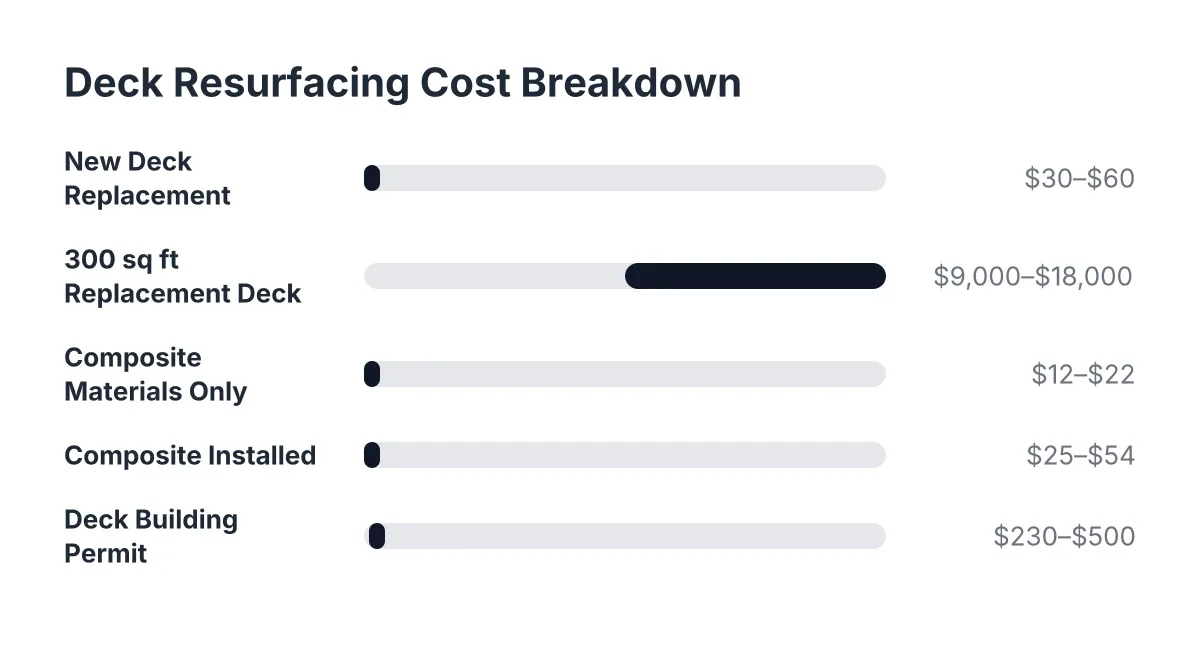
Material choice moves the number more than anything else. For reference, Angi reports that composite decking runs $25 to $54 per square foot professionally installed, while a full professionally built deck averages $30 to $60 per square foot. Resurfacing typically lands well below full replacement because you reuse the frame, footings, and often the stairs and structure of the railings. In other words, you pay for the surface, not the skeleton.
Hidden Costs to Plan For
Even a solid frame usually needs some prep work. For example, we often sister a joist or two, replace rusted hangers, add blocking for composite boards, or upgrade the ledger flashing while the frame is exposed. These items add modest cost, but they are exactly what makes the new surface last. Additionally, older Inland Empire decks sometimes have joist spacing set for 2×6 lumber that is too wide for modern composite boards. Correcting that spacing adds labor, so a good estimate accounts for it upfront rather than surprising you mid-project.
Railings are the other common add-on. Because building codes have tightened since many Ontario and Upland decks were built, worn railings often need full replacement rather than reuse. With this in mind, ask any contractor to price railings as a separate line item so you can compare bids fairly.
For a full breakdown with local numbers, read our guide on how much deck resurfacing costs. It walks through pricing by size, material, and frame condition so your deck refinishing cost estimate reflects reality, not a national average.
Choosing Your New Surface: Wood, Composite, and What Holds Up in Southern California
Once your frame passes inspection, the fun decision begins: what goes on top? Your choice shapes the look of the deck, the maintenance you sign up for, and a large share of your total deck refinishing cost. In Southern California, the climate should drive the decision as much as the budget.
Composite Resurfacing Over a Wood Frame
Composite over an existing wood frame is the most popular resurfacing choice we install across Ontario, Rancho Cucamonga, Fontana, and Chino. The appeal is simple. Composite boards never need staining or sealing, they resist the fading and splintering that Inland Empire sun causes, and modern lines look convincingly like real wood. However, composite has requirements. It is heavier and more flexible than lumber, so joist spacing usually needs to be 16 inches on center or tighter. Ventilation under the deck also matters, because trapped heat and moisture shorten board life. As a result, we always verify spacing, ventilation, and frame stiffness before recommending composite resurfacing over a wood frame.
New Wood Decking
Pressure-treated pine and redwood remain solid choices if you want the lowest upfront cost or a natural wood look. The tradeoff is maintenance. In our high-UV climate, wood decks need staining and sealing every one to two years to prevent graying, checking, and splintering. That ongoing care is real money and real weekends. Consequently, homeowners who plan to stay in their home long term often find composite cheaper over a ten-year horizon, even with its higher day-one price.
Board Replacement vs Full Resurfacing
Sometimes you do not need either. If damage is limited to a handful of boards, targeted deck board replacement restores safety for far less than resurfacing the whole deck. The catch is matching. New boards next to ten-year-old weathered ones stand out, and stain rarely hides the difference completely. Therefore, we usually recommend spot replacement for safety fixes and full resurfacing when appearance matters. Either way, an annual check of your deck is smart. NADRA publishes a free deck safety checklist you can run through each spring before heavy use.
Ready to Get Started?
If your Ontario, California deck looks worn but feels solid, resurfacing may save you thousands over full replacement. Our team inspects your frame honestly, tells you which option actually makes sense, and handles everything from board replacement to complete composite resurfacing across the Inland Empire. Reach out for a free inspection and a straightforward quote, and get a deck that looks new without paying for one from the ground up.